Research in India’s chicken farms

Animal Equality India has released a new investigation into the country’s chicken production industry, detailing numerous animal welfare and food safety violations.

THE DETAILS: Animal Equality investigated several chicken farms and meat markets from February 2019 to October 2020 in Maharashtra, Gujarat, Andhra Pradesh, and Telangana—states in India which are known for their chicken production.

What we found was shocking.

In India, It’s standard practice to give feed laden with antibiotics to grow the bodies of chickens unnaturally fast. As a result, their legs become crippled because of the unnatural weight gain. In our investigation, we found birds who could not walk or reach food or water.

We also found many chickens severely ill and dying of starvation, heart attacks, and respiratory infections. The carcasses of the dead birds were left to rot next to live chickens.

THE HORRORS OF PRODUCTION: Once these chickens reach their maximum weight, they’re crammed into overcrowded transport trucks. The birds are then sent on a rigorous journey that lasts for hours, sometimes days, without food or water. Many will die along the way, while those that remain are barely alive.

At the meat markets, the chickens are crammed into small cages for hours—often days—again without food or water.

Many chickens waiting for slaughter develop various infections and diseases, and aside from the absence of veterinary care, there is no health inspection conducted on the birds who will soon become food.

When the chickens are slaughtered, their throats are slit and they are thrown into drain bins where they languish in pain for several minutes before they die.

The meat from these poor birds is then prepared in filthy, unhygienic conditions.

Without food or water at the meat shop

PAST WORK IN INDIA: This is Animal Equality’s second investigation into Indian chicken farms.

For more…at https://worldanimalsvoice.com/2020/12/03/research-in-indias-chicken-farms/


Comparison to German practices…About 50,000,000 laying hens live in Germany! That’s quite a lot, considering that there are around 83,000,000 inhabitants.
In Germany, 97 percent of the chickens live in conventional barn farming.
Nowadays, facilities with over 200,000 animals are no longer uncommon.

Battery packs have been banned in Germany for several years. As a result, the meat industry came up with “small group farming”.
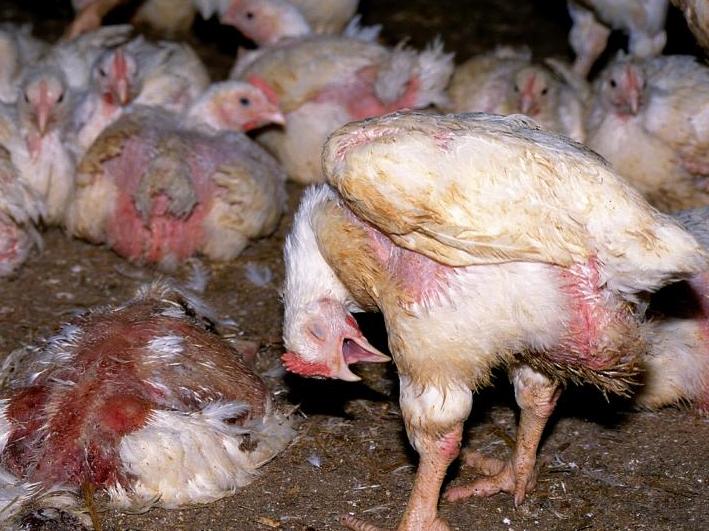
Chickens of a so-called meat breed in a German fattening farm.

These are also cages, but this time larger ones, in which up to 60 hens are crammed. For the hens also cruelty, each chicken has the area of ​​a 3/4 A-4 page available. Just that the chicken has room to lie down.
Apart from eating and laying eggs, a chicken cannot do any of the things it would like to do.

The most common poultry diseases are intestinal parasites, skin parasites, vitamin deficiency diseases, ball abscesses, laying deficiency, poisoning, goiter constipation – information from Zurich Animal Welfare.

The following can also occur blackhead disease (diarrhea), round and tapeworms, avian cholera, avian tuberculosis, botulism, foot ulcers, conjunctivitis, leg weakness syndrome, neck pouch, skeletal anomalies.

Until the time of slaughter, the chest and thigh muscles are enormously enlarged and together makeup to 66% of the body weight.

Conventional chicken producers only fatten hybrid animals.
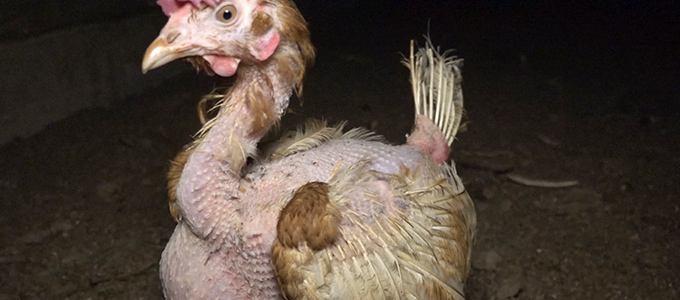
Käfig- und Bodenhaltung: Schockierende Einblicke in die deutsche EierindustrieHigh-performance hen, Germany

The focus of the breeding of high-performance broilers is a high amount of meat, efficient feed conversion, and the shortest possible fattening time due to large daily weight gains

Today’s mast hybrids reach this weight within 30 days or less.

Four globally active companies control the breeding of these mast hybrids: the Erich Wesjohann Group (EW Group), Hendrix Genetics, Groupe Grimaud, and Tyson.

The video was shot on an organic farm in Germany.

But you can see a lot of similarities to the video from India, except for the open cruel slaughter on the street and the transports.
India is known for having the worst animal transports, and not just related to poultry.

Nevertheless! No farm cruelty is justified just because there are worse ones elsewhere.
We don’t compete in cruelty.
We fight for these practices to be abolished no matter where in the world.

My best regards to all, Venus


Innovative Ideas

” The idea of dressing up as a shepherd seemed more promising to the wolf than the one with the sheepskin.”


…an idea is as good as its implementation

Regards and good night, Venus

The everyday cruelty to animals

Guest commentary by Daniela Schneider: (She is the campaign manager for animal transports at the animal rights organization Four paws Germany” based in Hamburg).

“Eyes wide open in panic, cattle shivering with exhaustion, huddled together and carted for days without a break in high-risk states such as Uzbekistan, Morocco, or Algeria under animal welfare law: Everyday torment of animals – even on German roads.

But instead of ending this ordeal, Agriculture Minister Germany`s Klöckner is not only inactive in this country.

It also misses the chance of the German EU Council Presidency to stop cruel animal transports across the EU.

If animal transports are dispatched from Germany to these third countries, this is almost always done in disregard of the applicable animal protection regulations.

“Four Paws”  has therefore filed 21 criminal charges against those responsible on suspicion of aiding and abetting animal cruelty.

Although almost all federal states have ensured that far fewer third-country exports are approved, transporters unscrupulously circumvent the applicable requirements.

The animals are first brought to other EU countries such as Hungary and then shipped on to third countries.

Instead of leaving the federal states alone as before, the minister should create nationwide uniform legislation that ensures that animals can no longer enter third countries. That would be an important first step and a strong signal in the direction of the EU.

Because the problem is a European one.

Only through an EU-wide ban on third-country exports and a limitation of transports to eight hours will the cruel animal transports actually end.

Together with us, 150,000 citizens are calling for this in a letter of protest to the minister.

Alternatives to the senseless death drives must become standard. If at all, only meat and breeding seeds should be transported instead of living animals.

Against the background of blatant animal welfare problems and a worsening climate crisis, the question arises why animals are “produced” on a massive scale and transported across the world like goods”.


http://archive.is/HlMhX#selection-393.0-417.391

And I mean…Around 3.8 million animals are transported every day in the EU alone. That’s 1.4 billion animals a year.
As in all branches of the economy, animal transport is all about money: animals are transported to where the highest profits await.

In the agricultural industry, work steps are separated: breeding, keeping, and fattening are concentrated where feed and wage costs are low.

For example, animals are born in Denmark, fattened in Germany, and finally slaughtered in Italy.

An EU animal welfare transport regulation EC 1/2005 applies throughout the EU.

Why animal transport laws don’t protect animals?

First and foremost because there is no time limit for animal transport. The animals are often on the move for days, sometimes even weeks, because there is no time limit for the transports.

On the other hand, because the EU regulation contains a large number of imprecise provisions that are always interpreted to the detriment of animals in practice.

Not even the few regulations that exist are observed: Serious deficiencies are found in around a third of the controlled transports.

Basically, food, litter, and drinking water are saved, because additional weight means higher transport costs.

And there is also a third reason for the meat industry and its lobbyists in Brussels to stick to live animal transports: The transport of live animals is still cheaper than transporting meat, which has to be permanently refrigerated.

And that is why the cruelty to animals on Europe’s roads never ends.
For a decisive change in the problem, one can forget about the EU.

Only civil society can change something – and it is developing into a new historical subject that even functions without a party program.

My best regards to all, Venus

Gang of poachers in Cyprus convicted

The police in Cyprus put one of the most notorious poaching gangs on the island to a halt in November.


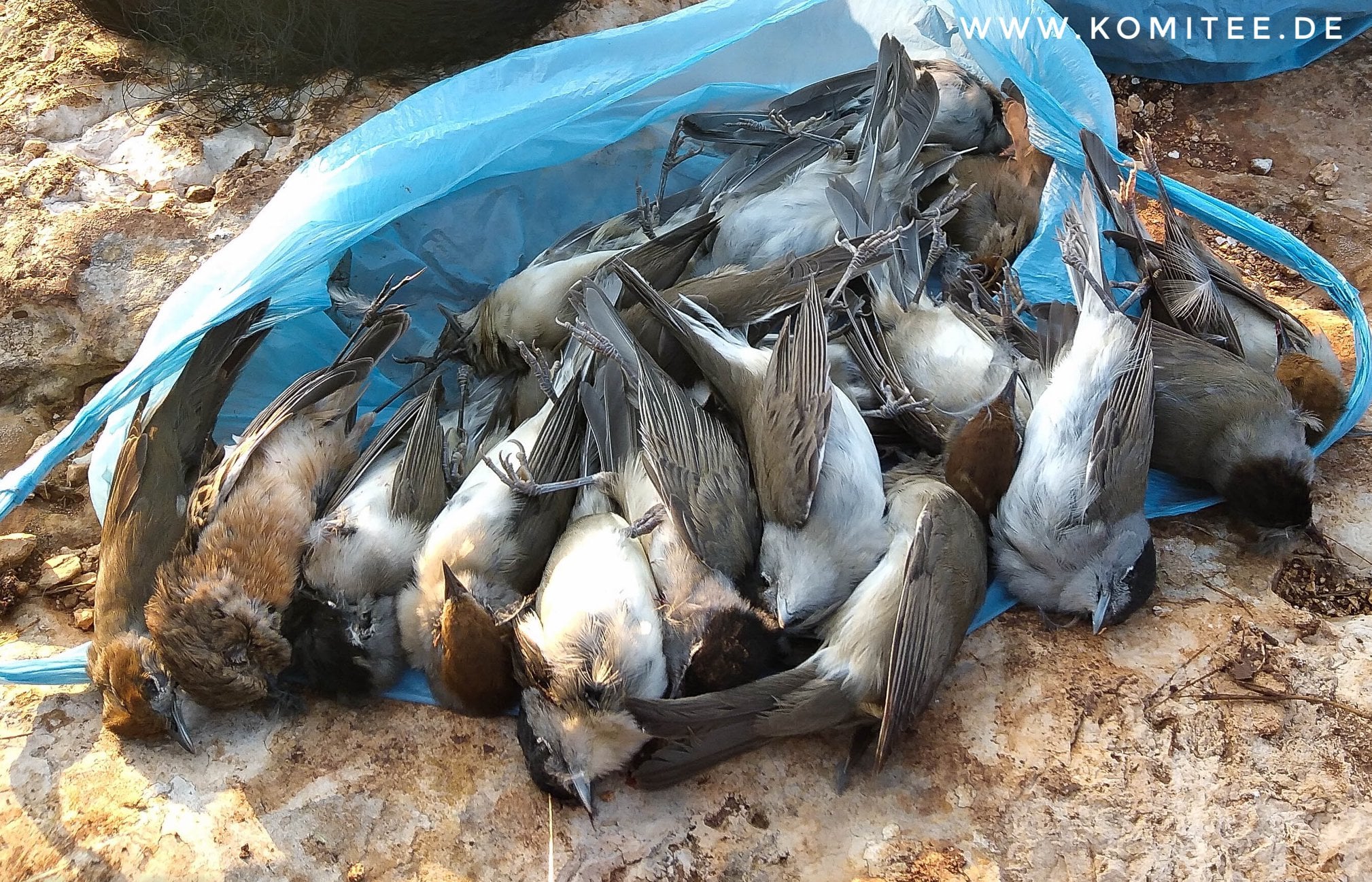
Equipped with house search warrants, they found three people with a total of five nets and 366 dead protected songbirds – mostly warblers.
The total fine for the criminal bird catcher known for many years is € 11,660.

It was the biggest blow to organized poaching in Cyprus in years. The police action was preceded by months of research by the Committee against Bird Murder and its partner BirdLife Cyprus, which led to the submission of numerous pieces of evidence.

We are very happy about this successful action against a gang that up to now seemed “untouchable” and despite numerous previous reports, was always able to avoid punishment.


https://www.facebook.com/Komitee.CABS

One of the comments was the question that would also be mine: “How will we know if they really pay the fine”?

And the answer from the committee: They will because it´s an administrative fine, they can’t refuse”.

One really must have a sick personality construct to catch the most harmless of the animals, to kill them, and to be proud of it.

My best regards to all, Venus


EU Backs Campaign Encouraging Public To Become ‘Beefatarians’.


EU Backs Campaign Encouraging Public To Become ‘Beefatarians’

The EU has financed more than €3.5 million to help the Proud of European Beef initiative to run for three years


Acampaign encouraging the public to become a ‘beefatarian’ has been backed by the EU.

The Proud of European Beef initiative is spearheaded by corporations Provacuno and APAQ-W. It is a three-year-long campaign that aims to makes consumers ‘confident’ about their decision to eat red meat.

The campaign is set to cost €4.5 million (approximately $5.39 million) – with ads running across countries such as France, Belgium and Spain. It will receive 80 percent (€3.6 million) of its funding from the European Commission.

‘A refusal to eat meat’

“The scope of the project is not only to highlighting the benefits of the product but to make the consumer feel identified and supported in its choice regarding it,” the campaign’s site states.

“Consumer behavior may lead to a refusal to eat meat due to the multiple types of information presented nowadays.

“But even so, those consumers who choose to eat red meat should feel at ease should they wish to reaffirm their choice for this product.”

Should the EU promote red meat?

Despite the campaign, The World Health Organization classifies red meat as a Group 2A carcinogen.

This means products such as pork, beef, and lamb ‘probably cause cancer’.

Moreover, the WHO says the strongest evidence for an association with eating red meat is for colorectal cancer. However, there is also evidence of links with pancreatic and prostate cancer.


EU Backs ‘Bizzare’ Campaign Urging Public To Become ‘Beefatarians’ (plantbasednews.org)

We say:

Food thoughts.

England: Award-Winning Vegan Kebab Joint To Open Fifth U.K Location In Manchester.

Award-Winning Vegan Kebab Joint To Open Fifth U.K Location In Manchester

‘To finally open during what we hope is the tail end of this pandemic fills us with optimism for the future’

Vegan kebab joint What The Pitta has announced it is opening a fifth store in the U.K.

The award-winning eatery will open its ‘biggest site yet’ in Manchester at the beginning of next year. 

‘Fills us with optimism’

Cem Yildiz is the co-founder of What The Pitta. He said the expansion feels like a ‘huge step forward’ for the company. 

According to Bdaily News, Yildiz said: “The site will be our biggest brick and mortar site yet… To finally open during what we hope is the tail end of this pandemic fills us with optimism for the future. Not just us, but hospitality as a whole.

“Manchester is my favourite city outside of London, with such an incredible food scene. We can’t wait to be a part of that. [We] hope the city welcomes us with open arms ready for their vegan kebabs.”

Award-winning vegan kebabs

Earlier this year, What The Pitta picked up the prize for Best Takeaway in London at the British Kebab Awards

The awards, which are held each year, were founded in 2013. Moreover, they are sponsored by Just Eat and ‘seek to celebrate kebab restaurants across the U.K’.

Yildiz told Plant Based News: “To win at the kebab awards is a huge statement for veganism…

“We were laughed at when we decided to create London’s first exclusively vegan kebab shop just over three years ago… Now, we’ve taken centre stage with our vegan spin on the British classic kebab.”

Award-Winning Vegan Kebab Joint To Open Fifth U.K Location (plantbasednews.org)

Netherlands: Video shows mink pulled from cages and thrown ‘like rubbish’ into gas chambers on Dutch fur farms.

Video shows mink pulled from cages and thrown ‘like rubbish’ into gas chambers on Dutch fur farms

23 November 2020

Mink were pulled from cages by their tails or hind legs and hurled into mobile gas chambers on fur farms in the Netherlands, video footage has revealed. The rough handling of the animals breaks EU animal-welfare regulations.

Animal rights campaigners said the video shows a behind-the-scenes view of the cruelty of the Dutch industry, which is closing next year. It also highlights the need for the UK to stop sales of real fur, they added.

The footage, secretly shot on two farms last week by Dutch group Animal Rights, shows the animals being pulled roughly from cages and thrown one after the other towards mobile gas chambers, sometimes from a great distance.

In one clip, the mink are heard screeching with alarm or pain.  

And workers are seen with their anti-coronavirus masks below their noses.

Claire Bass, executive director of Humane Society International/UK said: “Live mink are seen being yanked from their cage by the tail or hind leg, in clear breach of EU regulations, and tossed like trash into the mobile gas chamber one after the other in quick succession.  

The speed with which these sentient animals are thrown in together means they will almost certainly be dying in front of each other, again in breach of the rules.”

Read more at source

Independent

Video shows mink pulled from cages and thrown ‘like rubbish’ into gas chambers on Dutch fur farms | The Independent