
SAV Comment:
We Brits have always been a proud, animal loving nation. The Brown Dog Affair provides an overview of the UK fight against animal vivisection which has been going on for over 110 years now. As a result of all the events, we have some brilliant anti-vivisection organisations as you can see below. But this goes to show one simple thing – victories are not achieved overnight. They can be campaigns of decades or more; but with the dedication of good, strong people, the work goes on until it is eventually stopped.
National Anti-Vivisection Society (NAVS)
The National Anti-Vivisection Society (NAVS) is the world’s first organisation campaigning against animal experiments having been founded in 1875 by Miss Frances Power Cobbe, a great humanitarian who published many leaflets and articles opposing animal experiments, and gathered many notable people of the day to support our cause.
The Society was formed on 2 December 1875 in Victoria Street, London, under the name of the Victoria Street Society.
http://www.navs.org.uk/home/
British Union for the Abolition of Vivisection (BUAV)
For over 100 years the BUAV has been campaigning peacefully to create a world where nobody wants or believes we need to experiment on animals.
http://www.buav.org/
The Lord Dowding Fund for Humane Research
The objectives of the Lord Dowding Fund for Humane Research are: to support and fund better methods of scientific and medical research for testing products and curing disease which replace the use of animals; to fund areas of fundamental research which lead to the adoption of non-animal research methodology; to fund, promote and assist medical, surgical, and scientific research, learning, and educational training and processes for the purpose of replacing animals in education and training.
http://www.ldf.org.uk/research/49/50/0/
Animal Defenders International (ADI)
http://www.ad-international.org/animal_experiments/
Animal Aid
http://www.animalaid.org.uk/h/n/CAMPAIGNS/experiments/ALL///
Centre for Animals and Social Justice (CASJ) / (was) Uncaged
Many nonhuman animals are intelligent, aware individuals with rich mental lives that can be more complex than those of some humans. As sentient beings whose lives are profoundly affected by the actions of individuals, businesses and states, animals should be an essential concern of social justice.
CASJ = http://www.casj.org.uk/
Uncaged = http://www.uncaged.co.uk/
Dr Hadwen Trust
The Dr Hadwen Trust is the UK’s leading medical research charity that funds and promotes exclusively non-animal techniques to replace animal experiments. Their vital work benefits humans with the development of more relevant and reliable science whilst also benefiting laboratory animals. They believe that excellence in medical research can and should be pursued without animal experiments.
http://www.drhadwentrust.org/
Doctors and Lawyers for Responsible Medicine
Its objective is the immediate and total abolition of all animal experiments, on medical and scientific grounds.
http://www.dlrm.org/index.htm

European Coalition to End Animal Experiments (ECEAE)
Formed in 1990 by organisations across Europe to successfully campaign to ban cosmetics testing on animals. Today we lead campaigning on all animal testing issues in Europe, and are the only organisation solely dedicated to being a voice for animals in EU laboratories.
http://www.eceae.org/
Nurses Movement for Responsible Medicine
NMRM opposes animal experimentation on medical and scientific grounds. They now know that animals do not react in the same way to drugs and other substances as we do, due to differences in their absorption, distribution, metabolism, response to and elimination of drugs. But this is not something you are likely to hear from our country’s media, which has consistently shown itself to be pro-vivisection due the very many vested interests. Animal experimentation has resulted in immense human damage. This has affected people of all ages and continues to affect an unacceptably high percentage of patients.
http://www.nmrm.org/
SPEAK Campaigns
SPEAK is a grass roots animal rights group currently campaigning to end the use of animals in research carried out by Oxford University. SPEAK is against all animal experiments on ethical grounds and is currently focusing on Oxford University due to the huge numbers of animals suffering inside the laboratories of this well known institution.
http://www.speakcampaigns.org/
Stop Huntingdon Animal Cruelty (SHAC)
SHAC is a worldwide campaign, and the first of its kind, with SHAC groups in the UK and many other countries all uniting to target HLS and the companies that support them globally.
http://www.shac.net/
———————————————————————————————
Brown Dog affair
Please refer to the following Wikipedia link to see all the pictures associated with this article.
http://en.wikipedia.org/wiki/Brown_Dog_affair
The Brown Dog affair was a political controversy about vivisection that raged in Edwardian England from 1903 until 1910. It involved the infiltration of University of London medical lectures by Swedish women anti-vivisection activists, pitched battles between medical students and the police, police protection for the statue of a dog, a libel trial at the Royal Courts of Justice, and the establishment of a Royal Commission to investigate the use of animals in experiments. The affair became a cause célèbre that reportedly divided the country.[1]
The controversy was triggered by allegations that, in February 1903, William Bayliss of the Department of Physiology at University College London had performed an illegal dissection before an audience of 60 medical students on a brown terrier dog – adequately anaesthetized, according to Bayliss and his team; conscious and struggling, according to the Swedish activists. The procedure was condemned as cruel and unlawful by the National Anti-Vivisection Society. Bayliss, whose research on dogs led to the discovery of hormones, was outraged by the assault on his reputation. He sued for libel and won.[2]
Anti-vivisectionists commissioned a bronze statue of the dog as a memorial, unveiled in Battersea in 1906, but medical students were angered by its provocative plaque – “Men and women of England, how long shall these Things be?” – leading to frequent vandalism of the memorial and the need for a 24-hour police guard against the so-called “anti-doggers”. One doctor complained that the medical students’ failure to overcome the police was a sign of the “utter degeneration” of junior doctors and the Anglo-Saxon race. On 10 December 1907, 1,000 anti-doggers marched through central London waving effigies of the brown dog on sticks, clashing with suffragettes, trade unionists, and 400 police officers, one of a series of battles known as the Brown Dog riots.[3]
In March 1910, tired of the constant controversy, Battersea Council sent four workers accompanied by 120 police officers to remove the statue under cover of darkness, after which it was reportedly melted down by the council’s blacksmith, despite a 20,000-strong petition in its favour. A new statue of the brown dog was commissioned by anti-vivisection groups over 70 years later, and was erected in Battersea Park in 1985. Peter Mason writes that all that is left of the old statue is a hump in the pavement, the sign on a nearby fence reading, “No Dogs”.[4]
Background
Vivisection
Walter Gratzer, professor emeritus of biochemistry at King’s College London, writes that a powerful opposition to vivisection arose in England during the reign of Queen Victoria, represented equally in the House of Commons and House of Lords. The Queen herself was strongly opposed to it. At that time, the word “vivisection” was used to describe the dissection of live animals, either with or without anaesthesia, often in front of audiences of medical students.[5]
Well-known physiologists, such as Claude Bernard (1813–1878) and Charles Richet (1850–1935) in France, and Michael Foster (1836–1907) and Burdon Sanderson (1828–1905) in England, were frequently pilloried for their work. Bernard was a particular target of violent abuse, even from members of his own family. He appears to have shared their distaste, writing that “the science of life … is a superb and dazzlingly lighted hall which may be reached only by passing through a long and ghastly kitchen.” Gratzer reports that British anti-vivisectionists infiltrated the lectures in Paris of Bernard’s teacher, François Magendie (1783–1855), where dogs were strapped down on boards to be dissected, with Magendie allegedly shouting as they struggled, “Tais-toi, pauvre bête!” (“Shut up, you poor beast!”).[6]
Cruelty to Animals Act 1876
The opposition to vivisection led the government to set up the First Royal Commission on Vivisection in July 1875, which recommended that legislation be enacted to control it, and in December that year Frances Power Cobbe (1822–1904), a feminist and anti-vivisection activist, founded the National Anti-Vivisection Society (NAVS). There were around 300 experiments on animals each year in the UK in 1875; by 1903, the year of the brown dog’s dissection, the figure was 19,084; and by 2005 it was 2.81 million (7,306 of them dogs), counting vertebrate animals only.[7]
The 1875 Royal Commission led to the Cruelty to Animals Act 1876 – criticized by NAVS as “infamous but well-named” – which legalized and attempted to set limits on the practice. The law remained in force for 110 years, until it was replaced by the Animals (Scientific Procedures) Act 1986, the subject of similar criticism from the modern animal rights movement.[8]
The 1876 Act stipulated that researchers could not be prosecuted for cruelty, but that the animal must be anaesthetized, unless the anaesthesia would interfere with the point of the experiment. Each animal could be used only once, though several procedures regarded as part of the same experiment were permitted, and the animal had to be killed when the study was over, unless doing so would frustrate the object of the experiment.[9] Prosecutions under the Act could be made only with the approval of the Home Secretary, at the time Aretas Akers-Douglas, who was regarded as unsympathetic to the anti-vivisectionist cause.[10]
Ernest Starling and William Bayliss
In the early twentieth century, Ernest Starling (1866–1927), Professor of Physiology at University College, London, and his brother-in-law, William Bayliss (1860–1924), were using vivisection on dogs to determine whether the nervous system controls pancreatic secretions, as postulated by Ivan Pavlov (1849–1936).[11] John Henderson writes that Starling’s lab was the busiest physiological institution in London.[12]
The men knew that the pancreas produces digestive juices in response to increased acidity in the duodenum and jejunum, because of the arrival of chyme there. By severing the duodenal and jejunal nerves in anaesthetized dogs, while leaving the blood vessels intact, then introducing acid into the duodenum and jejunum, they discovered that the process is not mediated by a nervous response, but by a new type of chemical reflex. They named the chemical messenger secretin, because it is secreted by the intestinal lining into the bloodstream, stimulating the pancreas on circulation.[11]
In 1905 Starling coined the term “hormone” – from the Greek hormao ὁρµάω meaning “I arouse” or “I excite” – to describe chemicals such as secretin that are capable, in extremely small quantities, of stimulating organs from a distance. Bayliss and Starling had also used vivisection on anaesthetized dogs to discover peristalsis in 1899. They went on to discover a variety of other important physiological phenomena and principles, many of which were based on their experimental work involving animal vivisection.[13]
Vivisection of the dog
The court was shown this reconstruction of the brown dog’s dissection. The image shows William Bayliss (standing at the front), and on his right, Ernest Starling, Henry Dale, and Charles Scuttle, the laboratory technician.[12]
The brown dog was a mongrel of the terrier type, probably a former stray or pet, weighed 14 lb (6 kg), and had short rough hair. He was first used in a vivisection in December 1902 by Starling, who had cut open his abdomen and ligated the pancreatic duct. He lived in a cage for the next two months, reportedly upsetting people with his howling.[14]
He was used for another demonstration on 2 February 1903. Outside the lecture room, before the students arrived – according to testimony the researchers later gave in court – Starling first cut the dog open again to inspect the results of the previous surgery, which took about 45 minutes, after which he clamped the wound with forceps and handed the dog over to Bayliss.[15]
Bayliss cut a new opening in the dog’s neck to expose the lingual nerves of the salivary glands, which he attached to electrodes. The intention was to stimulate the nerves with electricity to demonstrate that salivary pressure was independent of blood pressure. The dog was then carried to the lecture theatre, stretched on his back on an operating board, with his legs tied to the board, his head clamped into position, and his mouth muzzled to keep him quiet. In front of around 60 students, Bayliss stimulated the nerves with electricity for half an hour, but was unable to demonstrate his point.[15]
The dog was then handed to a student, Henry Dale (1875–1968), a future Nobel laureate, who removed the dog’s pancreas, then killed him with a knife through the heart. This became a point of embarrassment during the libel trial, when Bayliss’s laboratory assistant, Charles Scuttle, testified that the dog had been killed with chloroform or a mixture of anaesthetic agents, but after Scuttle’s testimony Dale told the court that he had, in fact, used a knife.[15] According to Bayliss, a point disputed by the Swedish women, the dog had been anaesthetized earlier in the day with a morphine injection, then later with six fluid ounces of alcohol, chloroform, and ether, delivered from an ante-room to a tube in his trachea via a pipe hidden behind the bench the men were working on. Other students present said the dog had not struggled, but had merely twitched.[16]
Infiltration by Swedish students
Unknown to Starling and Bayliss, their lectures had been infiltrated by Lizzy Lind af Hageby (1878–1963) and Leisa Katherine Schartau, two Swedish anti-vivisection activists. Peter Mason writes that the women had known each other since childhood. Both came from distinguished families: Lind af Hageby was the daughter of a former chief justice of Sweden and the granddaughter of a chamberlain to the King of Sweden, while Schartau’s father was a Swedish army captain. In 1900 they had travelled to Paris together, where they visited the Pasteur Institute, a centre of animal experimentation, and were shocked by the rooms full of caged animals given diseases by the researchers. When they returned home in December 1900, they founded the Anti-Vivisection Society of Sweden.[17]
In 1902 the women decided to enroll as students at the London School of Medicine for Women – a vivisection-free college that had visiting arrangements with other London colleges – to gain medical training so they could become knowledgeable anti-vivisectionists. They attended 100 lectures and demonstrations at King’s and University College, including 50 experiments on live animals, of which 20 were what Mason called “full-scale vivisection”.[17] They kept a diary throughout, calling it Eye-Witnesses, later changing the title to The Shambles of Science: Extracts from the Diary of Two Students of Physiology. The women disputed that the brown dog had been anaesthetized; they wrote that the dog appeared conscious, and that there was no smell of anaesthesia or the usual hissing sound of the apparatus:[18]
Today’s lecture will include a repetition of a demonstration which failed last time. A large dog, stretched on its back on an operation board, is carried into the lecture-room by the demonstrator and the laboratory attendant. Its legs are fixed to the board, its head is firmly held in the usual manner, and it is tightly muzzled.
There is a large incision in the side of the neck, exposing the gland. The animal exhibits all signs of intense suffering; in his struggles, he again and again lifts his body from the board, and makes powerful attempts to get free.[18]
Involvement of Stephen Coleridge
Stephen Coleridge gave an angry speech about the allegations, possibly intending to provoke a suit for libel.
William Bayliss responded with a writ.
Lind af Hageby and Schartau showed their diary, at that point still unpublished, on 14 April 1903 to the barrister Stephen Coleridge (1854–1936), secretary of the National Anti-Vivisection Society (NAVS), and son of a former Lord Chief Justice of England. Coleridge’s attention was drawn to the account of the brown dog, because the Cruelty to Animals Act forbade the use of an animal in more than one experiment.[19] Yet it appeared that the brown dog had been used by Starling to perform surgery on the pancreas, used again by him when he opened the dog to inspect the results of the previous surgery, and used for a third time by Bayliss to study the salivary glands.[20]
Both this allegation and the claim that the dog had not been properly anaesthetized represented prima facie violations of the Act. In addition the women said the dog had been killed by Henry Dale, an unlicensed research student, and that the students had laughed during the procedure; there were “jokes and laughter everywhere” in the lecture hall while the dog was being dissected, according to their diary.[20]
Mason writes that Coleridge decided there was no point in relying on a prosecution under the Act, which he regarded as deliberately obstructive. Instead, he gave an angry speech about it to the annual meeting of the National Anti-Vivisection Society at St James’s Hall on 1 May 1903, attended by 2,000–3,000 people. According to Mason, support and apologies for absence were sent by Jerome K. Jerome, Thomas Hardy, and Rudyard Kipling.[21]
Coleridge’s speech included a statement from Lind af Hageby: “The dog struggled forcibly during the whole experiment and seemed to suffer extremely during the stimulation. No anaesthetic had been administered in my presence, and the lecturer said nothing about any attempts to anaesthetize the animal having previously been made.” Coleridge accused the scientists of having tortured the animal. “If this is not torture, let Mr. Bayliss and his friends … tell us in Heaven’s name what torture is.”[22]
Mason writes that a verbatim report of the speech was published the next day by the radical Daily News – founded by Charles Dickens – and over the next three days by other national and regional papers. Questions were raised in the House of Commons, particularly by Sir Frederick Banbury, a Conservative MP and sponsor of a vivisection bill aimed at ending demonstrations of the kind conducted by Starling and Bayliss. On 8 May, Coleridge challenged Bayliss in a letter to the Daily News: “As soon as Dr. Bayliss likes to test the bona fides and accuracy of my public declaration … he shall be confronted from the witness box by eyewitnesses I rely upon.” Bayliss demanded a public apology, and when it failed to materialize, he issued a writ for libel. Starling decided not to sue. Even The Lancet, a medical journal that was no supporter of Coleridge, wrote that “it may be contended that Professor Starling … committed a technical infringement of the Act.”[23]
Bayliss v. Coleridge
John Henderson writes that Coleridge tried to persuade the women not to publish their diary before the trial began, but they went ahead anyway, and it was published by Ernest Bell of Covent Garden in July 1903.[24] The trial began on 11 November that year before Lord Chief Justice Lord Alverstone at the Royal Courts of Justice and lasted four days, closing on 18 November. Mason reports that the British Medical Journal called it “a test case of the utmost gravity,” while the Morning Leader described the public gallery as packed and rowdy, with no spare seats or standing room, and queues 30 yards (30 metres) long forming outside the courthouse.[23]
Bayliss’s counsel, Rufus Isaacs, called Starling as his first witness. Starling admitted that he had broken the law by using the dog twice, but said in his defence that he had done so to avoid sacrificing two dogs. Bayliss testified that the dog had been anaesthetized with one-and-a-half grains of morphia and six ounces of alcohol, chloroform, and ether; Mason writes that Bayliss said he could not have performed the procedure had the dog been struggling, because the tubes he was using to anaesthetize the dog were fragile and would have broken.[25]
A veterinarian, Alf Sewell, said the system Bayliss was using was unlikely to be adequate, but other witnesses, including Frederick Hobday of the Royal Veterinary College, disagreed; there was even a claim that Bayliss had used too much anaesthesia, which is why the dog had failed to respond to the electrical stimulation. Bayliss said the dog had been suffering from chorea, a disease involving involuntary spasm, and that any movement the women had seen was not purposive.[25]
Coleridge’s defence called on the two Swedish women as witnesses. They testified that they were the first students to arrive at the lecture hall, and that they had seen the dog being brought in. They were left alone with the dog for about two minutes, and examined him themselves. They observed scars from the previous operations, and saw an incision in the neck where two tubes had been placed. They did not smell any anaesthetic, and said they could not see any apparatus delivering anaesthesia or any tubing in the dog’s trachea. They said the dog was arching its back and jerking its legs in what they regarded as an effort to escape. When the experiment began, they said, the dog continued to arch its back, “upheave its abdomen” and tremble. The women said they regarded the movement as “violent and purposeful”.[25]
Bayliss’s lawyer criticized Coleridge for having accepted the women’s statements without seeking corroboration, and for speaking about the issue publicly without first approaching Bayliss, though he knew that doing so could lead to litigation. Coleridge replied that he had not sought verification because he knew the claims would be denied, and that he continued to regard the women’s statement as true.[25] The Times reported that: “The Defendant, when placed in the witness box, did as much damage to his own case as the time at his disposal for the purpose would allow.”[26]
Verdict
Lord Alverstone told the jury the case was an important one of national interest – though he called The Shambles of Science “hysterical” – and advised the jury not to be swayed by arguments on the validity of vivisection. After retiring for 25 minutes, the jury unanimously found that Bayliss had been defamed, and on 18 November 1903 he was awarded £2,000 with £3,000 costs (worth around £250,000 in 1997, according to Mason).[28]
There are conflicting views as to how popular a decision it was. The Edinburgh Medical Journal wrote that the ruling was greeted by applause in the court; Frances Power Cobbe fell into a depression because of the animus of the public.[29] The Times declared itself satisfied with the verdict, though it criticized the rowdy behaviour of medical students during the trial, accusing them of “medical hooliganism”, while the The Sun, The Star and the Daily News backed Coleridge, calling the decision a miscarriage of justice. The Daily News launched a fund to cover Coleridge’s expenses, raising over £5,700 within four months. Bayliss donated his damages to UCL for use in research; Mason writes that Bayliss ignored the Daily Mail’s suggestion that he call it the “Stephen Coleridge Vivisection Fund”. According to Gratzer, the fund may still be in use today to buy animals. [30]
On 25 November 1903, Ernest Bell, publisher and printer of The Shambles of Science, apologized to Bayliss, and pledged to withdraw the 200-page book and hand over all remaining copies to Bayliss’s solicitors.[31] The Animal Defence and Anti-Vivisection Society, founded by Lind af Hageby in 1903, republished the book, printing a fifth edition by 1913. The chapter “Fun”, which had caused such offence, was replaced with one called “The Vivisections of the Brown Dog”, describing the experiment and the trial.[32] In December 1903 Mark Twain – himself opposed to vivisection – published his short story, A Dog’s Tale, in Harper’s, written from the point of view of a dog whose puppy is experimented on and killed. Shelley Fisher Fishkin writes that, given the timing and Twain’s views, the story may have been inspired by The Shambles of Science and the libel trial.[33]
Brown Dog memorial
After the trial, Lind af Hageby was approached by Anna Louisa Woodward, founder of the World League Against Vivisection, who suggested the idea of a public memorial. Woodward raised a subscription, and commissioned from sculptor Joseph Whitehead a bronze statue of the dog on top of a granite memorial stone – 7 ft 6 in (2.29 m) tall – containing a drinking fountain for human beings, and a lower trough for dogs and horses.[34]
The group turned to the borough of Battersea for a location for the memorial. Lansbury writes that the area was known as a hotbed of radicalism – proletarian, socialist, belching smoke, and full of slums – and was closely associated with the anti-vivisection movement. Battersea General Hospital refused to perform vivisection or employ doctors who engaged in it, and was known locally as the “Antiviv” or the “Old Anti”. The chairman of the Battersea Dogs Home, the Duke of Portland, rejected a request in 1907 that its lost dogs be sold to vivisectors as “not only horrible, but absurd.”[35]
Battersea council agreed to provide a space for the statue on its newly completed Latchmere Estate, a housing estate for the working class offering terraced homes at seven and sixpence a week.[35] The statue was unveiled on 15 September 1906 in front of a large crowd – speakers included George Bernard Shaw and the Irish feminist Charlotte Despard – bearing an inscription described by The New York Times as the “hysterical language customary of anti-vivisectionists” and “a slander on the whole medical profession”:[36]
In Memory of the Brown Terrier Dog Done to Death in the Laboratories of University College in February, 1903, after having endured Vivisection extending over more than Two Months and having been handed from one Vivisector to Another Till Death came to his Release. Also in Memory of the 232 dogs Vivisected at the same place during the year 1902. Men and Women of England, how long shall these Things be?[37]
Riots
Medical students at London’s teaching hospitals were enraged by the plaque. The first year of the statue’s existence was a quiet one, while University College explored whether they could take legal action over it, but from November 1907 onwards the students turned Battersea into the scene of frequent disruption.[38]
The first action was on 20 November 1907, when a group of University College students, led by undergraduate William Howard Lister, crossed the Thames from the north over to Battersea with a crowbar and a sledgehammer, and tried to attack the statue. Ten of them were arrested by two police officers; one local doctor told the South Western Star that this was a sign of the “utter degeneration” of junior doctors and the Anglo-Saxon race.[38] The next day, others protested in Tottenham Court Road against the fines levied on the ten, and the day after that saw a demonstration of hundreds of students who marched holding effigies of the brown dog on sticks. The Times reported that they marched down the Strand to burn an effigy of a magistrate, and when it failed to ignite threw it in the Thames.[39]
As we go walking after dark,
We turn our steps to Latchmere Park,
And there we see, to our surprise,
A little brown dog that stands and lies.
Ha, ha, ha! Hee, hee, hee!
Little brown dog how we hate thee.
Sung by the rioters to the tune of Little Brown Jug as they marched down the Strand on 10 December 1907.[40]
Women’s suffrage meetings were routinely invaded by medical students barking and shouting “Down with the Brown Dog!”, though the students knew not all suffragettes were anti-vivisectionists. A meeting organized by Millicent Fawcett was violently invaded on 5 December 1907.[41] The rioting reached its height five days later on Tuesday, 10 December, when 100 medical students tried to pull the memorial down. The previous protests had been spontaneous, but this one was organized to coincide with the annual Oxford-Cambridge rugby match at Queen’s Club, West Kensington, the protesters hoping that some of the thousands of Oxbridge students due to attend would swell their numbers. Peter Mason writes that street vendors were selling handkerchiefs with the date of the protest printed on them, and the words “Brown dog’s inscription is a lie, and the statuette an insult to the London University.”[42]
Toward late afternoon, a group of protesters headed for Battersea to uproot the statue and throw it in the Thames. Lansbury writes that, driven out of the Latchmere Estate by workers, the students proceeded down Battersea Park Road instead, intending to attack Battersea General Hospital, the “Antiviv”, but were again forced back. The Daily Chronicle reported that, when one student fell from the top of a tram, the workers shouted that it was “the brown dog’s revenge”.[43]
A second group headed for central London, waving more effigies of the brown dog, joined by a police escort and, briefly, a busker with bagpipes.[42] As the marchers reached Trafalgar Square, they were 1,000 strong, facing 400 police officers, some of them mounted. The students gathered around Nelson’s Column, the ringleaders climbing onto its base to make speeches. As students fought with police on the ground, mounted police charged the crowd, scattering them into smaller groups and arresting the stragglers, including one Cambridge undergraduate, Alexander Bowley, who was arrested for “barking like a dog”. The fighting continued for hours before the police gained control of the crowd.[44]
Over the following days and weeks, more rioting broke out, with medical and veterinary students uniting. Lizzy Lind af Hageby arranged a meeting of anti-vivisectionists at Acton Central Hall on 16 December, and though it was protected by a contingent of workers, Lansbury writes that over 100 students managed to smuggle themselves in, and the event deteriorated into an exchange of chairs, fists, and smoke bombs.[41]
Questions were asked in the House of Commons about the cost of policing the statue. London’s police commissioner wrote to Battersea Council to ask whether they would contribute to the cost, which had reached £700 a year. Councillor John Archer – the first black person to be elected to public office in the UK, and later elected Mayor of Battersea – told the Daily Mail that he was amazed by the request, considering Battersea was already paying £22,000 a year in police rates. Other councillors, concerned about a hike in the rates, suggested the statue be encased in a steel cage and surrounded by a barbed wire fence. The Canine Defence League wondered whether, if Battersea were to organize raids on laboratories to destroy vivisection instruments, the laboratories would be required to pay the police costs themselves.[45]
“Exit the ‘Brown Dog'”
Battersea Council grew tired of the controversy. A new Conservative council was elected in November 1909 amid talk of removing the statue. There were protests in support of it, and the 500-strong Brown Dog memorial defence committee was established. Twenty thousand people signed a petition, and 1,500 attended a rally in February 1910 addressed by Irish suffragette and Sinn Féin activist Charlotte Despard, Liberal MP George Greenwood, and Lind af Hageby. There were demonstrations in central London and speeches in Hyde Park, with supporters wearing masks of dogs.[47]
The protests were to no avail. The statue was quietly removed before dawn on 10 March 1910 by four council workmen accompanied by 120 police officers. It was at first hidden in a bicycle shed, then believed to have been destroyed by a council blacksmith, who reportedly smashed it, then melted it down.[48] Nine days later, 3,000 anti-vivisectionists gathered in Trafalgar Square to demand the return of the statue, but it was clear by then that Battersea Council had turned its back on the whole affair.[49]
Strange relationships
Susan McHugh of the University of New England writes that the dog’s mongrel heritage reflected the extraordinary political coalition that rallied to the statue’s defence. The riots saw socialists, trade unionists, Marxists, liberals, and suffragettes descend on Battersea to fight the medical students, even though the suffragettes, identified with the bourgeoisie, were not a group toward whom organized male workers felt any warmth; working-class men did not want to encourage the cheaper labour of women. But the “Brown Dog Done to Death in the Laboratories of University College” by the male scientific establishment united them all.[50]
Coral Lansbury writes that the causes of feminism and women’s suffrage became closely linked with the anti-vivisection movement. Three of the four vice-presidents of the Battersea General Hospital that refused to allow vivisection were women. She argues that the Brown Dog affair became a matter of opposing symbols, the iconography of vivisection striking a chord with women. The vivisected dog muzzled and strapped to the operating board blurred into images of suffragettes on hunger strike restrained and force-fed in Brixton Prison, or women strapped down for childbirth, or into the gynaecologist’s chair by an all-powerful male medical establishment, forced to have their ovaries and uteruses removed as a cure for “mania.”[51] Lind af-Hageby and Despard saw it as a battle between feminism and machismo.[52]
Both sides saw themselves as heirs to the future. Hilda Kean writes that the Swedish protagonists were young and female, anti-establishment and progressive, while the accused scientists, older and male, were viewed as remnants of a previous age.[53] It was the Swedish women’s hard-won access to higher education that had made the case possible in the first place, creating a new form of political agitation, a “new form of witnessing”, according to Susan Hamilton of the University of Alberta.[54] Against this, Lansbury writes, the students saw the women and the trade unionists as representative of superstition and sentimentality, anti-science, anti-progress – “women of both sexes” defending a brutal, insanitary past – while the students and their teachers were the “New Priesthood”.[55]
Memorial restored
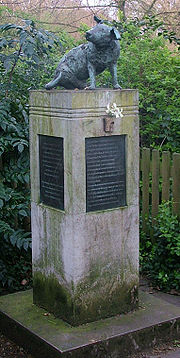
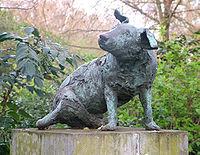
The new Brown Dog by Nicola Hicks, erected in Battersea Park in 1985
The New York Times wrote in March 1910 that “it is not considered at all probable that the effigy will ever again be exhibited in a public place”, but on 12 December 1985, a new memorial to the brown dog was erected behind the Pump House in Battersea Park, commissioned by the National Anti-Vivisection Society and the British Union for the Abolition of Vivisection, and unveiled by actress Geraldine James.[56]
The new statue, by sculptor Nicola Hicks, is mounted on a 5-foot-high (1.5 m) Portland stone plinth, the dog based on Hicks’s own terrier, and described by Peter Mason as “a coquettish contrast to its down-to-earth predecessor”.[57] It repeats the original inscription, and adds:
This monument replaces the original memorial of the brown dog erected by public subscription in Latchmere Recreation Ground, Battersea in 1906. The sufferings of the brown dog at the hands of the vivisectors generated much protest and mass demonstrations. It represented the revulsion of the people of London to vivisection and animal experimentation. This new monument is dedicated to the continuing struggle to end these practices. After much controversy the former monument was removed in the early hours of 10 March 1910. This was the result of a decision taken by the then Battersea Metropolitan Borough Council, the previous council having supported the erection of the memorial.
Animal experimentation is one of the greatest moral issues of our time and should have no place in a civilized society. In 1903, 19,084 animals suffered and died in British laboratories. During 1984, 3,497,355 animals were burned, blinded, irradiated, poisoned and subjected to countless other horrifyingly cruel experiments in Great Britain.[58]
Echoing the fate of the previous memorial, the statue was moved into storage in 1992 by Battersea Park’s owners, the Conservative Borough of Wandsworth, as part of a park renovation scheme, according to the council. Anti-vivisectionists, suspicious of the explanation, campaigned for its return. It was reinstated in the park’s Woodland Walk in 1994, near the Old English Garden, a more secluded location than before.[59]
Hilda Kean has criticized the new statue. The old Brown Dog was upright and defiant, she writes, not begging for mercy, which made it a radical political statement. The new Brown Dog is a pet, the creator’s own terrier, sited in the Old English Garden as “heritage”. Quoting David Lowenthal, professor emeritus at UCL, Kean writes that “what heritage does not highlight, it hides.” She writes that the new statue has been separated from its anti-vivisection message and from popular images of animal rights activism – the balaclavas of activists and the painful eyes of rabbits. The new Brown Dog is too safe, she argues. Unlike its controversial ancestor, it makes no one uncomfortable.[60]
Filed under: CAMPAIGNS - Global Animal Welfare Issues, GENERAL NEWS - International / National / Regional, LETTERS | Leave a comment »















 Serbian Animals Voice (SAV)