Our recent post on the events in Tordesillas, including action and campaign information:
https://serbiananimalsvoice.wordpress.com/2010/09/15/sadistic-spain-toro-de-la-vega-update-150910-mayor-maria-del-milagro-zarzuelo-tells-the-world-the-town-hall-had-made-attempts-in-recent-years-to-make-the-fiesta-less-barbaric-in-previous/
Uk journalist and animal welfare campaigner Danny send his report on the events of last week.
An excellent article – please read this before you visit our action link above.
EU citizens – please copy this article / post to your MEP’s, and ask them to give you their stance on Spanish ‘fiesta’s’;
http://www.europarl.europa.eu/members/expert/groupAndCountry.do?language=EN
Who knows where Danny will be investigating animal abuse issues next ?
SAV.
————————————————————-
http://www.dailymail.co.uk/news/article-1313480/Spains-blood-fiestas-make-bullfights-tame-youre-paying-them.html
Daily Mail. 20 September 2010.
Spain’s sickening ‘blood fiestas’ make bullfights seem tame – but the most shocking thing about them is YOU’RE paying for them.
By Danny Penman In Tordesillas
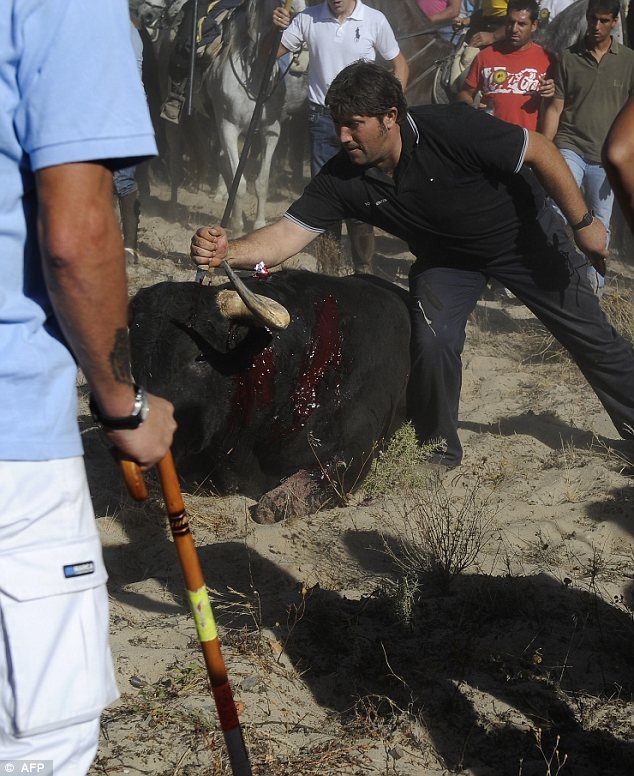
Marcos held aloft the bloodsoaked bull’s ears and bowed deeply to the crowd. Moments earlier he’d sliced them off the young bull, which now lay on one side, blood pooling beneath him. But the poor creature wasn’t quite finished yet. In a pitiful act of defiance, he mustered just enough energy to raise his
head a few inches off the ground and tried to stare down his attackers.
Marcos responded by unsheathing a vicious looking knife and stabbing him in the back of the neck for a second time. The bull’s head flopped back into the dust — he was finished and Marcos, the amateur matador, yelled in triumph. As the official killer of the bull, he had won the right to parade the animal’s coveted ears, tail and testicles around town on a ceremonial spear. He had also been granted permission to eat the bull’s testicles – widely regarded in Spain as the choicest of all cuts of meat and a rare honour indeed. In the eyes of many, Marcos Rodríguez San José was truly king for the day.
Casual brutality towards animals is,of course, well known in Spanish bullrings, but the sights I witnessed last Tuesday, during the annual Toro de la Vega ‘blood fiesta’ in Tordesillas, were as sickening as they were brutal.
What is more, such blood fiestas are far more common than the more famous and well-known sport of bullfighting. Blood fiestas are not performed for the entertainment of tourists. They are gruesome traditions that kill thousands more animals than bullfighting — often in the most barbaric ways imaginable. Yet millions of the Britons who visit Spain every year will be unaware of their existence.
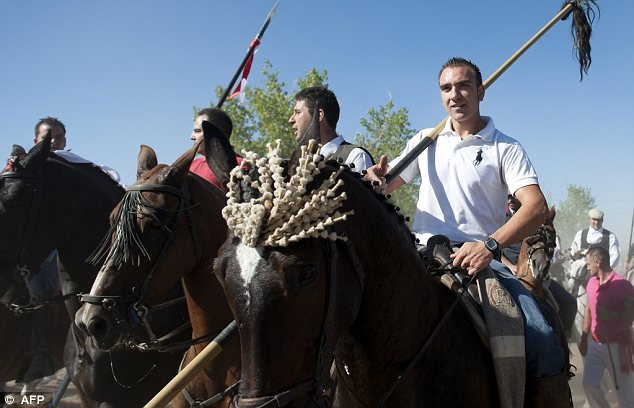
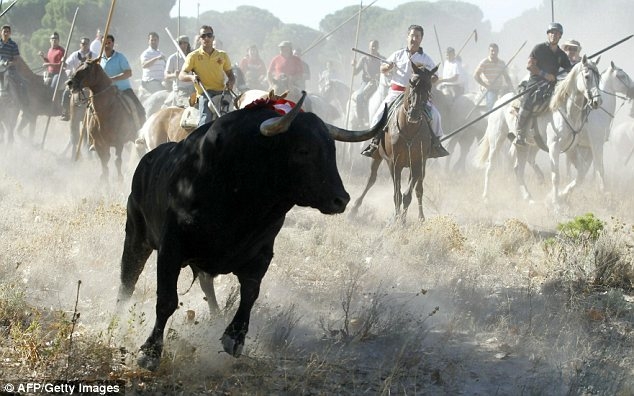
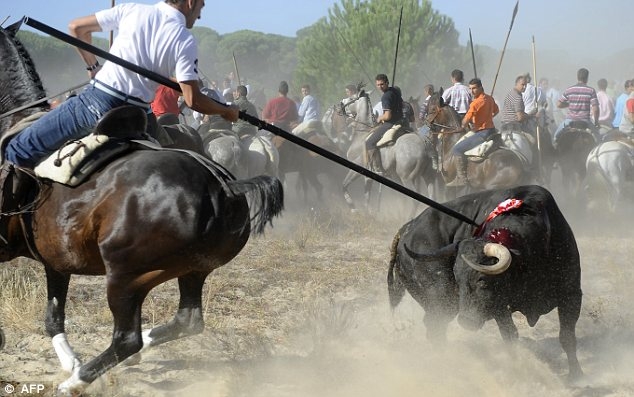
The Toro de la Vega is a case in point. It’s a centuries-old tradition in which a bull is chased through the streets by thousands of men who beat it with sticks and pelt it with stones. Although this is chilling to watch, it is only when the bull reaches the meadows outside Tordesillas that the spectacle begins in earnest. The bull whose brutal death I witnessed had been given the name Platanito (meaning ‘little banana’) by animal welfare officers. I watched as men on horseback tried to skewer it with their eight-foot long spears. Spear after spear sliced open his back. Once his strength began to ebb, the men became increasingly bold and moved in closer. This was the bit they clearly loved most of all — a time when they could begin to play with the bull without serious risk of injury to themselves.
I watched as one horseman impaled the creature and twisted and turned his spear deeper and deeper into him. This seemed to fatally weaken the animal and he fell onto his front knees snorting and bellowing — his distress apparent. Within moments, several more spears had pierced his body. Finally, Marcos stepped forward to deliver the fatal blows to the bull’s heart and neck. It was, mercifully, the end of Platanito’s suffering. Although the Toro de la Vega is undoubtedly horrifying to witness, what is equally shocking is the fact that we are all helping to pay for it. The European Union spends £37 million a year directly subsidising blood fiestas like the Toro de la Vega and other sports, such as bullfighting. It also ploughs tens of millions of pounds into the towns that host them and has begun renovating dilapidated bullrings. As if that weren’t bad enough, now some MEPs are campaigning to have bullfighting and blood fiestas officially recognised as part of Europe’s cultural heritage.
If this should succeed, then not only will the Toro de la Vega be given an official veneer of respectability, it may eventually become eligible for European arts and cultural funding. ‘We’re all tightening our belts in Britain and yet our money continues to flow into bullfights and blood fiestas across Spain,’ says Jaqueline Foster, Conservative MEP and vice-president of the European Parliament’s Intergroup on the Welfare and Conservation of Animals.
‘The Spanish can support these fiestas with their own money, if they want to, but there’s absolutely no way they should be using ours to do so. I have been unable to find a single good reason why we are being forced to pay for these horrible sports.’
I decided to delve into the EU’s Byzantine bureaucracy to find out why it is spending so much of our money supporting blood fiestas and why it appears resolutely determined to carry on doing so. And, perhaps predictably, it turned into a tale of bungling, patronage and, some might say, corruption. The trail begins 100 miles west of Madrid at Finca Valdeolivas, the farm that bred Platanito. It’s a lavish estate set in beautiful countryside owned by the Gil family. Judging by the number of expensive cars and pick-up trucks parked in their driveway, they must be one of the richest families in the area. Finca Valdeolivas is in the heart of Spain’s fighting bull country and it’s clear the Gils are taking full advantage of it. Hundreds of the animals graze contentedly in the long shadows cast by cork and oak trees. Sleek Andalusian thoroughbred horses, raised as the mounts for bullfighting picadores, lie in nearby sun-drenched fields. It is a rural idyll — and one largely funded by northern European taxpayers.
I tried to talk to Don Miguel Ángel Gil Marín, head of the family that owns the Finca, but he declined to answer my questions. I was, however, able to examine the EU’s accounts and discover that Finca Valdeolivas received at least £139,000 in subsidies last year. It is impossible to say what proportion of this money directly supported the rearing of bulls for blood fiestas, but the farm certainly seems to specialise in breeding them. The majority of the money flowing into Finca Valdeolivas is from the Common Agricultural Policy’s Single Farm Payment scheme. This pays landowners a fee for managing the land, leaving them free to farm it in any way they choose.
The idea is to reward landowners for farming less intensively and to cut back on the type of over-production that led to the infamous wine lakes and butter mountains. This scheme encouraged landowners in Britain to progressively switch to more environmentally friendly farming practices such as organic and freerange. In Spain, farmers are using the money to rear animals for blood fiestas and bullfights. In effect, every bull they rear for a blood fiesta earns them £183 for every year of its life. The EU rewarded Finca Valdeolivas with £915 for breeding Platanito for the Toro de la Vega.
Given that Spain sacrifices at least 40,000 bulls a year, the EU’s annual subsidy to the industry totals almost £37 million. Since the new subsidy scheme was introduced in 2005, the EU has spent £185 million supporting blood fiestas and bullfighting.
By the end of next year, the total will likely top a quarter of a billion pounds. But even this is likely to be the tip of an iceberg, as the exact subsidy figures are disguised within the EU’s maze of bureaucracy.
Spain receives £4.3 billion in agricultural support every year. Campaigners fear that a significant proportion of this is siphoned off to provide more animals for fiestas across the country. Spanish towns and cities also receive an array of grants to help them preserve their cultural heritage. The country now
receives £1.1 billion a year from the EU’s Rural Development Programme, for example, a proportion of which is being used to renovate bullrings. In the towns of Haro, in the province of Rioja, and Toro, in Zamora, the EU is so proud of its support that it has erected big signs outside the bullrings highlighting its contribution.
It’s virtually impossible to find out exactly how much is funnelled into bloodsports through such grants because the EU cannot, or will not, divulge how it spends its money. Northern European taxpayers are not just helping pay for bulls for blood fiestas but also for cows, goats, chickens and geese,
too. Up to 15,000 towns and villages sacrifice animals as centrepieces of their fiestas — often out of the gaze of tourists and the media. Some involve hanging chickens upside down by their feet on washing lines while townfolk ride underneath and pull their heads off to win prizes. Another involves placing chickens in boxes with their heads poking out of the top. Local men and boys then chop off as many heads as possible while blindfolded. In yet another fiesta, birds are sealed inside clay pots and stoned to death.
Although such cruel games are now theoretically banned, they are still common throughout Spain. This may be because the country’s animal welfare laws have one curious exemption: animals may be mistreated so long as it’s necessary for the smooth running of a fiesta. Even if a blood fiesta does not
involve the immediate death of an animal, it can still inflict grotesque cruelty. Next month, for example, Spain’s fire-bull festivals begin. In these, burning balls of wax and paraffin are attached to a bull’s horns and the terrified animal is chased through the streets. Most survive, but they often suffer horrific injuries. For its part, the European Commission (the executive body of the EU) says it genuinely does not know how much money it is pumping into Spanish blood fiestas. ‘The member states and our cultural partners are responsible for selecting the projects that we fund,’ said a spokesman for the European Commission. ‘We do not know, for example, if a bullring that has been renovated with our help is being used to host bullfights or not.’ Perhaps this attitude is not surprising, as the EU’s accounts are notoriously opaque.
Independent auditors have thrown out the EU’s accounts for 13 out of the past 15 years because they failed to provide ‘a true and fair account’ of its spending. Auditors generally use such phrases to signal either incompetence or corruption — or both. ‘It’s impossible to say how much money is being siphoned off,’ says Tony Moore, director of the British charity Fight Against Animal Cruelty In Europe. ‘Blood fiesta organisers certainly think it’s a lot. They tell me that in the past they could only afford to sacrifice one or two animals whereas now they can torture and kill ten.’ He notes that support for the fiestas and bullfighting exists throughout the upper reaches of the EU.
The Portuguese President of the European Commission Jose Manuel Barroso is a keen supporter. He overturned Portugal’s 76-year-old ban on ‘death bullfighting’ when he was the country’s prime minister.
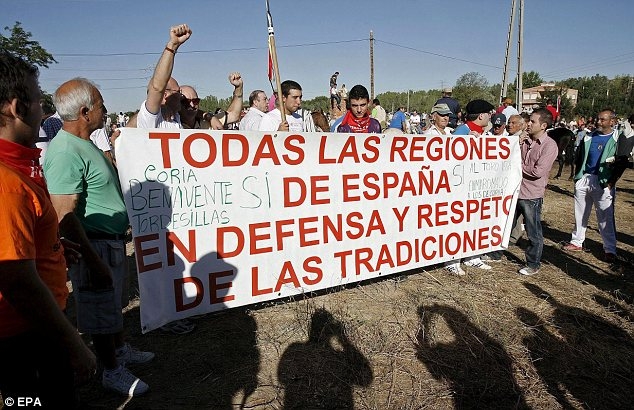
Animal welfare campaigners fear that if the blood fiestas gain the official European seal of approval then the EU will start pouring even more money into them. Ironically, just as MEPs are calling for enhanced support for bullfighting and blood fiestas, the Spanish are increasingly turning against them. One recent poll found that 60 per cent of people opposed bullfighting. Another suggested that only a quarter had any interest in it and that such support is largely confined to older generations. This gradual shift in attitudes came to the fore in July when Catalonia’s regional parliament voted to ban bullfighting. The ban has shocked many old school Spaniards who are keen to dismiss it as no more than a bid by the independent-minded region to carve out its own distinct identity. They insist that bullfighting and blood fiestas such as the Toro de la Vega are not cruel. Instead, they claim that it’s a beautiful form of art that is central to Spanish culture.
When I watched Platanito die last week I saw no evidence of the beautiful art and rich culture that Spain is famous for.
What I saw was a celebration of mob rule, of cruelty, of wickedness, even.
As I watched Platanito’s eyes close for the last time, I felt sick to my stomach to know that I had helped pay for his death with my taxes — just as you had too.
Filed under: CAMPAIGNS - Global Animal Welfare Issues, GENERAL NEWS - International / National / Regional, LETTERS | Leave a comment »