Opinion: Mark Smith: Cruel and unjustified: the legal case against the Scottish Government that you might not have heard about
There’s an important case coming up at the Court of Session in the next few weeks, but when I phoned the Scottish Government to find out more, they told me it would be inappropriate to talk about it. I disagree. The fact that the case is happening, and the fact that the Government is defending it, is infuriating and depressing and we should definitely talk about it and I hope to God the Government loses.
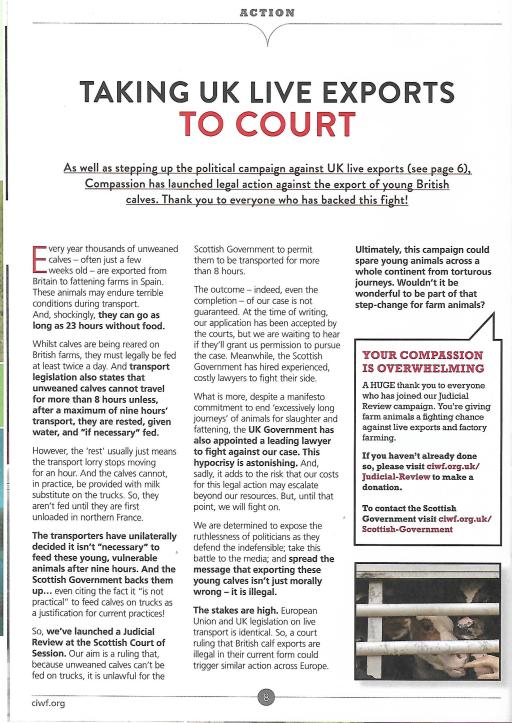
The issue at the heart of the case is animal welfare, specifically the welfare of young calves, and it’s important because it raises several moral and political questions. First: how should we treat farm animals in Scotland? Second: do we want Scotland to have the highest standards because if we do, why is the Scottish Government allowing a practice that’s no longer happening in England? And third: will we learn lessons from Covid? Because in Scotland we still disrespect animals in ways that have spread disease in the past and could do so again in the future.
I have to say here that, until I started looking into this case, I hadn’t properly realised Scotland was still persisting with a practice that became such an infamous issue 30 years ago. You may remember it: in the 90s, half a million male dairy calves were being exported from the UK every year, mostly for veal, but the dairy industry eventually realised – thanks to a campaign against the practice – that their image was suffering and the number of exports dropped dramatically.
However, the trade does still continue and I’m sad to say that for the last three years the only place in Britain where it’s been happening is Scotland. Since 2017, more than 12,000 calves have been exported from Scotland to Spain where they are fattened for beef. The calves are usually taken from their mothers on their first day of life and loaded on to the trucks at two weeks old. Many other male calves are shot at birth (in the UK, about 95,000 a year).
Ah but wasn’t there a whole scandal about this a couple of years ago and didn’t P&O say they would stop carrying calves from Scotland? True, but the Scottish Government remained supportive of live exports and, after P&O made their decision in 2018, the industry switched its tactics. So now, instead of going by boat from Cairnryan, the calves are driven to Ramsgate where a ship, chartered by the exporters, takes them to France and then by road to Spain.
Which is where the court case comes in. The petitioner in the case is Compassion in World Farming, the organisation that campaigns for better farming standards, and their argument is that, in allowing the export of calves to Spain, the Scottish Government is breaking the law. The Government disagrees and has appointed a QC to fight the case, although exactly what their defence will be we don’t yet know.
What the law says is that unweaned animals should not be transported for more than eight hours unless, after nine hours, they are given water and if necessary fed. Now as far as we know, after eight hours or so, the calves from Scotland are stopped at a motorway service station in Essex and the automatic watering system in the trucks is operated. But each truck is tightly packed with up to 250 calves and no one goes on board to check if all the calves take the water. Chances are many don’t.
As for feed, what calves of that age receive is milk or a milk replacement, but the trucks don’t have the facilities for that so for the entire journey to France (23 hours or so), they will not be fed. What the Government may argue – and it would be a pretty lowdown argument if they try it – is that it’s not necessary to feed the calves. But calves of that age feed at least twice a day (and if they’re with their mothers, a good deal more) and the schedule of documents sent to the Court of Session includes an unequivocal statement from Professor Donald Broom, the UK’s foremost authority on animal welfare: it is necessary to give milk or milk replacement to calves that have been transported for eight or nine hours.
Compassion in World Farming say the Scottish Government has also tried to argue – surprise, surprise – that the problem arises in England and when I got in touch with the Government, they said it would be inappropriate to comment while legal proceedings were ongoing. They did, however, say they were committed to consulting on the recommendations of the Farm Animal Welfare Committee, which includes a nine-hour limit on journeys for calves. “Our preferred policy intention,” said the spokesman, “is not to support unnecessary long journeys involved in the export of livestock.”
But a statement like that raises more questions than answers. First, why support exports anyway – the UK imports a lot of beef so why not use the male dairy calves for beef in this country? Secondly, even if you think live exports are a good idea, why fight a case over a time limit you say you support? And thirdly, is the fight really worth it? The calves being exported represent the rump of an industry that isn’t even economically significant any more. Do we really want to be the last place in Britain where this happens?
And perhaps the fact that the case is happening in the middle of a pandemic should also give the Government pause for thought. If you haven’t watched the recent webinar with the celebrated primatologist Jane Goodall, I recommend it. She didn’t hold back. Humans have brought coronavirus on ourselves, she said, because of our disrespect for animals that have been pushed closer into contact with each other, and they’ve been pushed closer together in markets, on intensive farms, and in trucks parked up at motorway service stations in Essex.
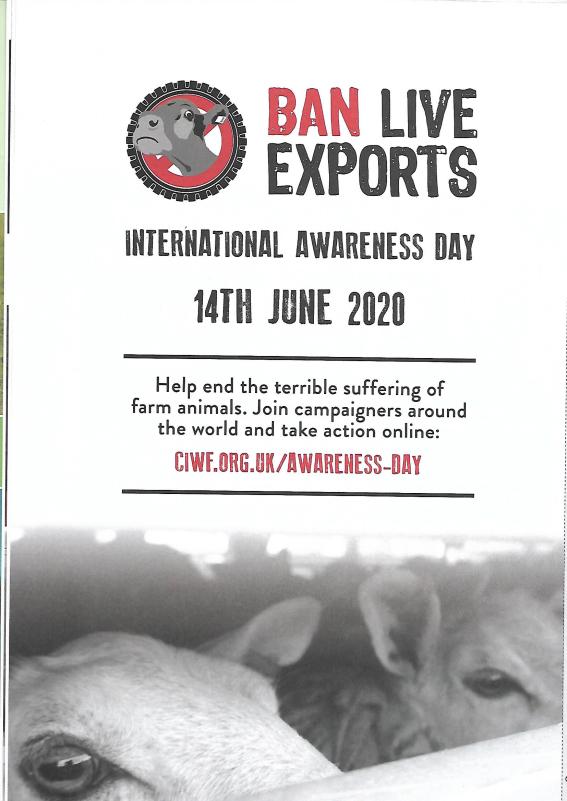
So what happens now? The case against the Scottish Government is due to be heard on August 4th and campaigners on animal welfare will be keeping a close eye on it. There’s also an awareness day on live exports this Sunday. The aim, in the end, is to stop live exports all together and the hope is that the Scottish Government will show some sense. What we’re realising is it may take a judgment of the Court of Session to make that happen.
Posted on June 9, 2020 by Serbian Animals Voice (SAV)
In September 2009, this picture had caused outrage, anger, and numerous petitions worldwide.
It comes from a town on the island of Crete, Greece, and shows a pitbull puppy bathed in blood because a shit teenager, his owner, cut off his ears with the sheep scissors!!
The then 19-year-old budding murderer had proudly published the crime via FB and was therefore caught.
Nobody knows whether he was punished.
What is known is the great happiness of the mutilated dog.
He was adopted in Sweden three years after the torture.
Today he has a nice family on his side, people who were then attentive and sensitive to his fate via Facebook and adopted him.
The video says it all.
And I mean…Nothing works more than a victim who has survived torture and murder.
A surviving victim is a sting in the flesh of the violent offender.
Hundreds of thousands of evil Facebook comments will never be able to develop as much strength against the psychopath as the pictures of happy, beautiful and characterful animals that were saved and finally get the opportunity to show who they are.
Posted on June 9, 2020 by Serbian Animals Voice (SAV)
We have not forgotten!
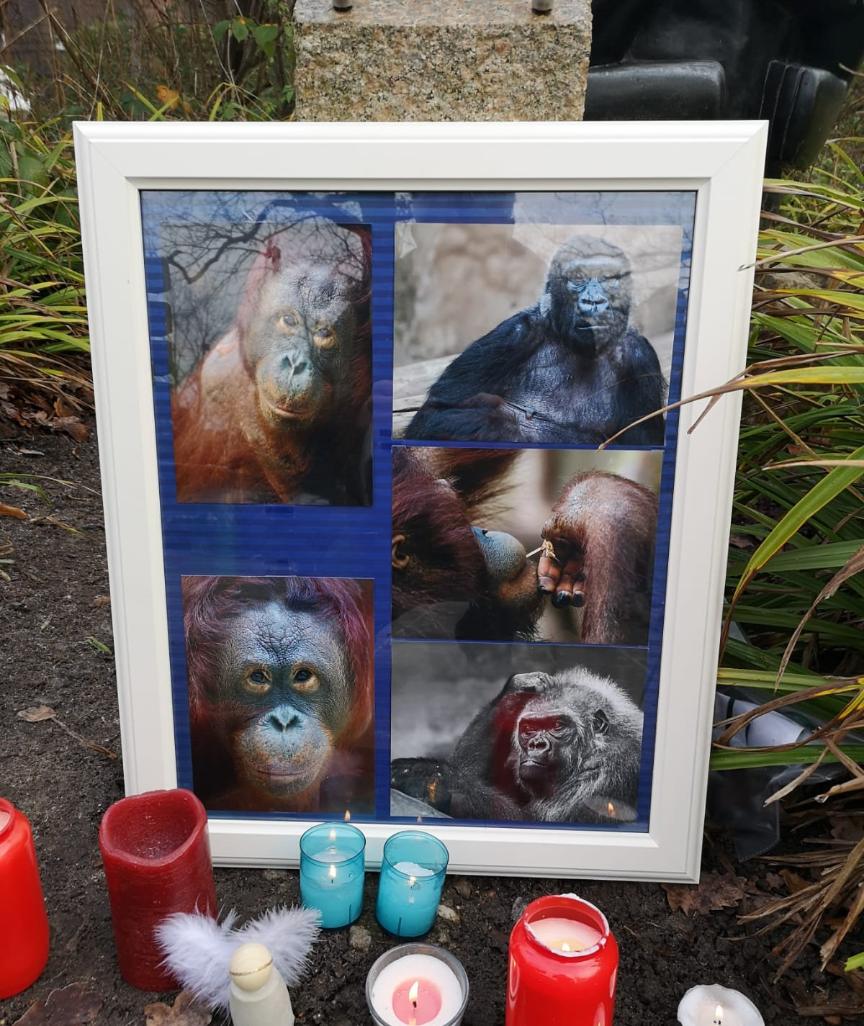
Over 50 animals died on New Year’s Eve when the monkey house in the Krefeld Zoo (Germany) burned down.
The zoo presented its new construction plans on Thursday: A new monkey prison is to be built for over 20 million euros, in which even more animals than before are to be locked up.
Please help us to prevent the construction of a new monkey house in the Krefeld Zoo!
The zoo director in front of the burned monkey house
Shortly after the devastating fire, those responsible for the zoo announced that they were planning to build a new monkey house and that they also wanted to keep apes.
Please appeal to the mayor, the members of the city council and the zoo to refrain from building a new monkey house and instead to transfer the donations to species conservation projects that use the money to protect large areas of the natural habitats of great apes in Africa and Asia in the long term, and thus theirs Can secure the future.
Gorilla Massa
Police officers armed with machine guns were on standby during the extinguishing work to kill any animals that were fleeing or panicking.
Only after the extinguishing work was finished were two seriously injured apes discovered in the burned-down monkey house in the morning.
The orangutan lady was released by an overdose of sedative by a veterinarian.
The sedative did not work for gorilla man Massa. He was ultimately killed by a police officer with multiple shots from a machine gun.
For Massa that was the end of a long-suffering.
Please sign our petition to the zoo and the mayor and city council members of the city of Krefeld.
Shortly after the fire, the zoo director announced that a new prison for these intelligent animals should be built.
The Krefeld Zoo received donations of EUR 1.43 million shortly afterward!
Behind this lies the ideology (and desire) of an indifferent society for the monkey’s enslavement with the ridiculous reason of “protecting species”.
In reality, it is no different than the desire for fun and entertainment with primates, which are similar in behavior to us, and therefore suitable for the pastime of Sunday visitors at the zoo.
All those who donated to the construction of the new monkey house are illiterate and indifferent proletarians who believe that slavery is a species-appropriate stance for monkeys and are therefore proud to have co-financed the slave house and its slave owners.
Posted on June 8, 2020 by Serbian Animals Voice (SAV)
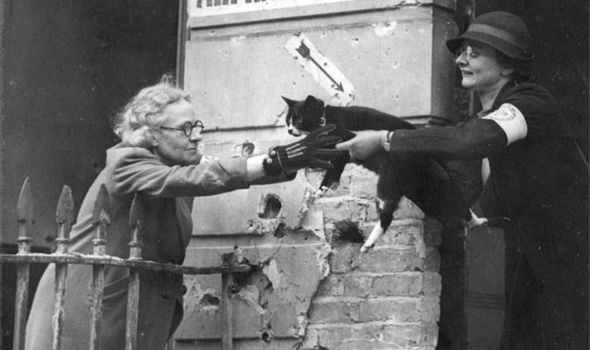
On September 3, 1939, British Prime Minister Neville Chamberlain announced to the BC that Britain had declared war on Germany.
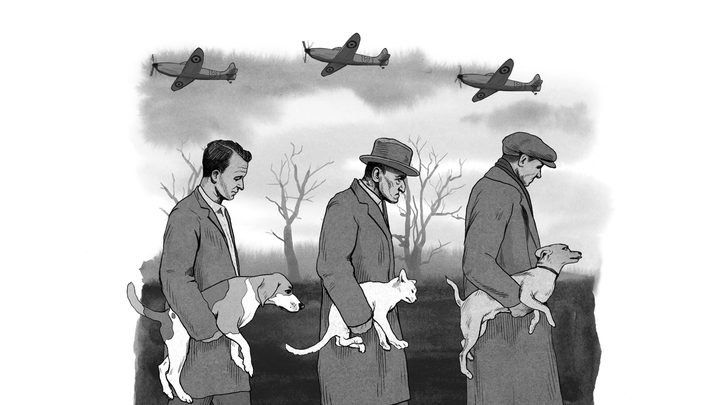
At that moment something happened that almost no one has ever mentioned. Without the authorities’ requests, around 400,000 dogs and cats (26% of the animals that lived with their families in London) were sacrificed in the first four days of World War II.
Pets were dying all over the city these days. Veterinary clinics and animal shelters were busy with an unprecedented extermination facility. A large operator ordered night shifts because the work could not be done otherwise.
People had brought their favorites here to have them killed. Hundreds of the citizens stood neatly lined up in front of a small animal shelter in north London.
Cats and dogs were waiting with them. Life ended here for the animals.
The dog protection association ran out of chloroform to put to sleep; the helpers had to electrocute the dogs.
Many companies soon no longer knew what to do with the carcasses. Most of them were taken to a large sanatorium for animals that had offered a meadow on its grounds in an emergency.
Today there is not even a plaque to commemorate the mass grave. How did the pet massacre, this collective hysteria, come about in a country that sees itself as fond of animals?
And I mean…It should be noted that this great massacre took place long before the bombing of London began, long before the people really felt the effects of the armed conflict.
It was not an inevitable result of the war, but an individual decision that became collective.
But perhaps what’s most shocking about this unprecedented mass action was that none of it was done out of any real necessity.
Rather the owners took the fateful decision to have their pets euthanized because they believed they were doing the best by their animals.
Somehow, the memory of how hard dogs and cats suffered during the First World War triggered this collective madness as soon as it became known that a new war was coming.
People would rather do that than see their animal starve.
This mass killing of pets is a tragic and shameful episode in history, but at the beginning of the corona pandemic, almost 90 years after the London massacre, the same massacre is taking place across Europe.
In China, there were many pets that were sold or given away, in Germany many farm animals were killed or gassed, and mass death still threatens zoo animals everywhere.
Back then it was the war, today Corona is the cause.
It is always the weak one, these without rights, the voiceless, who falls as the victim.
The story repeats itself, but human animals are not capable of learning.










 Serbian Animals Voice (SAV)