Posted on September 23, 2020 by Serbian Animals Voice (SAV)
respiratory – Google Search
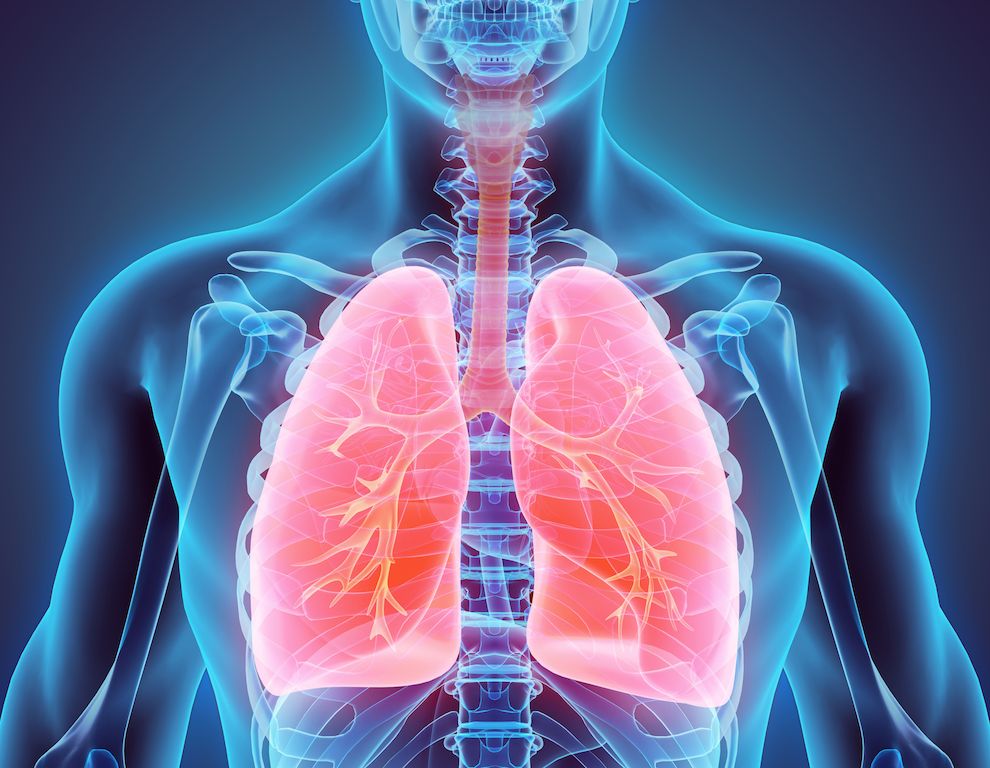
Tackling respiratory diseases with advanced non-animal models
21 September 2020
A new JRC study describes almost 300 non-animal models used for research on respiratory diseases and the development of new drugs and therapies.
Respiratory diseases such as asthma, chronic obstructive pulmonary disease (COPD), cystic fibrosis, pulmonary fibrosis and lung cancer are the most common of all diseases and causes of death worldwide.
However, over 90% of new candidate drugs fail to make it through clinical trials and gain market approval. Although there are several reasons for this, limitations of animal models to capture critical aspects of human physiology and disease are being increasingly cited as a critical issue.
Attention is shifting therefore to non-animal models and methods based on human relevant tools and thinking to advance our understanding of respiratory diseases and offer new hope to patients.
The study, coordinated by the JRC’s EU Reference Laboratory for alternatives to animal testing (EURL ECVAM), has produced a unique knowledge base that contains detailed descriptions of nearly 300 non-animal models being used for respiratory disease research.
The knowledge base is in an easy-to-use spreadsheet format and is freely available to download from the EURL ECVAM Collection in the JRC Data Catalogue.
In building the knowledge base, over 21,000 abstracts from the scientific literature were screened and from these, a total of 284 publications were selected that described the most representative and innovative models.
“To our knowledge this is the first time that such advanced non-animal models used in biomedical sciences have been systematically collected and analysed”, comments JRC scientist Laura Gribaldo. “It’s been a real challenge to put all the information together in a structured and easily accessible format since there is a huge amount of heterogeneous data out there spread over a plethora of different scientific journals and electronic resources.”
To our knowledge this is the first time that such advanced non-animal models used in biomedical sciences have been systematically collected and analysed.
From our live export campaigner friends at SAFE in New Zealand:
Kia ora Mark
Tens of thousands of animals have died in live export disasters over the last decade.
Animals are exported alive from New Zealand for breeding due to a loophole in our law. These animals are transported in dangerous conditions on open sea voyages or by air. When they reach their destination, they are likely kept and slaughtered in ways that are illegal in New Zealand.
Live export is not worth the suffering.
SAFE has launched an ambitious international campaign to put pressure on Labour leader Jacinda Ardern to impose a complete ban on all live export.
This advertisement is running in the Guardian online and will be seen by hundreds of thousands of readers across the UK and Europe.
Jacinda Ardern is known around the world for being a good leader and in Aotearoa New Zealand for putting kindness at the forefront of her values. Sadly, that kindness does not extend to animals.
The appalling human and animal suffering that happened when the Gulf Livestock 1 sank cannot happen again.
Jacinda Ardern needs to know just how many people care about animal welfare, and that the world’s attention is on how New Zealand handles this disaster. Our international reputation depends on it.
SAFE has run an advertisement in the Guardian newspaper so that people around the world can ask Jacinda Ardern to extend her kindness to animals and ban live export once and for all. You can help by sharing this advertisement with your friends and family via email and social media.
Share the advertisement now:
This year, approximately 65,000 cows have left our shores. There are significant risks to the welfare of farmed animals transported by ship, especially over long distances. The Pacific Ocean is renowned for rough seas that can cause the cows to suffer seasickness and be thrown around and injured. The rough seas, unnatural diet, high stocking densities and heat stress all have a negative effect on these animals, with some suffering injuries and others dying on board.
Once the journey is over, they may well end up confined in concrete factory farms for the rest of their lives, never to set foot on grass again. Then, when no longer deemed profitable, these cows will be killed, most likely by methods so cruel they are illegal in New Zealand.
We need to keep up the opposition to this cruel trade, and we can’t do it without you. Please make a gift today towards SAFE’s international campaign so we can continue to shine a spotlight on New Zealand’s cruel live export trade.
Animals need us to all work together to end their suffering.
Posted on September 22, 2020 by Serbian Animals Voice (SAV)
Bullfight in Esquivias endangers public health!
This summer we have not stopped working for animals.
In addition to holding street protests in the main cities of Spain, we have infiltrated the bullfights that continue to be organized, despite the health crisis.
We were witnesses of savagery in Salamanca and denounced.
And now we bring to light these images of the bullfight on August 21 in Esquivias(Toledo).
We have placed the corresponding complaints in the hands of the authorities.
It broke our hearts to witness the Forajido killed in the square.
There is no greater pain than seeing a helpless and bewildered being suffer, unsuccessfully seeking the help of those who applaud every time he bleeds.
We believe that it is important to make these images known, no matter how harsh, so that his death is not in vain.
We live days of uncertainty in a country in crisis and some prefer to continue torturing animals to death instead of working for better normalcy.
Did you know that extraordinary items are still being allocated to rescue bullfighting?
They touch 7.3 million euros and Madrid leads the ranking of the communities that will give the most money to the sector, with up to 4.5 million euros.
It is outrageous!
We are working so that bullfighting is condemned by society and its rejection increases.
Only by joining forces can we ensure that it continues to decline and achieve its abolition once and for all.
Only with you, we are stronger! We need your help now more than ever to confront the powerful bullfighting lobby in Spain.
And I mean…“If bullfighting is an “art form,” then so are ritualistic cult killings. If bullfighting is “authentic religious drama,” so too is war and genocide. If the matador is ennobled, let us praise every mass murderer” (Steven Best)
The European Union does not pay extra agricultural subsidies for bullfighting. But part of their annual 30 billion euros in direct aid for agricultural land in the EU Member States also goes to farms that breed fighting bulls.
This is known as “agricultural subsidies”!
Official figures are not available. The Greens estimate that annual subsidies of 130 million euros go to bullfighting.
This is subsidized animal cruelty – nothing less.
Perhaps someone will soon come up with the idea of reviving the witch burnings, which were well attended in the Middle Ages and very popular by bored audiences.
This was also a sad culture in Spain!
Except for a few mentally weak proletarian Germans and a few brain-sick Europeans, this form of “culture” really doesn’t even resonate with the dumbest of the very dumb.
We can be sure that every day there are more and more animal lovers and animal rights activists (= antitaurinos) who see this massacre as a disgrace for their country and want to abolish it.
Time is ticking for the animals and we know, it will end.
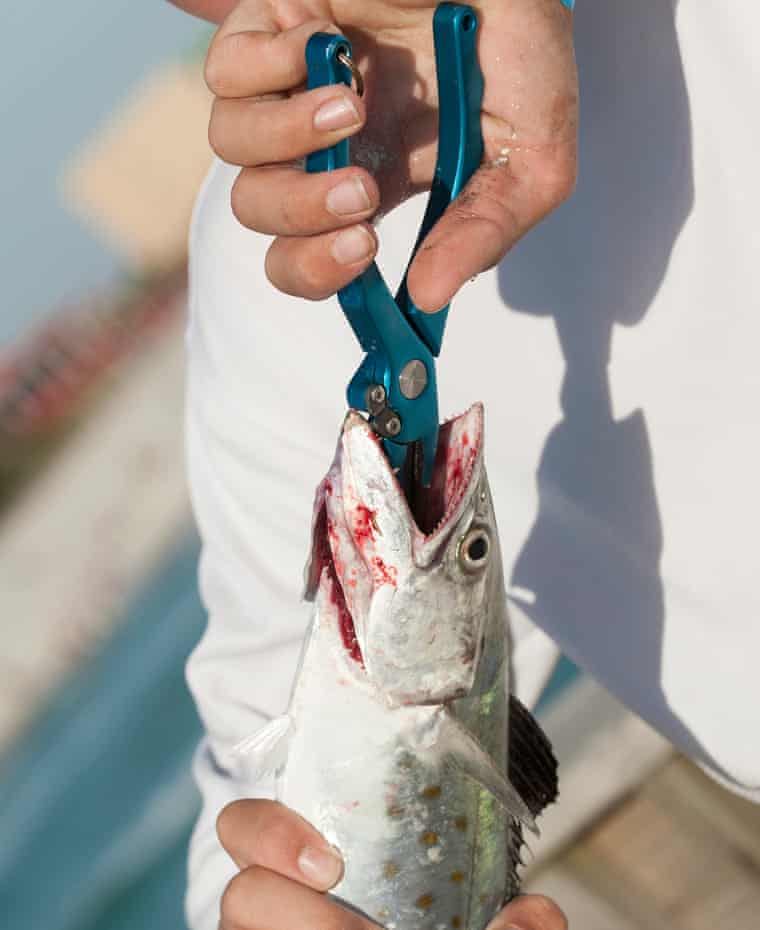
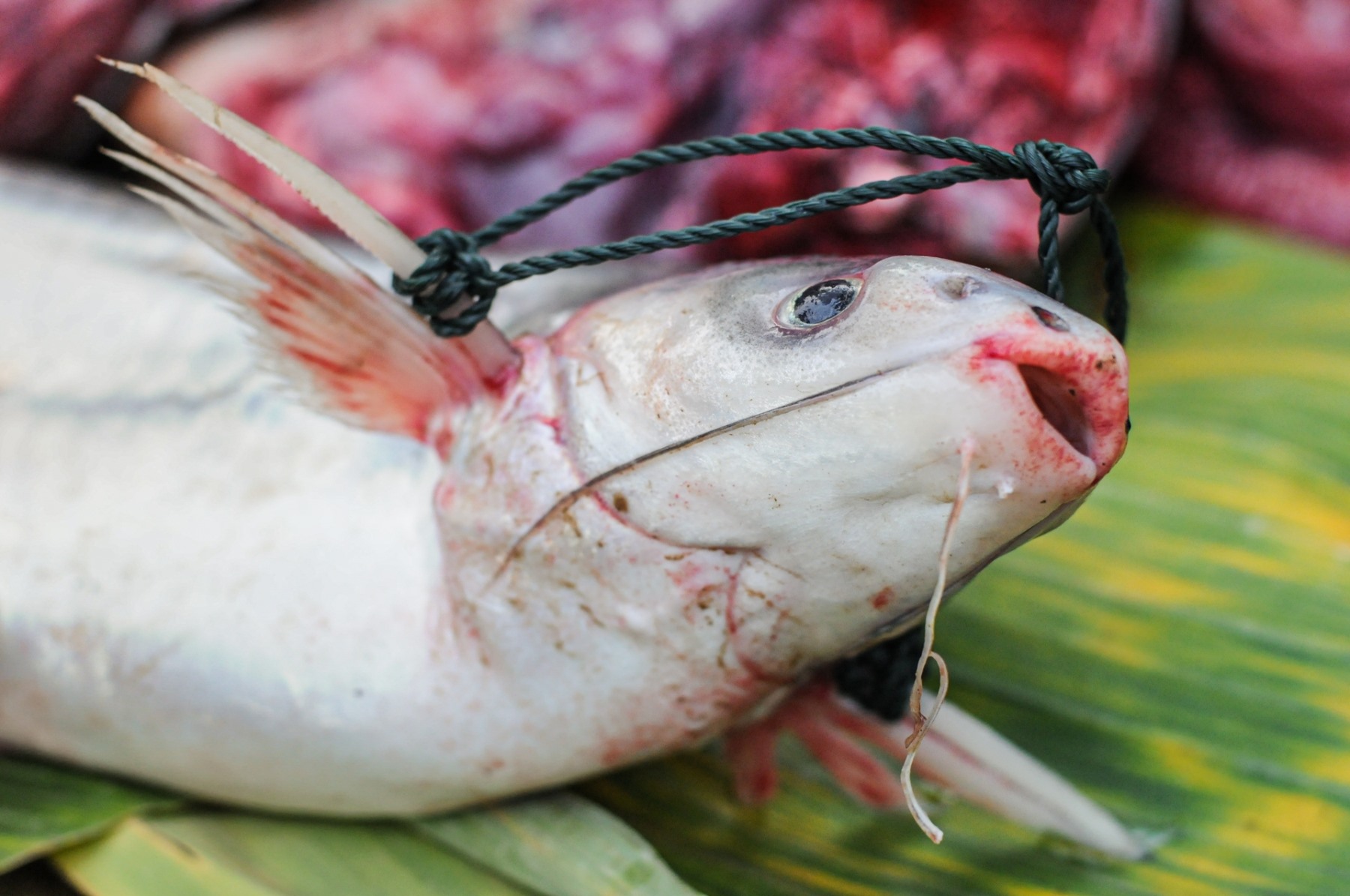
Fish don’t audibly scream when they’re impaled on hooks or grimace when the hooks are ripped from their mouths, but their behavior offers evidence of their suffering—if we’re willing to look.
Biologist Victoria Braithwaite says that “there is as much evidence that fish feel pain and suffer as there is for birds and mammals.”
For example, when Braithwaite and her colleagues exposed fish to irritating chemicals, the animals behaved as any of us might: They lost their appetite, their gills beat faster, and they rubbed the affected areas against the side of the tank.
It is hard to imagine that swallowing a bait with a fish hook in it does not feel extremely painful.
The fish also shows a terrible fidget in the video in response.
Neurobiologists have long recognized that fish have nervous systems that comprehend and respond to pain.
Even though fish don’t have the same brain structures that humans do—fish do not have a neocortex, for example—Dr. Ian Duncan reminds us that we “have to look at behavior and physiology,” not just anatomy. “It’s possible for a brain to evolve in different ways,” he says.
“That’s what is happening in the fish line. It’s evolved in some other ways in other parts of the brain to receive pain.”
And I mean…For a long time, it was said that fish had no nerves in the oral cavity and generally felt little or no pain.
But according to the latest research, this groundless belief is over.
As Dr. Lynne Sneddonfrom Liverpool University reported a year ago in the journal “Philosophical Transactions of the Royal Society B” (DOI: 10.1098 / rstb.2019.0290) that a lot of fish can feel pain – also and especially in the mouth.
It does not matter whether a fish “only” feels pain or whether it also associates an “emotion” with it.
As long as there is even the possibility that it is so (and it is highly likely), it is ethically and morally unjustifiable to subject an animal to torture purely out of ignorance and only for one’s own (useless) gain.
Humans can only afford this discussion because they are the stronger ones in the pack. Unfortunately, the “ethics of the ruler” were not only practiced by the inhabitants of Germany a few years ago.
That should be enough of a warning to never again invoke the right of the strongest for your own benefit.
Fish feel pain. And the human species is what causes it
If humans continue emitting greenhouse gases at the current pace, global sea levels could rise more than 15 inches (38 centimeters) by 2100, scientists found in a new study.
Greenhouse gases emitted by human activity, such as carbon dioxide, contribute significantly to climate change and warming temperatures on planet Earth, studies continue to show. As things heat up, ice sheets in Greenland and Antarctica melt. A new study by an international team of more than 60 ice, ocean and atmospheric scientists estimates just how much these melting ice sheets will contribute to global sea levels.
“One of the biggest uncertainties when it comes to how much sea level will rise in the future is how much the ice sheets will contribute,” project leader and ice scientist Sophie Nowicki, now at the University at Buffalo and formerly at NASA’s Goddard Space Flight Center in Maryland, said in a statement. “And how much the ice sheets contribute is really dependent on what the climate will do.”
The results of this study show that, if human greenhouse gas emissions continue at the pace they’re currently at, Greenland and Antarctica’s melting ice sheets will contribute over 15 inches (28 centimeters) to global sea levels. This new study is part of the Ice Sheet Model Intercomparison Project (ISMIP6), which is led by NASA Goddard.
The ISMIP6 team investigated how sea levels will rise between 2015 and 2100, exploring how sea levels will change in a variety of carbon-emission scenarios
They found that, with high emissions (like we see now) extending throughout this time period, Greenland’s melting ice sheet will contribute about 3.5 in (9 cm) to global sea level rise. With lower emissions, they estimate that number to be about 1.3 in (3 cm).
Ice sheet loss in Antarctica is a little more difficult to predict, because, while ice shelves will continue to erode on the western side of the continent, East Antarctica could actually gain mass as temperatures rise because of increasing snowfall. Because of this, the team found a larger range of possible ice sheet loss here.
The team determined that ice-sheet loss in Antarctica could boost sea levels up to 12 in (30 cm), with West Antarctica causing up to 7.1 in (18 cm) of sea level rise by 2100 with the highest predicted emissions.
However, to be clear: These increases in global sea levels are just predictions for the years 2015 to 2100, so they don’t account for the significant ice sheet loss that has already taken place between the pre-industrial era and modern day.
“The Amundsen Sea region in West Antarctica and Wilkes Land in East Antarctica are the two regions most sensitive to warming ocean temperatures and changing currents, and will continue to lose large amounts of ice,” Helene Seroussi, an ice scientist at NASA’s Jet Propulsion Laboratory in Southern California, who led the Antarctic ice sheet modeling in the ISMIP6 project, said in the same statement.
“With these new results, we can focus our efforts in the correct direction and know what needs to be worked on to continue improving the projections,” Seroussi said.
These results are in line with estimates made by the Intergovernmental Panel on Climate Change (IPCC), whose 2019 Special Report on Oceans and the Cryosphere showed that melting ice sheets would contribute to about one-third of the total global sea level rise.
According to the 2019 IPCC report, melting ice sheets in Greenland will contribute 3.1 to 10.6 inches (8 to 27 cm) to global sea level rise between the years 2000 and 2100. For Antarctica, the report estimates that melting ice sheets will add 1.2 to 11 inches (3 to 28 cm).
The results from this new work will help to inform the next IPCC report, the sixth overall, which is set to be released in 2022, according to the same statement.
“The strength of ISMIP6 was to bring together most of the ice sheet modeling groups around the world, and then connect with other communities of ocean and atmospheric modelers as well, to better understand what could happen to the ice sheets,” Heiko Goelzer, a scientist from Utrecht University in the Netherlands who is now at NORCE Norwegian Research Centre in Norway, said in the same statement.
“It took over six years of workshops and teleconferences with scientists from around the world working on ice sheet, atmosphere, and ocean modeling to build a community that was able to ultimately improve our sea level rise projections,” added Nowicki, who led the Greenland ice sheet ISMIP6 project. “The reason it worked is because the polar community is small, and we’re all very keen on getting this problem of future sea level right. We need to know these numbers.”
This work was published Sept. 17 in a special issue of the journal The Cryosphere.
A 12-storey pig farm: has China found the way to tackle animal disease?
21 September 2020
Biosecure farms complete with staff quarantine and chutes for dead pigs are seen as progress, but may carry their own risks.
The buildings do not even look like farms. They are huge grey concrete blocks, many storeys high, which stand side by side in the middle of what might look like a quarry, a “hole” of red earth dug in the heart of a mountain.
We are on the Yaji mountain, which in Chinese means “sacred”, a few kilometres south of the city of Guigang in southern China. What we are looking at is the tallest pig farm in the world; units up to nine storeys high housing thousands of pigs, with construction of a 12-storey pig unit under way.
“On each floor we can breed 1,270 pigs,” says Yuanfei Gao, vice-president of Yangxiang, the company that built the farm. “But in the future with the design of the new buildings we plan to have 1,300 pigs per floor.”
Yangxiang is one of the Chinese giants of the pork industry, producing about 2 million pigs a year in a dozen farms throughout China. The Yaji mountain site is its largest and most advanced multistorey farming system, and will have the capacity to produce around 840,000 pigs a year when construction is finished.












 Serbian Animals Voice (SAV)