Posted on September 23, 2019 by Serbian Animals Voice (SAV)
Report from “Committee against the bird murder e.V”.
War against train birds in Lebanon: In the first days of the large committee bird protection camp in Lebanon, our teams have already observed hundreds of hunters who, without regard to and in violation of the hunting law, have attacked everything within reach of their guns.
Not far from the city of Danniyeh in the north of the “Cedar State”, a committee team witnessed a true migratory bird massacre: Hunters had set up electronic decoys with goat-song singing during the night and shot at the birds with the help of giant spotlights.
Hundreds of shots were fired without the police intervening.
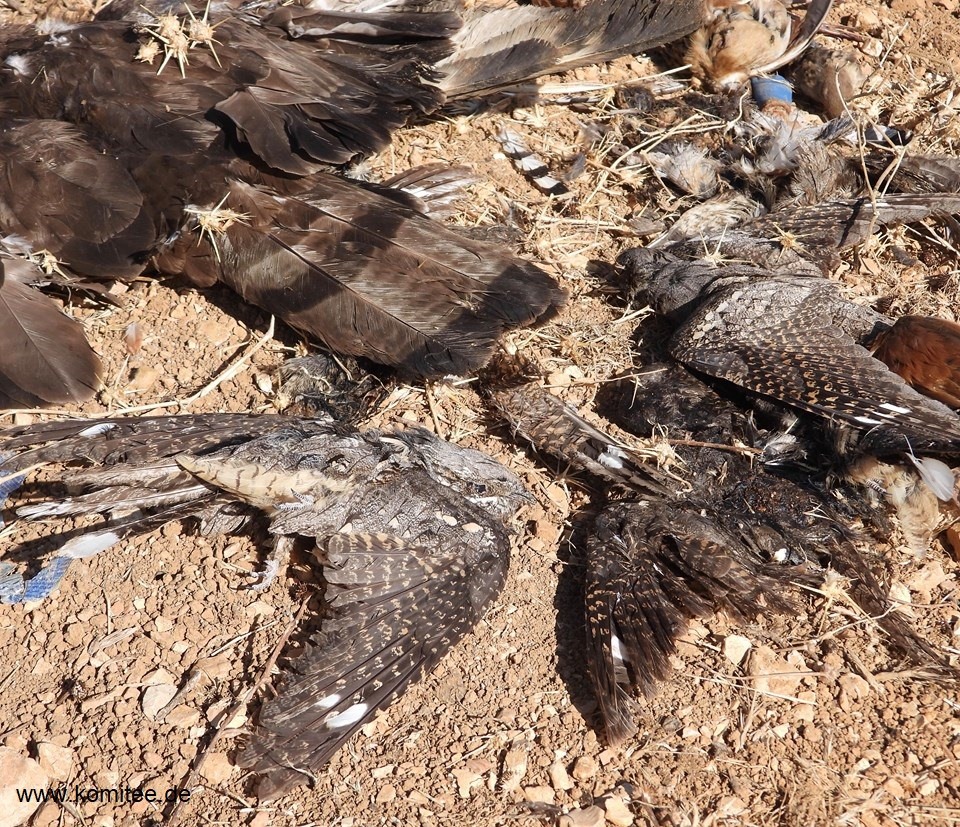
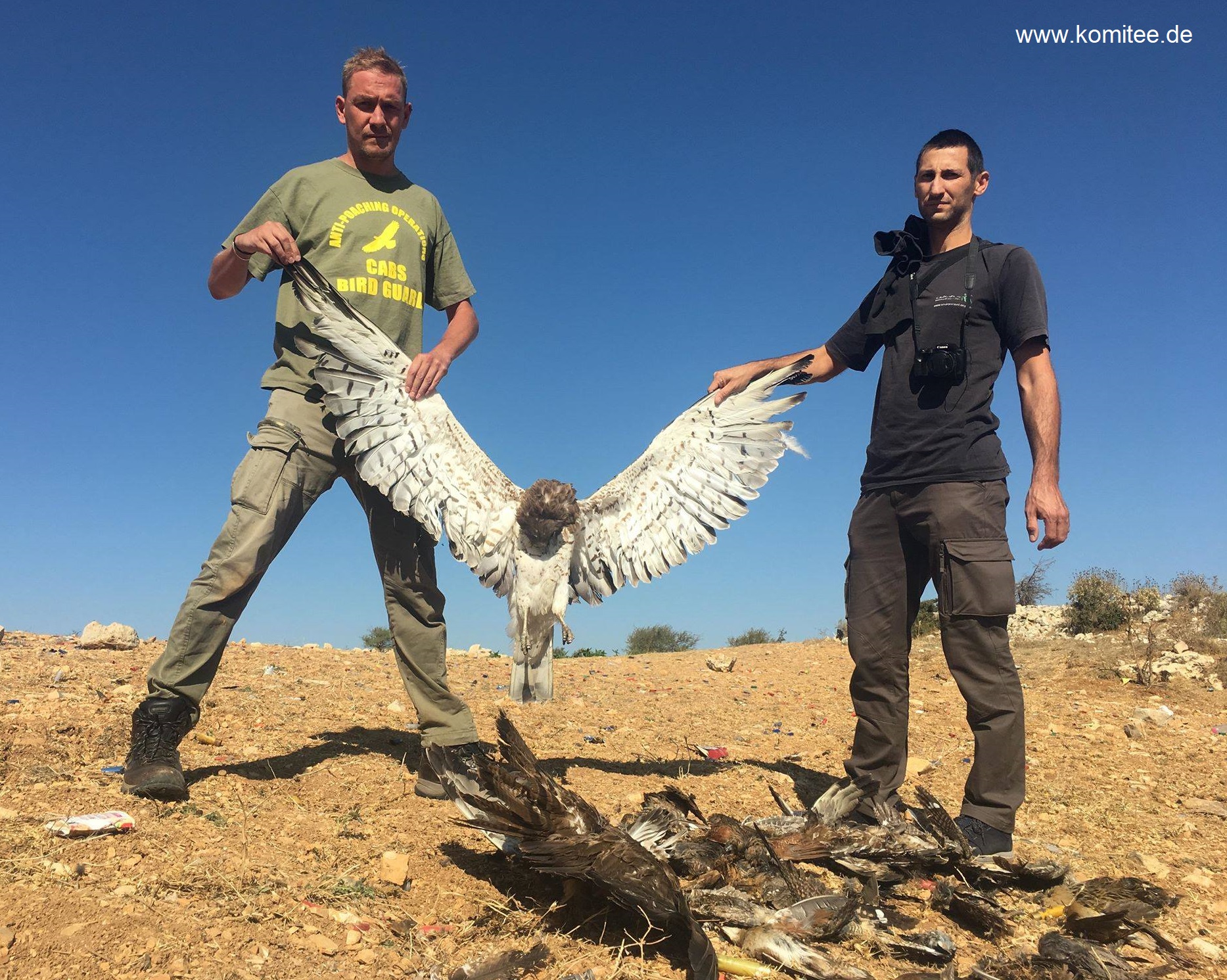
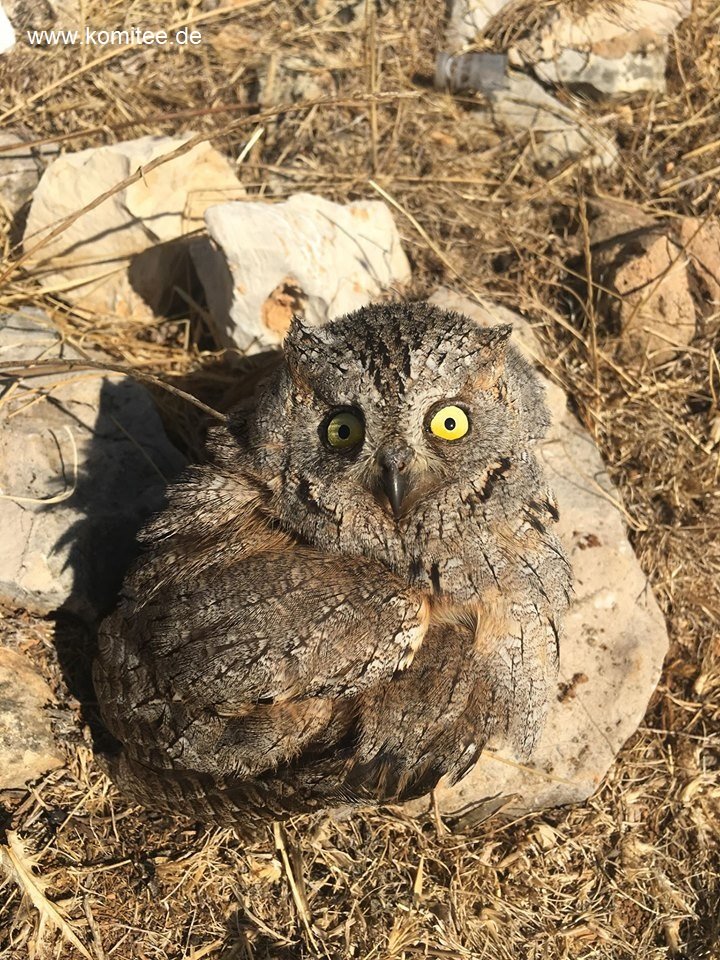
As dawn set in, we inspected the area and found dozens of dead birds – especially goat’s milkweed, scops owls and a short-toed eagle (see current photos).
One of the owls was still alive, but died shortly thereafter of their serious injuries. The committee and its partners SPNL have today called on the government to significantly expand its efforts against poaching to tackle this ecological catastrophe!
My comment: Every year tens of millions of migratory birds are killed.
In Lebanon, in Cyprus, in Malta … Exhausted from the journey that lies behind them, the birds there look for a shelter to rest. The murders exploit this moment and shoot the animals up close.
The result: Every year environmental activists read about 25 million empty cartridge cases.
German companies earn money with weapons and ammunition beautiful with.
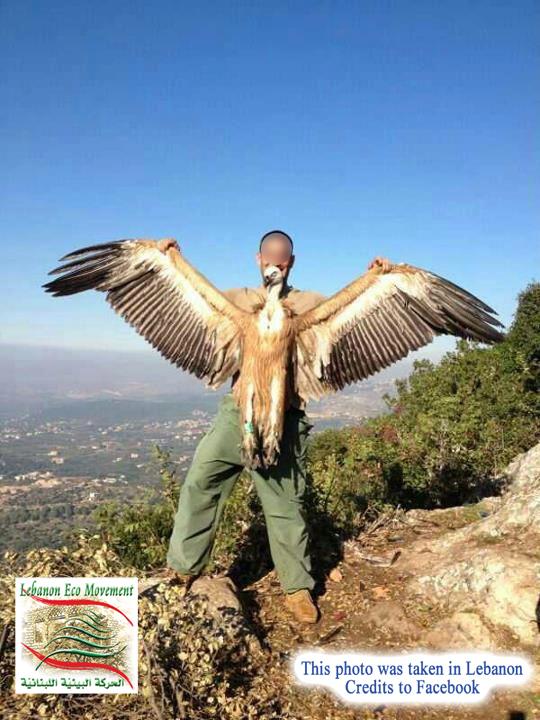
Machismo culture plays an important role in poaching: men proudly pose in photographs with their trophies taken. The bigger the better. Many upload the pictures on social networks.
These crimes continue to take place with the help of an offender-friendly system and of course of a society that claims to be “tolerant”, which is nothing but cowardice openly to condemning these crimes.
Posted on September 23, 2019 by Serbian Animals Voice (SAV)
Bigotry begins when categories such as race, age, gender, sex, sexual orientation, or species are used to justify discrimination.
Speciesism—like sexism, racism, and other forms of discrimination—is an oppressive belief system in which those with power draw boundaries to justify using or excluding their fellow beings who are less powerful. A human supremacist line of “reasoning” is used to defend treating other living, feeling beings like research tools, fabric, toys, or even food ingredients—even though they share our capacity for pain, hunger, fear, thirst, love, joy, and loneliness and have as much interest in freedom and staying alive as humans do.
From childhood, most humans are conditioned to view certain species as worthy of care and compassion and others as less important or unworthy—based on arbitrary human preferences. This toxic view also leads humans to draw groundless distinctions between animal species based on the worth of those animals to them. Consider the following examples:
Animals are often referred to as property. Many humans call themselves an animal’s “owner” and refer to the animal as “it,” as if he or she were an inanimate object like a table or a chair.
Most humans wouldn’t dream of keeping their dog in a cramped, crowded warehouse on a slab of filthy concrete, which is the way pigs are treated in the food industry—even though pigs are able to experience the same pain, joy, fear, and misery that dogs can.
Some people wear coats trimmed with fur from coyotes or stuffed with feathers pulled from a screaming goose, but most of them would never consider tearing fistfuls of fur out of a crying kitten’s back with their own hands.
Many people judge other cultures for eating dogs or poaching wildlife while willfully turning a blind eye to their own cruel habits—as if eating other animals or hunting deer were any different.
It’s speciesist to believe that the differences between humans and other animals are enough to warrant torturing and killing those we don’t relate to. It’s speciesist to think that we are superior and are therefore somehow justified in raping, caging, and mutilating animals who don’t look exactly like us. It’s speciesist to exploit others because we don’t understand them fully or at all, to assume that they’re not as intelligent as we are when we measure their intelligence in human terms, and to dismiss their suffering because it benefits us.
Whether we have feathers or fur, skin or scales, we’re all able to experience complex feelings such as love, sadness, pain, and joy and we all have a will to live—these things are not unique to humans. Consider these examples:
Elephants and chimpanzees will mourn and shed tears if a member of their family dies.
Mother cows will walk for miles to find their stolen babies.
Many orcas stay with their families for life in the oceans.
Rats willingly put themselves in harm’s way to save others.
Fish like physical contact with other fish and often gently rub against one another—in the same way that a cat weaves in and out of your legs.
Help end speciesism by pledging to recognize that animals are not ours to use or abuse and that all living, feeling beings deserve to be treated with respect and compassion.
Take PETA’s Cruelty-Free Shopping Guide along with you next time you head to the store! The handy guide will help you find humane products at a glance. Order a FREE copyHERE
Searching for Cruelty-Free Cosmetics, Personal-Care Products, Vegan Products, or more? Click HERE to search.
Want to do more than go vegan? Help others to do so! Click below for nominal, or no, fees to vegan literature that you can use to convince others that veganism is the only compassionate route to being an animal friend:
Posted on September 22, 2019 by Serbian Animals Voice (SAV)
Isn’t it surprising to think just how beautiful and raw nature was a few million years ago, and how it has changed into something that the world is worrying about, now?
It’s astounding to see how humans have evolved and emerged on one hand and have managed to put our mother Nature in such grave danger, on the other.
And… I can imagine (almost) no other politically effective action, which as only one creates so much, as the vegan way of life. With just one thing, not eating meat, we can do a lot of things well for our planet.
Posted on September 22, 2019 by Serbian Animals Voice (SAV)
A PETA Asia investigation uncovered horrific abuse in Kenya’s donkey slaughter industry, which exists only to meet China’s demand for ejiao, a traditional Chinese medicine.
Workers cruelly beat donkeys before they’re taken to the abattoir to be slaughtered – all so that their skin can be boiled down to make the gelatine used for ejiao.
Many donkeys are transported to these facilities by lorry – forced to endure a gruelling trip that can take several days, during which the animals are deprived of both food and water.
Eyewitnesses found dead donkeys who hadn’t survived the torturous journey abandoned outside an abattoir. One donkey on a lorry appeared to be injured and was unable to stand up. Workers dragged her out, dumped her at the facility’s front gate, and kicked her.
Mark, we believe this cruelty must be stopped. Do you agree?
If so, please urge Kenya’s cabinet secretary for agriculture to ban all donkey abattoirs:
Posted on September 22, 2019 by Serbian Animals Voice (SAV)
By 2030, food production will undergo radical change. The “RethinkX think tank”anticipates dramatic changes especially in meat production.
The think tank expects that food produced on a herbal and microbiological basis over the next ten years will gain huge market shares – and that traditional meat and milk production will face equally great losses. That’s why the number of cattle in the US will halve by 2030, forecasters predict in their analysis “Major disruption in food and agriculture in the next decade”.
Sales of the beef and dairy sector, amounting to around US $ 400 billion at present, will at least be halved by today’s price levels, according to the forecast.
At the same time, production costs in conventional agriculture will double. The lower demand for agricultural goods will lead to a depreciation of agricultural land by 40 to 80 percent, because the demand for vegetable raw materials is falling.
Tony Seba,co-founder of RethinkX and one of the authors of the report, sees several developments that overlap and reinforce each other. Seba sees technological developments such as “precision fermentation” (exact fermentation) and a new production model, which he calls “food-as-software”, as the most important driver.
This would dramatically reduce the cost of protein production and increase quality.
By “precision fermentation” he means processes that allow microorganisms to be programmed to produce almost any complex organic molecule. The costs of these new procedures have fallen exponentially in recent years.
By 2025, they could drop to less than $ 10 per kilogram. By 2035, they would be five times and ten times cheaper by 2035 than classical animal proteins.
The study predicts a “creeping death” for classical animal processing. Product for product, which hitherto comes from cows, will be replaced by alternatives that are cheaper and of better quality. The drastic conclusion is that “industrial livestock will collapse long before modern technologies produce the perfect cellular steak at a competitive price.”
And here’s the sensation: Nestle starts with veggie hack
Incredible Burger is followed by Incredible Hack. The world’s largest food company Nestlé continues to hunt for Beyond Meat. The pressure of competition is growing. The latest hype on plant-based meat substitutes even Nestlé Professional serves from October 2019 with a new product.
Nestlétherefore wants to expand its meatless meat business. “We have a long list of products that we want to introduce,” said Germany boss Marc-Aurel Boersch at Media Day of the billion-dollar group in Frankfurt.
The Manager Hubert Stücke has to think for a long time. “I am now 35 years at Nestlé. Over the years, however, I have rarely experienced such dynamics in a single product, ” says the manager from the board of the German national company of the world’s largest food manufacturer. “Maybe with the 5-minute terrine or the Nescafé cappuccino.”
“The demand is huge. In the short term, we have extended production by one additional shift, ” said Garden Gourmet Marketing Manager Christian Adams.
If a competition does not take place among giants then it would be hard to very hard to expect this change based on the consumer’s decision.
This argument seems to work.
Capitalism becomes active only where there is profit.
The reason why Nestlé and other companies market the vegan range is not the love of animals.
As in the past, hatred of animals was not the reason for the sale of animal products. The profit always decides in the caritalistic economic system.
Now Nestléhas to keep up, as Beyond Meat is already making huge profits with its Veggi steak.
Nobody has anything against the fact that the manufacturers make profit with it.
We also win, because this will be a positive result against meat consumption.
This is called a win-win situation.
What is offered on the market, the consumer buys.
However, there is a risk that the giant Nestlè wants only to ruin the – in comparison – small company Beyond Meat,and therefore increases just as invasively to market competition.
And may be, once it’s done, Nestlè returns to selling animal products.
I desided for the purchase of Beyond Meat.
Finally, one can not forget that Nestlé steals the water in Africa and sells it dearly.

















 Serbian Animals Voice (SAV)