Posted on December 9, 2019 by Serbian Animals Voice (SAV)
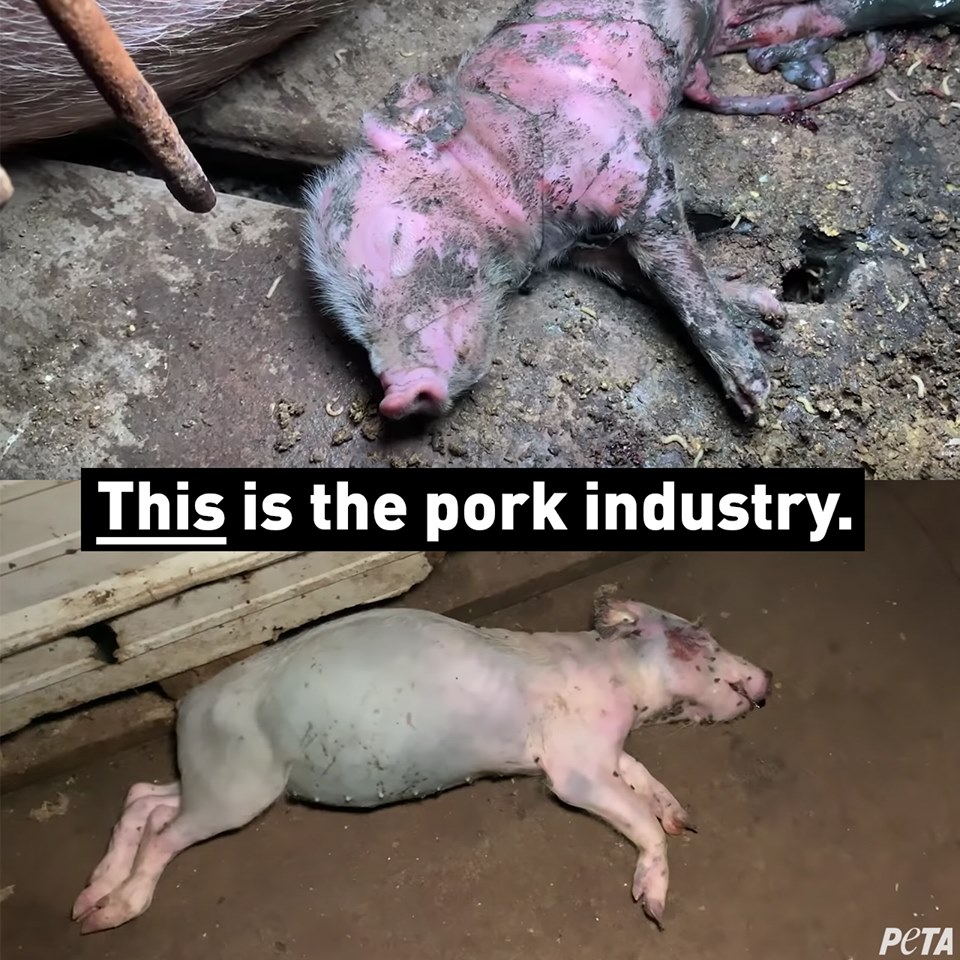
Disgusting images of industrial meat production show factory farming, animals as commodities, and hundreds of women and men doing the work to satisfy world consumer hunger for cheap meat and animal protein.
The video, apparently from China, shows the cruel reality behind meat production, its mechanization and the people involved in the process.
It makes us realize that things can not go on like this.
The filmmaker Ron Frickeis on a world tour and in his impressive video we can see in 6 minutes the madness of industrial meat, milk and egg production, slaughterhouses, supermarkets and fast food – “restaurants”, to the stomach of the consumers, wich in the end it will be removed by a plastic surgery!
The Meat Mafia works similarly all over the world, it is not only China the sinner of the meat industry.
The meat should be as cheap as possible, the profit big; To achieve these goals, every slaughterhouse in the world uses almost all means.
This system works with cheap workers who are under the pressure of a quick “completion” of the slaughter job and therefore treat animals like garbage.
In Germany, we have battle numbers of over 1,500 pigs per hour, in the run. The worker, who is supposed to prick a pig “pet-friendly”, usually has less than two seconds.
Anyone can imagine the likelihood of a mistake, which means torture and agonizing death for the animals for minutes.
As soon as these criminal conditions become known to the public, the corrupt politicians and authorities speak of an exception.
But the problem in factory farming is not the exceptions, it`s the legal framework.
Because even when criminal and illegal practices in slaughterhouses come to light, the judiciary is on the side of the perpetrators, and therefore the perpetrators are not persecuted, but those who expose these crimes.
Whether, how and when the current global animal holocaust comes to an end, is not yet foreseeable.
OPINION: Nearly 200,000 deaths by suffocation, because of a power cut. What a tragedy and a terrible way to die.
New Zealand is a nation of animal lovers. We lavish attention on our dogs, we dote on our cats, often valuing them as important members of our families.
If this tragedy had involved dogs or cats, this appalling loss of life would be the lead story on all the news bulletins and the subsequent investigation would be a topic on everyone’s minds for weeks. But when the individuals who perished in such a terrible way are chickens, it’s just a passing bit of shock news.
It is the Ministry for Primary Industries’ (MPI) job to monitor that factory farms have working emergency back-up systems. So was this farm being effectively monitored? It looks like yet again, MPI hasn’t had the resources to ensure this factory farm wasn’t breaking the law
Less than a year ago, at another West Auckland farm that was also part of Tegel’s supply chain, 50,000 birds burned to death. The details that were made public reported a lack of water available for fighting the fire.
These birds are treated as mere production units, rather than living, breathing beings. Even our Animal Welfare Act recognises that chickens are sentient, accepting that they are fully able to experience a range of emotions. Despite this, the chicken meat industry kills 125 million birds a year in New Zealand. So, the loss of 195,000 birds is presumably just a blip on their production schedules, and insurance will soften the blow.
But taking a look behind the walls of these chicken factory farms, we see that these birds suffer even when it’s business as usual.
Highly selectively bred to double in size each week, their bodies just can’t cope. According to a 2013 Ministry for Primary Industries report, up to a third are painfully lame in the last weeks of their short lives and up to ten thousand die a very stressful death of heart failure or are culled, every day in sheds across New Zealand. The Poultry Industry of New Zealand puts that figure at 6000 – but even that is 6000 individuals that are so sick and deformed that they can’t even survive to the age of six-weeks, when most are taken for slaughter.
These are the birds that are out of sight, out of mind, hidden inside barren window-less sheds. Most people only interact with one of these chickens at mealtimes. Chicken meat is so cheap compared with other meats, that it’s eaten almost without thinking by people who would be appalled if they stepped inside a chicken factory-farm.
Few people even know what one of these white-feathered, blue-eyed, overgrown baby-birds looks like.
One of these individuals is a chicken who was found in a West Auckland factory farm, trapped on her back, unable to get up. This, sadly, is something that commonly happens with these top-heavy birds. If she’d been left there she would have died, just out of reach of food and water. She would have become just another statistic among the thousands.
Instead Womble was taken to a sanctuary, given treatment for her wounds and is living the life she deserves. She has just had her first birthday, so has already lived more than eight times longer than the others left behind in the shed. Her curious, playful personality soon emerged, and her adventures are being followed by many on her Instagram channel.
Kindness and compassion are great qualities to celebrate, and we can widen the circle of our compassion to include all sentient animals. If you care about animals and don’t want to support corporate cruelty, the easy solution is to choose chicken-friendly plant-based alternatives at your supermarket and you can also email MPI, making sure it throws the full force of our animal welfare laws at Tegel for its negligence.
Together we can create an Aotearoa New Zealand that cares about all animals.
Marianne Macdonald is the head of campaigns for the animal welfare group SAFE.
Posted on December 8, 2019 by Serbian Animals Voice (SAV)
Carolin Günther(Caroletta) works as a painter and illustrator. “About Meat” is a project of the heart.
This book (“That’s how we’ve always done it”) is something for you, if you
surreal and detailed illustrations like.
are a friend of clear words and sharp poetry.
Discrimination, oppression and violence in any form reject.
In addition, the book addresses to all who
like to pet cats and / or dogs.
Chicken nuggets find great and chick-shredding stupid.
Donate to the shelter and eat meat sandwiches.
First and foremost, the illustration book “That’s how we’ve always done it” is for everyone who does it differently.
As a young child, she saw a slaughter, heard and smelled, and soon thereafter stopped eating animals uncompromisingly. That’s 30 years ago.
Today she lives completely vegan and is a public advocate for animal rights and environmental issues. Her illustration series “About Meat” was nominated for the 2018World Illustration Awards and featured in Greenpeace magazine.
Most of us lovingly caress their dog or cat and bite in the next moment in a roast sausage without the slightest glimmer, what’s actually in it, where it comes from, and what the animal looked like that had to die for it.
We can not make the connection between the sausage on our plate and the animal that was this time. Because the so-called useful animals are invisible.
Their killing takes place far behind closed doors.
To draw attention to this topic, Carolin Günther recently launched the art project “About Meat”.A main motive of the picture series is the categorization of animals in “inedible” and “edible”. All illustrations were created in classic handwork and follow a common design concept.
With each picture that came in the last few months, she grew with the desire to put it in book form. In cardboard picture book form.
Cardboard picture books explain the world and playfully promote the development of children. Maybe, that works for adults as well.
All pictures are from her picture book: “That’s how we’ve always done it”.
And I mean … such books should read children in their early age. These are books that bite and sting, although they do not receive any trace of gruesome video images.
The sooner our children learn the truth about the suffering of the animals, the greater the likelihood of alleviating this suffering of the animals.
Posted on December 7, 2019 by Serbian Animals Voice (SAV)
Updated December 6, 2019:
Following an intense campaign by PETA USA and the help of tens of thousands of supporters, the Air Transport Service Group (ATSG) has now announced that it is completing monkey transports in experimental laboratories.
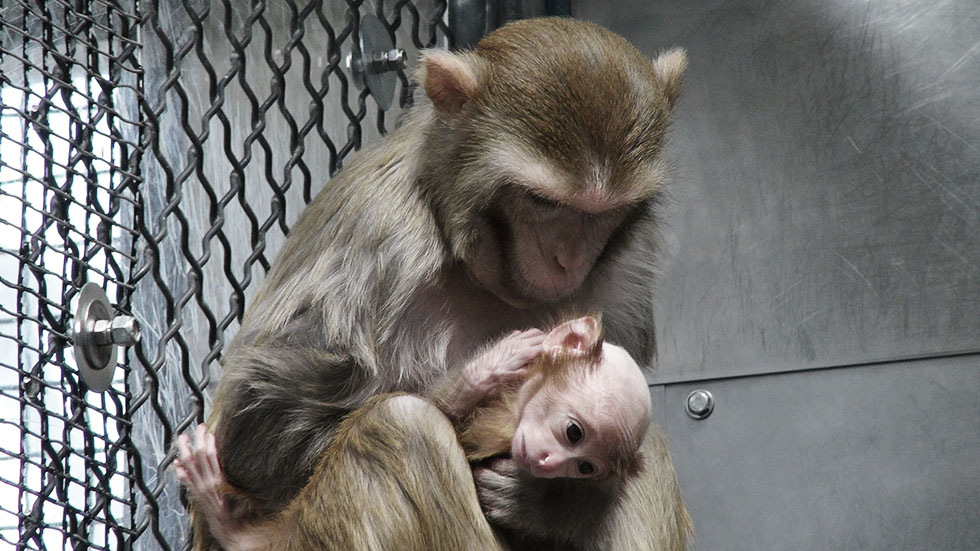
Image: Animal experiments with primates at the National Institute of Health, USA.
This announcement comes just a week after our US counterparts told Amazon to convince their current business partner – ATSG – to stop these atrocious transports.
For far too long, airlines have been making money on the bloody business of killing monkeys to their deaths. The sensitive animals are taken from countries such as China or from the island state of Mauritius, to laboratories in the United States or to Europe.
The places of origin of the monkeys offer them no protection, so they are often snatched from their homes and their families or bred in horror animal factories.
ATSG and its affiliates – Air Transport International (ATI) and ABX Air – have delivered thousands of monkeys to US research centers where frightened animals await terrible things.
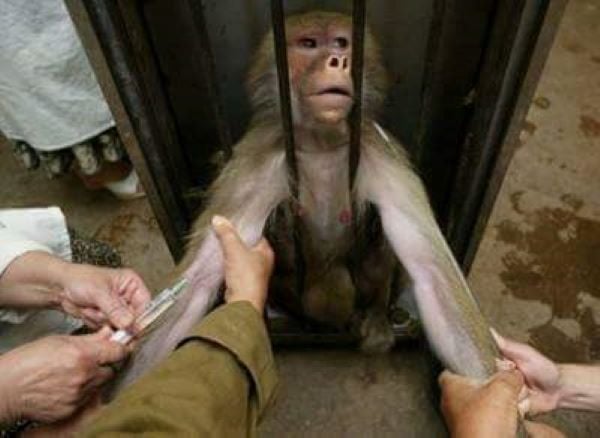
Mostly they are locked in tight cages, in the course of the experiments they are then poisoned with chemicals, mutilated, deprived of food and water intake, infected with some deadly diseases and killed in the end usually emotionally cold.
ATI has repeatedly violated the minimum requirements for such animal transport in the past. The monkeys had to survive these – already stressful – flights without water and food and spend hours in their own excrements.
The United States Department of Agriculture is currently completing the infringement.
We’ve received disturbing reports that Michigan-based airline Kalitta Airhas begun shipping monkeys from China to the U.S., where they will be cruelly experimented on in laboratories.
According to multiple credible sources, Kalitta Air reportedly transported crates of live monkeys from China to the U.S. recently. We contacted the airline’s executive team multiple times, but they refused to answer our questions about their policy.
However, one employee did confirm that the company did bring at least one shipment of monkeys to the U.S. for use in laboratories.
Every year, thousands of monkeys are transported from countries such as China, Mauritius, and Vietnam to the U.S. and the European Union to be imprisoned in laboratories and tormented in experiments. Some are bred in captivity on cramped, terror monkey factory farms, while others are abducted from their families in the wild.
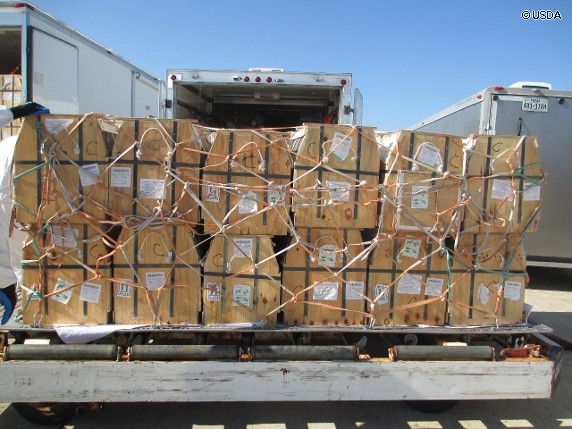
The traumatized monkeys are crammed into small wooden crates and transported in the dark and terrifying cargo holds of planes for as long as 30 hours.
During the transport, the monkeys receive no food or water for more than 24 hours – a violation of the Animal Welfare Act. Some of the hungry, thirsty and confused monkeys must also sit in the midst of their own excretions during the unbearably long flight.
Many die a painful death on their long journeys, some of them over 30 hours long.
When they arrive in the U.S., they’re transported to facilities where they’re imprisoned in cramped cages and frequently cut open, poisoned, crippled, addicted to drugs, shocked, and killed.
Air France is the last major airline that continues to enrich this bloody business and kidnap monkeys from Mauritius to Europe.
Please help* and ask Air France to join all the other major airlines worldwide and stop transporting monkeys to their deaths in experimental laboratories!
My comment: Every year more than 6,000 monkeys in Europe are misused for animal experiments, half of which are imported from Mauritius and flown by Air France to Europe!
Those of the animals surviving the horror journey land on the hands of the practicing Dr.Mengele, in the Dachau laboratories for animals, which are equipped with their own justice, and are supported by corrupt politicians.
The news is good, and we are very pleased that another company stops its flying coffins.
It has come the time of consistent and hard action; Sinners and criminals should be punished and we have to do that where we can.
Therefore: do not fly with Air France!
Until the company stops the death transports.
Posted on December 7, 2019 by Serbian Animals Voice (SAV)
Indonesian Province Pledges ‘Zero Tolerance’ for Dog Meat
Progress toward ending the dog meat trade in Indonesia! This week, Governor Ganjar Pranowo called for a ban on the consumption of dog meat throughout Central Java.
Every month around 13,000 dogs are slaughtered for consumption in the region. Governor Ganjar Pranowo met with representatives from Dog Meat Free Indonesia on Tuesday, which was followed by his announcement.
He proclaimed, “We must push the Surakarta administration to issue a strict regulation that prohibits people from consuming or selling dog meat.”
Further legal support for this ban comes from a law passed in 2012 stating that dogs are not defined as food since they do not come from forests or farms. According to the Jakarta Post, Ganjar said, “The law clearly prohibits it. Once a regency issues a ban, every other region will follow suit. Agency heads will convene to discuss such a regulation.”
Many concerns surround the health and safety of the dog meat trade. The transportation of the dogs sent to slaughter increase the likelihood of the spread of disease such as rabies, and for the dogs the rampant abuse within the industry drew sympathy.
It is also a barbaric and inhumane business. Dogs are often beaten to death in front of onlookers, and some are blow torched while still alive.
While dog meat is easily found in the stalls of street vendors, only a small percentage of the population consumes dog meat. However, it is still a lucrative trade.
We applaud Governor Ganjar Pranowo for his call to help put an end this brutal practice, and urge other provinces to follow suit.
Poachers left the corpse of a 40-year-old Sumatran elephant to rot on an Indonesian plantation after hacking off the majestic animal’s head.
“The elephant’s head had been cut off and its severed trunk was found a metre away from the body,” said Suharyono, head of a local conservation agency, in a statement. “We suspect the elephant was hunted and killed, and then its head was cut off to remove the tusks.”
The Sumatran elephant is listed as “critically endangered.” According to the World Wildlife Fund, “nearly 70 percent of [their] habitat has been destroyed in one generation.”
Poaching has also skewed the breeding rates for these magnificent creatures, making it even more difficult for the species to survive.
Asian Species Expert Dr. Barney Long notes, “we could possibly see the Sumatran elephant be restricted to just a few remote populations within our lifetimes.”
Sign this petition today to urge the Indonesian government to do everything in their power to bring these poachers to justice, and work to protect the remaining animals. The Sumatran elephants must be protected before all hope is lost.











 Serbian Animals Voice (SAV)