Posted on October 24, 2019 by Serbian Animals Voice (SAV)
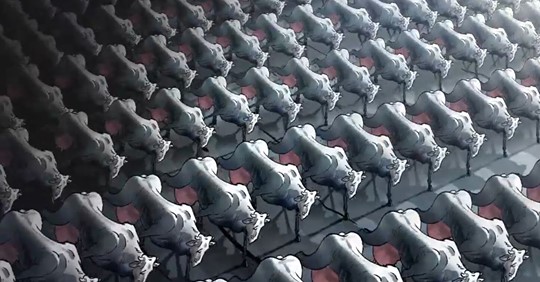
From Katjesthere is now the vegan chocolate Chocjes. The commercial will clarify that cows are not dairy machines.
We really loved the Chocjes commercial.
Apart from the fact that the illustrations come from none other than Gerald Scarfe, who was already responsible for the Pink Floyd cover of “The Wall”, the video contains a clear vegan message.
You see a whole army of mechanical cows.
Dark scenery. Gloomy music. Cows march like soldiers in the Third Reich. So it starts, the new commercial of Katjes. Then a woman’s voice says: “Every life is valuable. And cows are not dairy machines. Not even for chocolate. “
A scene change follows. Pink background. Gentle music. Oat plants sprout from the ground. And the woman’s voice says, “Luckily there are chocjes now. The vegan chocolate from Katjes. Cool without a cow. “Then the commercial ends.
The message is unequivocal and will encourage many to think about it. On the website of Katjes it says: “Cow’s milk is not originally intended for us humans, but as first food for young calves. […] With oat drink many people feel better. And the cows too. It’s cool! “- We see exactly the same way!
We celebrate it when big companies offer vegan products. So they also get their hands on our meat-eating friends and possibly try them out. And maybe they even taste the one or the other.
Katjes has also brought two types of vegan chocolate to the supermarkets. “Chocjes Original” and “Chocjes Haselnuss” convince with a skilful blend of organic oat milk and sustainable cocoa.
Hey Katjes! thanks for this great video! Of course, the milk chocolate sticks in the throats of many spectators. Oh, by the way, Katjes! If you veganize your fruit gums now, then you are true heroes for us. ♥
My comment: And again the farmers are offended and lament:
The Bavarian Farmers Association (BBV) reacted shocked and submitted a complaint to the German Advertising Council. In it, the BBV writes: “In the TV spot cows are referred to as” dairy machines “and animal owners the exploitation of their cows assumed. That is discriminatory and unjustified. It must be possible to promote a vegan product without spreading lies about agriculture “!!!
Also on the Internet, the commercial of Katjes causes a stir. There is hysteria among the farmers!
In the group “Agricultural women” on Facebook, a user says: “What kind of crazy advertising!! Here, it always gets stupider. I really don`t understand what’s going on with humanity anymore ” !!!
Also on the company’s Facebook page Katjes reaps a shitstorm for the commercial.
A user writes: “In my opinion, this video testifies to an abysmally bad marketing department!It’s about populism and hate against a whole profession!Bravo Katjes!It could not have been worse! “
And now from me to all who lament: Stop playing the victims!
You can afford to write a lot of bullshit, because you don`t have any suffering!
You will not be murdered, raped, exploited, enslaved and tortured out of pure greed for profit !!!
The animals are the victims who can not raise their voices and that’s why we have to do it! And not you, the farmers, the slaveholders, who enrich themselves with the miserable suffering of the dairy cows, and also cash subsidies from EU. Stop playing the victims!
Posted on October 23, 2019 by Serbian Animals Voice (SAV)
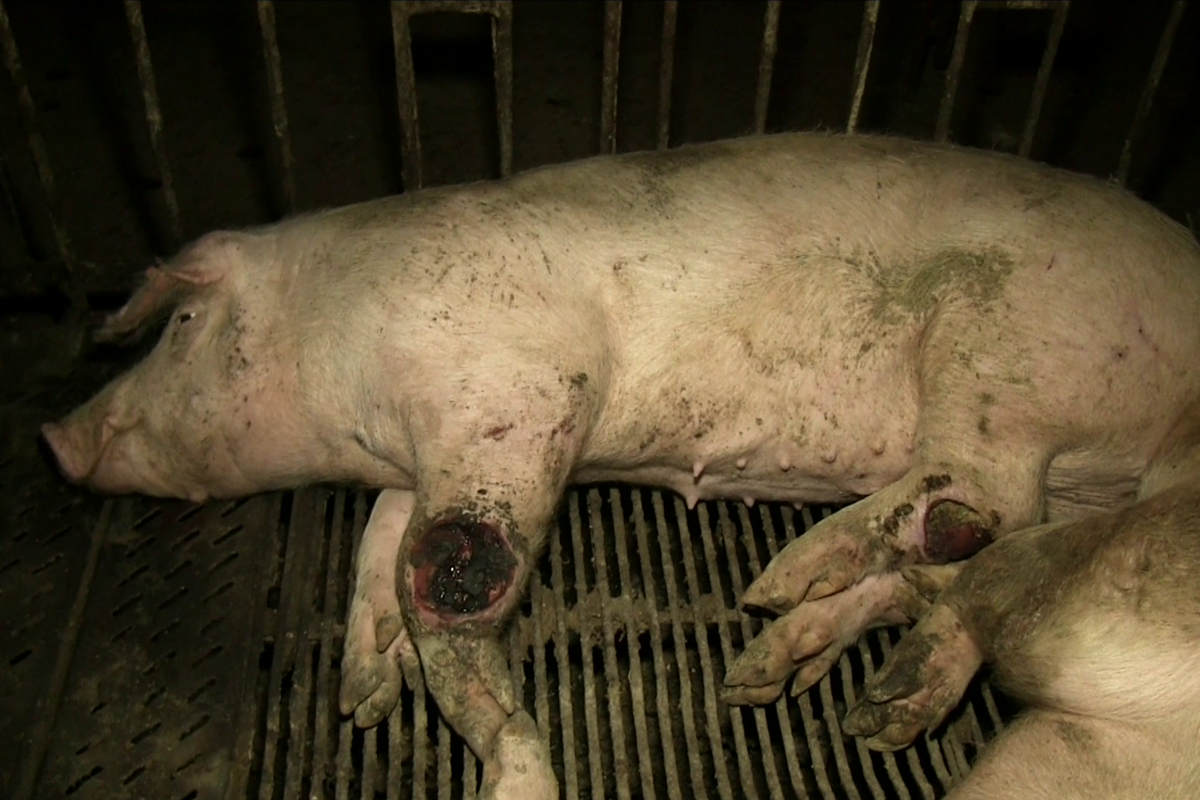
The man in the pigsty looks at the animal. For days, the fattening pig had hardly moved in the bay, the hind legs can not use it anymore, it is pushed by its conspecifics, annoyed and nibbled.
After a while, the man brings a wooden club, opens the gate and presses on the skull of the animal. Again and again until it stops moving.
But it is not dead! after a while – the man is long gone – it raises his head, trying to get up. Only half an hour later, the employee comes back and sets a bolt gun on the head of the animal – after several minutes of agony, in which the pig crawling through the whole grid box, the animal finally dies.
All this is on video, filmed for a week by a hidden camera in the pig farm of Woosmerhofer Land Producer in Vielank in Mecklenburg-Vorpommern (Germany).
In Germany, every fifth pig born for the meat industry does not reach the age of slaughter because it is ill or injured.In numbers, this means that 13.6 million pigs in German breeding and fattening systems die each year before reaching the planned age of slaughter.
A worker hits the pig on the head with a piece of wood to kill it. After ten strokes it is still alive and conscious: it moves and raises its head.
More than half an hour later, the worker stuns the suffering pig with a bolt shot. The prescribed immediate killing by a throat cut – before it wakes up again – is omitted.
The pig dies only after several minutes of agony.
The fact that pigs are regularly killed in this farm shows shots from a different area of the facility.
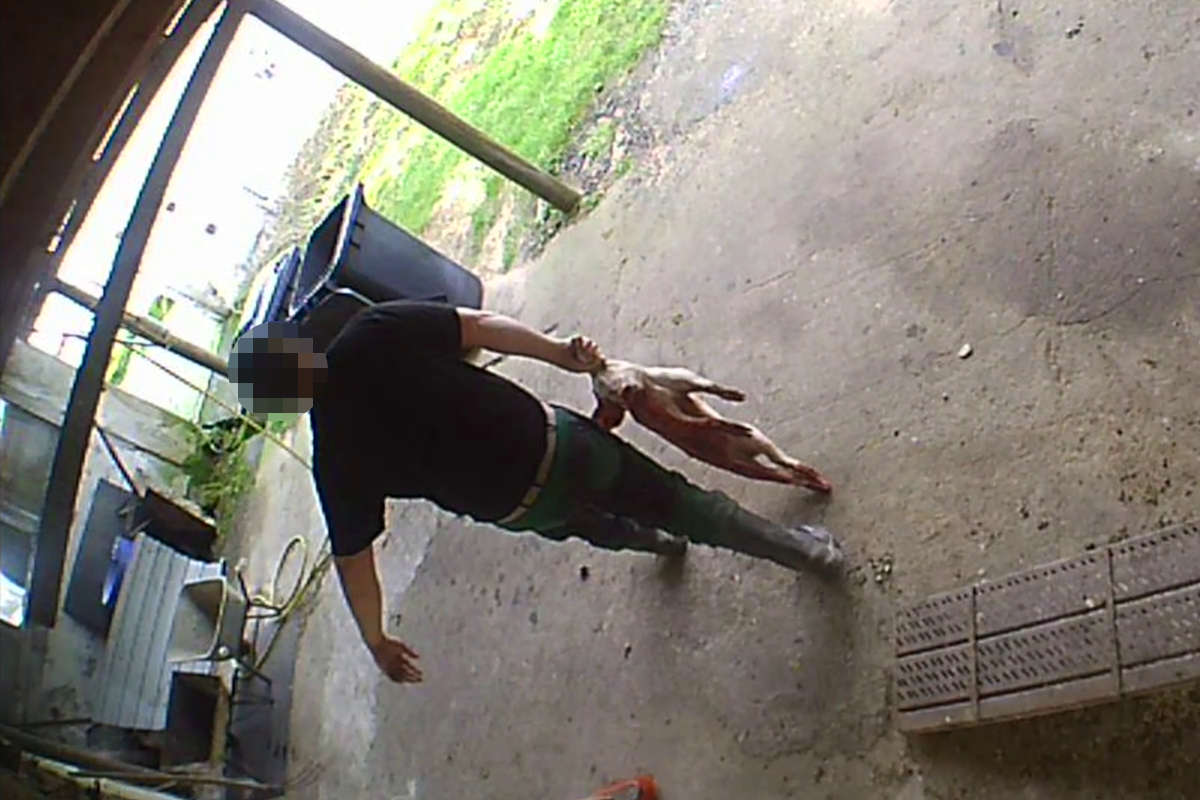
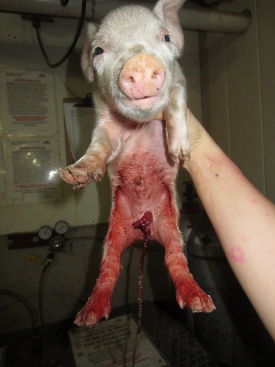
There, blood-spattered young pigs, so-called runners, are thrown into the cadaver barrels.
The indifferent reactions of the workers make it clear that this procedure must be everyday practice here.
This is the logical consequence of an ideology that considers animals as goods: the life and death of these animals is decided on their own economic benefit. Their millions of suffering and even clear legal prohibitions play no role in the animal industry.
My comment: It is an organized crime that sees the light of the public only thanks to the undercover investigations by animal rights activists.
The photographs were filmed with hidden cameras installed in the two pigsties of the livestock farms from the end of January and the beginning of February to May 2019, and a team shot with a mobile camera.
And nevertheless! Even if they come to light, the maximum impact is that the slaughterhouse employee, the “black sheep”, will be fired without notice, and the prosecutor closes the case for lack of evidence.
Everyone returns to their everyday lives and the case is forgotten.
Obviously, this crime in animal welfare is not rated as economic crime as in any other industry, and therefore remains without punishable consequences in Germany.
The ARIWA organization calls the animal industry a “lawless area”!
Several times a year activists publish new photos or videos from mass animal husbandry. Every time bad pictures that no one can bear.
For two days it gets excited, the slaughterhouse operators assert that there are isolated cases, then continue as before. The German citizens are simply not interested in animals being tormented. It is only important that you buy meat for less than 2, – € / kg to put it on the 900, – € grill.
For years, the “stinginess is cool” mentality maintained, and every meal must be made of meat, which calls the German “life standard” and then one wonders if our planet is destroyed, and why the production conditions are so catastrophic. Our species is shit ..
Posted on October 23, 2019 by Serbian Animals Voice (SAV)
As we have covered many times; currently in England the government are undertaking Badger culling with the policy that it will reduce the spread of Bovine TB to cattle. This has been proven not to work in the past with the Krebs report, but the government are doing this now to pacify farmers who keep livestock. For years animal campaigners have been asking for vaccination to prevent the spread; but to date the government has only wanted to kill.
Here is a new article in a UK newspaper which shows pictures of dead (culled) badgers waiting to be incinerated.
It is now probable that the UK will be having a General Election before Christmas this year. The killing government have to think long and hard about this situation if they want support and votes to keep them in government.
The new hunting season has begun, and already seven wolves have been killed in Montana. It costs just $19 to buy a wolf hunting license in the state.
Montana, Idaho and Wyoming are showing how little they care for wildlife and how easy they want to make it for wolves to be shot.
Wolves are highly social and have deep bonds within packs. Each death shatters a wolf family, breaks up a breeding pair, or orphans a litter of pups.
The Trump administration’s plan to take away Endangered Species Act protection from most wolves in the lower 48 will expose them to more hunting, more trapping, more shattered packs.
Wolves need to be protected and allowed to raise their pups free from traps and guns.
The job of wolf recovery is far from over, which is why we’re pushing hard for a national recovery plan. We see the tragic results when wolf management is turned over to states.
No one fights harder to save wolves than the Center. We know how to win in the courts and in the halls of power — but we can’t do it without you.
Kierán Suckling
Executive Director
Center for Biological Diversity
P.S. Monthly supporters who give steady gifts of $10 or $20 power the Center’s swift and continued action to save wolves. Do your part by starting a monthly donation.
Posted on October 22, 2019 by Serbian Animals Voice (SAV)
Judith is a trained animal keeper, research and clinic, and worked for 5 years in various animal testing laboratories. What she has experienced and why she decided one day to change the job, she tells us in this interview.
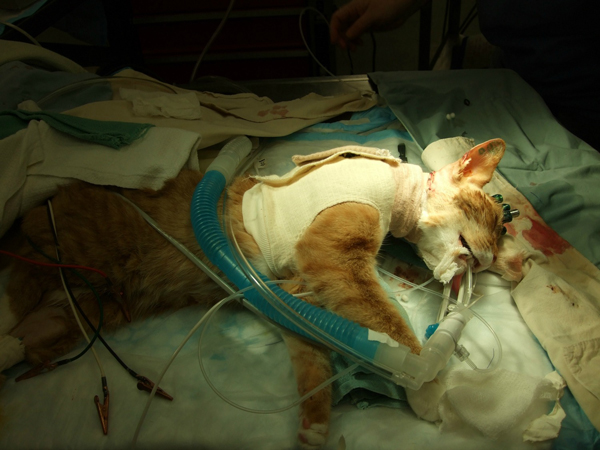
PETA: What happens behind the laboratory doors? JUDITH: A lot. With dogs, for example, transplantation experiments are made.
What nobody knows: The animals not only suffer during the experiments, but just as before and after.
Our beagle were so severely paralyzed with immunosuppressive drugs before the transplants that they often died before the actual tests – of internal bleeding or infection.
I can not forget the sight of the dogs in their mini-boxes. They have partially bled continuously from all orifices and have been maltreated several times a day on the doctor’s desk – and not only by trained professionals, but also by inexperienced interns.
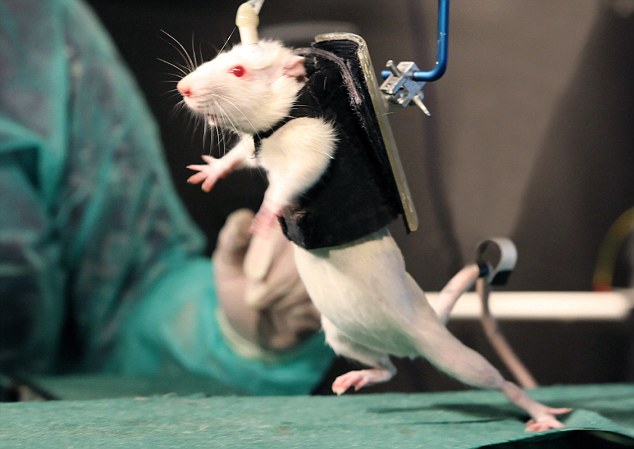
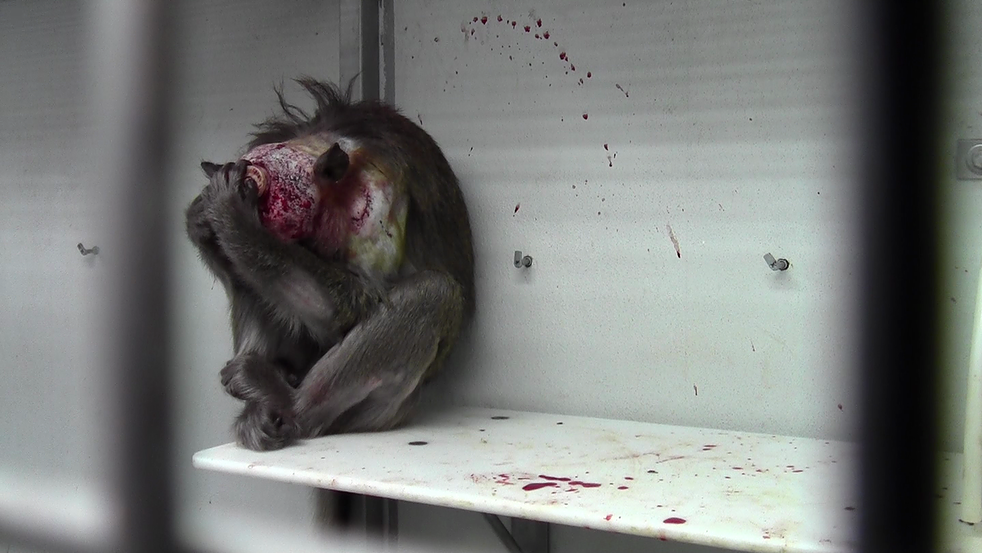
Like the dogs, I have seen many other animals suffer and die in the lab: especially mice, but also cats, rabbits, hamsters, goats or ferrets.
PETA: What happens to animals that are “unusable” for experiments? JUDITH: Life is worthless in animal testing laboratories. An animal whose genetic code does not fit the experiment is killed and disposed of carelessly.
There are lab groups, there is only one mouse of 100 genetically suitable – the other 99 are so “garbage” and are treated the same way. Sometimes you could only work with the 16th generation – you can imagine how many animals had to be born for it.
The animal mothers are treated like breeding machines. They bore babies in the chord, most of them killed right afterwards.
PETA: Can a zookeeper make life easier for animals in the lab? JUDITH: Unfortunately not really. Although it cleans the cages and gives the animals to eat and drink, but in chord.
A caregiver can get around 4,000 mice, so there’s no time for a relationship with the animals. Empathy is out of place and annoying when killing hundreds of animals – laboratory jargon.
You simply throw mice into a CO2 pot and leave. Some die faster, others slower.
PETA: What experiences behind the lab walls have bothered you the most? JUDITH:Every day there are new atrocities done to the animals. We cut off the tail of young mice to do genetic testing.
Often a nerve was accidentally pulled out – that must be incredible pain for the animals, because they were not stunned and squeaked loud and even tried to bite.
Often the head of baby mices was cut off with scissors. I had a colleague who thought it was funny when the fur of the mouse was still torn off with the head and half of the body was exposed naked, but also that was tolerated. There was never anything said neither by colleagues nor by the boss.
I have also often seen a mouse mother biting her babies right after birth – out of sheer stress, as the cages are too small and the animals are almost permanently pregnant. Maybe also from lack of nutrients, as the countless pregnancies on the body consume.
PETA: One day you decided not to work in animal testing laboratories anymore. Why? JUDITH: I had a bad experience with a bitch that opened my eyes. I found her dead in her cage on a Saturday morning – as far as nothing was out of the ordinary. She was circled and looked quite peaceful.
Now we only had very narrow cadaver tons. But the bitch was stiff and too big for the barrel. Since corporal rigidity would persist for many hours and only the most urgent things needed to be done on Saturdays, my boss told me to take the Surgical Saw and cut the bitch until it fits in the bucket.
I was so shocked that I realized the moment what I’ve been doing for years.
I did not saw the bitch in the end – I drove back to the lab late at night and carefully put her dead body in the ton.
PETA: What did the work in the animal testing laboratory do to you? JUDITH: You quickly get used to the daily inhumanities that happen there. You do not think about it, it becomes everyday and you quickly get a black humor.
As a result, I have not understood for far too long what I actually do every day.
I had always felt like animal love, and yet I have so many poor souls on my conscience. But I am very grateful that my eyes were opened and I was able to break away from this machinery. There are so many more stories that I could tell, but that would go beyond the scope.
PETA:What do you want for the future? JUDITH:I hope that more and more people are becoming aware of how cruel and unnecessary animal testing is and that we have to fight against it with all our might.
All of us!
Whether as a consumer, student or normal citizen, everyone has to take to the streets for the animals. Because it is also possible without animal experiments – that must finally arrive in politics and in the money providers.
Posted on October 21, 2019 by Serbian Animals Voice (SAV)
Animal Equality has released a report on Italy’s milk industry, revealing controversial practices the sector often tries to hide from consumers.
In footage obtained from our investigative work on several farms in Northern Italy, we exposed what actually happens inside dairy farms, compared to what is marketed by the farms’ advertising. What the footage shows is the tragic exploitation of cows, with endless amounts of suffering!
What we found:
– Calves taken from mothers a few hours after birth
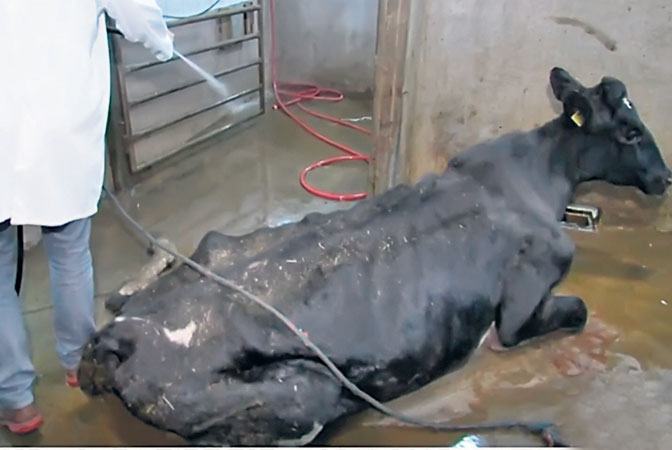
– Calves and cows living in cramped, unsanitary conditions, and covered with feces and mud
– Farmworkers performing preventive practices and care without veterinary supervision, which is illegal
– Cows with mastitis and very serious wounds, including wounded hooves illegally covered with scotch tape
– Cows “grazing zero,” which means they do not have access to pastures, as opposed to what is constantly shown in the advertisements of dairy farms
All these practices-and not only in Italy- demonstrate one thing: that the image conveyed daily by the dairy industry is not the reality cows live in. This form of extreme exploitation causes cows enormous suffering, specifically by quickly consuming their bodies and leading to premature death within just a few years.
To justify this criminal situation, milk mafia sells milk to us as a natural food that makes us big and strong and a source of calcium.
Meanwhile, however, has been scientifically confirmed that the milk is not only unhealthy, but also makes sick.
We all thought or still think that milk is a healthy, balanced drink. But here is the first mistake.
Because milk is not just a drink, it can be called a staple food because of its high nutrient density. That’s why milk makes us sick.
It can trigger allergies, especially in infants, lead to chronic infections, skin problems and eczema, promote asthma, diabetes and even cancer. This could be due to the foreign proteins in the milk against which the body is fighting. Many of these diseases can be due to a milk allergy.
In Asia and Africa, for example, just one percent of the population can digest milk.
Most people want to see milk as one of the most natural products fresh from the cow that lives on the meadow, with no additives, no hormones, no antibiotics.
And although the reality is shown every day and in many countries even by the state TV channels, the milk consumers are making a lot of ridiculous excuses to continue to consume a product which makes them sick and the animals victimized.
One of these excuses is the “organic” milk.
And the biggest lie of the milk mafia.
Conclusion: We despise murder of people, but we regard murder of animals as normal. Because they are lower beings for us.
In our Western world, it has never been so easy to live without meat and milk.
Man can eat animals and just can not eat. Both is possible.
Above all, because we humans claim that we have developed a strong sense of morality that we can apply accordingly. But we have learned to turn feelings of empathy into apathy. We have learned not to feel, because otherwise we would feel responsible for our actions.
With the pet at home, it works.
We teach our children to love the pets, not to eat them. When it comes to our own dog or kitten, we must never do that, and we emphasize that among the evil Chinese, such a crime is quite common.
We must teach our children that it is not right to kill other beings for no reason. Children are very open to it. But we do not clarify it, we do not tell them the full truth, because we ourselves can not cope with the truth.
Who serves as an obedient servant the system of meat and milk mafia, will defend his schnitzel and not the truth about animals that become meat in the factories.
Posted on October 21, 2019 by Serbian Animals Voice (SAV)
Background Information (WAV)
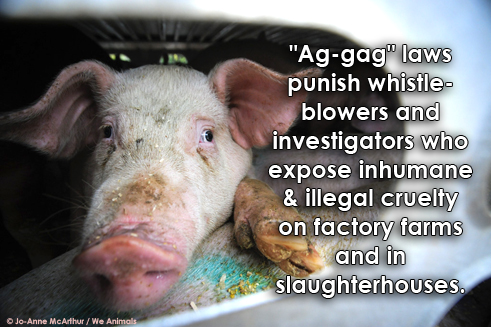
Ag-Gag laws seek to “gag” would-be whistleblowers and undercover activists by punishing them for recording footage of what goes on in animal agriculture. They were originally designed to prevent the public from learning about animal cruelty.
Twenty-five states have attempted to pass modern-day ag-gag laws, and six of those states have succeeded. The states that have passed ag-gag laws are (in chronological order), Iowa Utah, Missouri, Idaho, Wyoming, and North Carolina.
USA – Government Regulation of Factory Farms. The USDA is the primary federal agency charged with regulating animal food production and slaughter industries. Through sub-agency programs, the USDA oversees food production laws.
However, there are no federal laws that set humane care standards for animals in factory farms.
Factory farms perpetuate climate change, produce enormous volumes of manure, pollute the air and water, exploit workers, fuel antibiotic resistance and harm the rural communities they claim to help.
The meat industry depends, more than anything else, on walls.
The walls of farms and slaughterhouses prevent consumers from seeing what the production of their food really looks like. They prevent journalists and activists from exposing unethical, even criminal acts within. They enable corporations to paint happy, bucolic pictures of their operations that bear no resemblance to the reality of modern-day factory farming.
To get inside those walls, over the last two decades, dozens of activists have gone undercover, finding employment on factory farms and wearing concealed cameras, shooting hundreds of hours of footage over the course of months on the job. They have documented the routine acts of mistreatment and abuse of animals that are an inherent part of raising livestock for slaughter with maximum profit in mind.
The videos they have produced have made an enormous impact on the industry, grabbing headlines, pushing consumers away from meat, compelling retailers to pull products from shelves, and even causing government regulators to temporarily shutter some farms.
In response, the industry has pushed to criminalize undercover investigations, through legislation known informally as “ag-gag.” Ag-gag laws target activists in a variety of ways, from imposing criminal penalties on investigators for misrepresenting themselves on employment applications to outright banning the collection of footage on the premises of animal agriculture operations without the owners’ permission.
In Iowa, an ag-gag law passed in 2011 was struck down earlier this year by a federal judge. But thanks to the political power it wields in the state, the meat industry did not have to wait long to see the law resurrected. Just two months after the court’s decision, Iowa’s legislature passed a brand new ag-gag bill, and its newly elected governor, Kim Reynolds, signed it into law.
Our short documentary tells the story of one undercover investigator whose footage is at the center of Iowa’s ag-gag backlash.
Take PETA’s Cruelty-Free Shopping Guide along with you next time you head to the store! The handy guide will help you find humane products at a glance. Order a FREE copyHERE
Searching for Cruelty-Free Cosmetics, Personal-Care Products, Vegan Products, or more? Click HERE to search.
Want to do more than go vegan? Help others to do so! Click below for nominal, or no, fees to vegan literature that you can use to convince others that veganism is the only compassionate route to being an animal friend: