Posted on March 4, 2020 by Serbian Animals Voice (SAV)
WAV comment – Being the daughter of Sir Paul, huge animal rights campaigner, ex Beatle, and veggie campaigner; protecting the environment and animal rights have always been the trademark of Stella’s products. What else would you expect ?
“These animals are the ingredients of everyone else’s fashion shows. We are the only luxury fashion house in the world that isn’t killing animals on the runway. I wanted to make that point, but in a joyous way.”
The Stella McCartney brand has worked without leather, fur, skins, feathers or animal glues since its launch in 2001.
Don’t the (humans dressed up as) animals on the catwalk look great as well as sending a clear message to the fashion houses of the world – that you don’t have to kill to promote your products and designs now. Fortunately, the world is changing; people are ditching products that involve the suffering and killing of animals for ‘looks and so called ‘beauty’.
We thank Stella for putting on such a great promotion of showing that you don’t need dead animal by-products now days to look good – there is so much ‘cruelty free fashion’ out there for people to buy now.
Fur is dead; leather is dying out, and people are finally waking up to the cruelties involved – so bring it on !
Stella McCartney goes wild to drive home animal-free message
Paris show features wildlife costumes to emphasise the label’s planet-friendly ethos
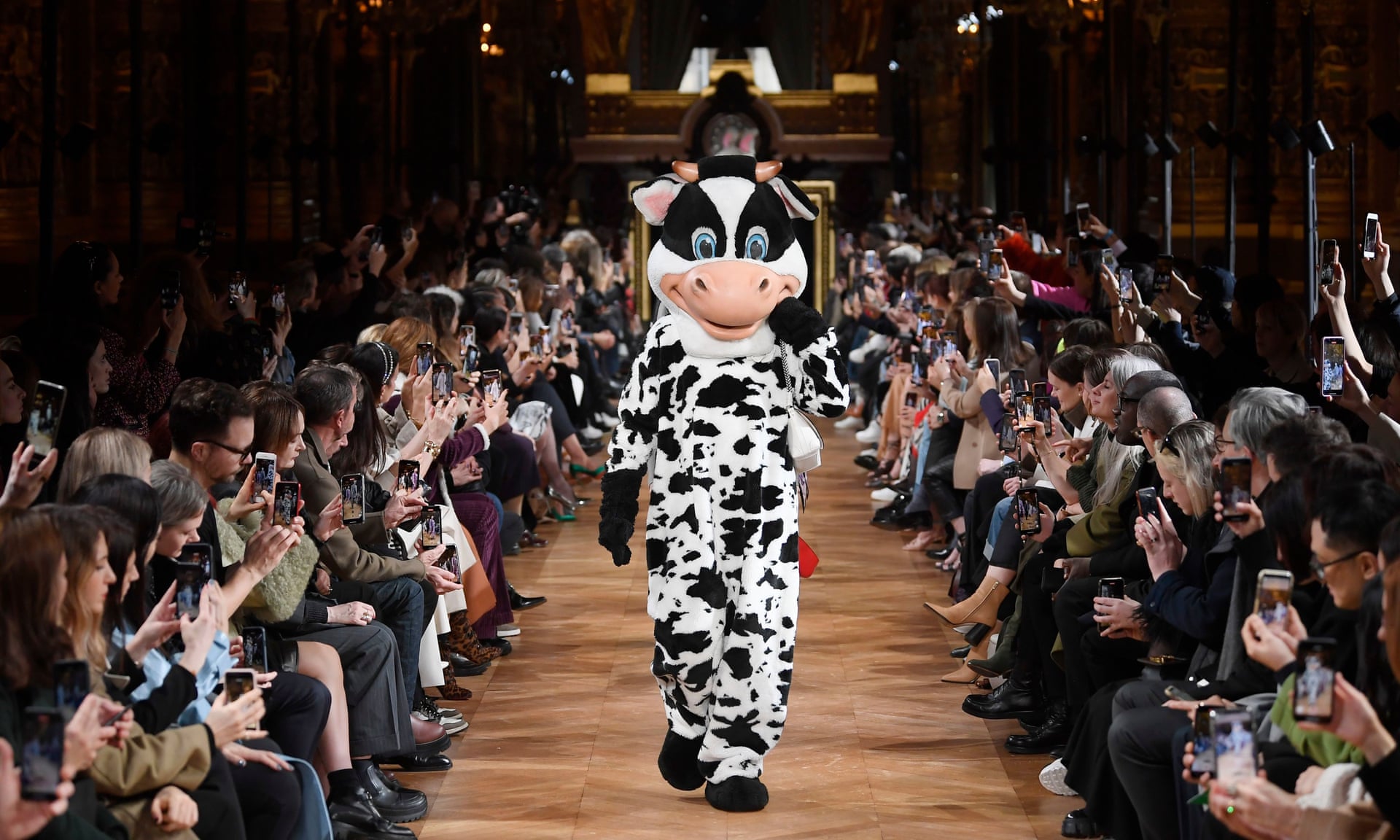
The singer Janelle Monáe and actor Shailene Woodley were in the front row, but two rabbits, a fox, a horse, two cows and a crocodile stole the show. People in lifesize animal costumes, of the kind more usually seen at theme park parades than at Paris fashion week, joined models for the finale of Stella McCartney’s show, swinging their new-season handbags and posing for the cameras.
The optics were fun, but the message was serious – that there are animals on almost every catwalk, it’s just that they are usually dead. The half-moon shoulder bag carried jauntily by a brown cow here was made from a vegan alternative to leather, while other bags were created from second-life plastic.
“What we try to do here at Stella is to sugarcoat a powerful, meaningful message in a little bit of humour and fun, to make our point in a palatable and digestible way so that people listen,” said McCartney. “These animals are the ingredients of everyone else’s fashion shows. We are the only luxury fashion house in the world that isn’t killing animals on the runway. I wanted to make that point, but in a joyous way.”
The Stella McCartney brand has worked without leather, fur, skins, feathers or animal glues since its launch in 2001, “but it has taken me my entire career to get the fabrics to the stage they are at now, where our animal-free leather is soft enough, and has enough luxury to it,” the designer said after the show.
This collection featured more leather alternatives than ever before, not only in bags and shoes but in decoratively perforated lightweight trench coats and fluffy shagpile shearlings. “We do it like this because it’s better for the animals and better for the planet.”
Last year, McCartney sold a stake in her brand to LVMH in a deal that gave her a role as special adviser on sustainability to the luxury group’s chairman and chief executive, Bernard Arnault. The role poses a challenge – Arnault was widely criticised last year after describing Greta Thunberg as “demoralising” – but McCartney is confident she can have an impact.
“I think the sheer fact that he has invested his time and his money and mindset into a different business model [at Stella] already has an impact. You don’t come onboard at Stella and not start to think differently. My goal is to make changes more broadly at LVMH. Mr Arnault’s goal is to respond to what people are asking for today, and to learn, and to change.”
McCartney described her role so far as “about bringing information, talking about alternatives in manufacturing and sourcing. I’m introducing the technologies and techniques and suppliers that we use here at Stella to the other LVMH brands.”
Coats, a focal point of every Stella winter collection, looked strong this season. In dense twill melton wool, with high storm collars and cosy tie belts, the coats and jackets were an appealing blend of utility and chic.
Knitwear was another strong point, with three-piece looks – a tunic, a midi skirt and a polo neck worn beneath – in toning lumberjack checks.
Posted on March 4, 2020 by Serbian Animals Voice (SAV)
(WTXL) — Florida had one of the highest numbers of cats and dogs killed at shelters last year, according to a new study.
The study conducted by Best Friends Animal Society found that in 2018, 352,000 cats and dogs entered shelters in the state of Florida, 262,000 were saved and 55,400 were killed.
It also only found 40 no-kill communities in Florida.
According to the study, Florida was only behind California, Texas, and North Carolina.
The study stated that last year, about 733,000 dogs and cats were killed in our nation’s animal shelters, simply because they didn’t have safe places to call home (!!!)
The study found 2,000 dogs and cats in America are killed every day in shelters.
Best Friends Animal Societyis the only national animal welfare organization dedicated to ending the killing of dogs and cats in America’s shelters.
A leader in the no-kill movement, Best Friends partners with thousands of animal welfare groups across the country on innovative lifesaving programs.
In addition to Lifesaving Centers in New York City, Los Angeles, Atlanta, Salt Lake City, and soon, Houston, Best Friends runs the nation’s largest no-kill sanctuary for companion animals in Kanab, Utah.
Working together with you, we will end the killing and Save Them All®!
For more information, visit bestfriends.org. #SaveThemAll
And I mean ... We cannot save all animals, we all know it.
But that’s not the main question!
The question is: how many animals CAN I save?
And if everyone answers this question with the adoption of just one shelter animal, the shelters will soon have to report bankruptcy.
A bit of food, a warm place to sleep, two- three beautiful walks in nature with your new friend a day, that is the “huge” effort that you have when a new family member comes into your home. And a lot of felicity, partnership because…
He loves you
He respects you
He is loyal to you
He doesn’t betray you
He is your only real friend who always stands by you…
A life without an animal at home is possible but boring.
Posted on March 3, 2020 by Serbian Animals Voice (SAV)
This is the reality of a rabbit slaughterhouse in Spain.
– Rabbits are transported in containers after a stressful 12-hour trip.
– They take them to the “bleeding zone” and hang them upside down.
Terrified wait watching while others are killed right in front of them.
– And, then, it is their turn to also be HANGED, DEGOLLATED and DISPELELED for meat.
Is it only in Spain?
No! This is how it works in all totalitarian, fascist systems, as well as the system of human animals, which they have constructed against all other animal species.
This fascist system of the stronger race enables us per se to practice the worst torture, injustice and exploitation of other animal species, with the only justification not to belong to the same species.
Every totalitarian system has perpetrators and victims.
We are on the side of the victims.
Posted on March 3, 2020 by Serbian Animals Voice (SAV)
Commentary by Peter Hammarstedt (Sweden) – captain of Sea Shepherd
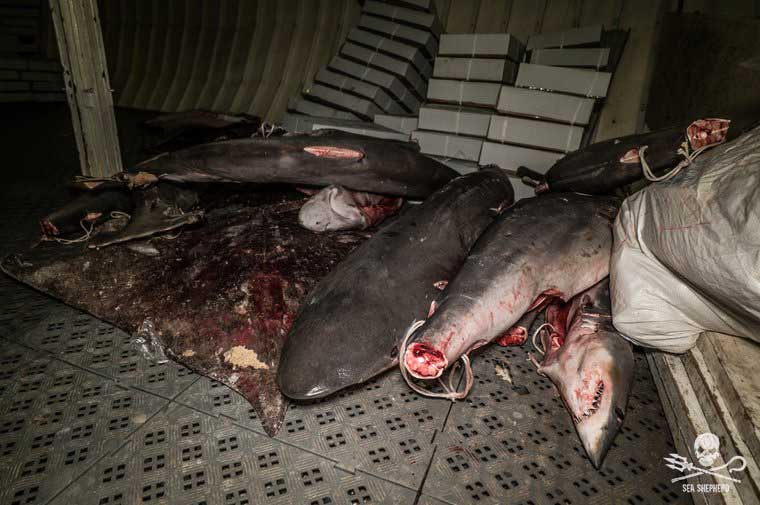
Europe kills the fastest shark in the world, while African countries struggle to save the shark from extinction.
Last week, Senegal and Canada submitted an application to the International Atlantic Tuna Conservation Commission (ICCAT) for strict guidelines to protect the shortfin maco after a 2017 study showed that the world’s fastest shark species, itself if the catch rate was zero, there would only be a fifty percent chance of recovering.
Gabon, The Gambia and Liberia supported the application, which provides for a ban on carrying short-fin makos on board, even if they were “accidentally” killed.
The three African coastal states conduct patrols at sea together with Sea Shepherd.
dead mako sharks in Liberian waters
The participants in the convention of the Washington Convention on the Protection of Species had previously voted for a trade ban on short-fin mako products.
To our horror, despite the efforts made by the African bloc, the application was smashed by the European Union and the United States.
These made a weakened countermotion, which contradicted the best scientific recommendations.Unfortunately, this is not surprising since European fishing vessels are largely responsible for catching shortfin macos.
The failure of the application is devastating, but it gives me hope to see how our African partner countries play a pioneering role in the question of better shark protection measures.
I am proud of Gabon, The Gambia and Liberia, who are fighting for the shortfin mako, and I trust that in future African coastal states will increasingly work for shark protection at international gatherings and conferences.
In addition, although the country is the largest market for shark fins, China has voted for measures to protect the short fin maco.
Sea Shepherd thanks the Gambia, Gabon and Liberia and the other 13 supporters of Senegal’s application for their strong commitment to nature conservation at the ICCAT meeting.
Up to 11,000 sharks are killed by humans every hour. Shark populations have decreased by 90% in the past century and a quarter of all shark species are threatened with extinction.
The supporters of Senegal’s application understood the urgency of shark protection and the importance of better protection measures for the heavily exploited shortfin mako.
My comment:“In their 400 million year evolution, the Mako sharks became the perfect hunter and even survived the dinosaurs, ”said marine biologist Ralf Sonntag for the International Animal Welfare Fund (IFAW).
And now they were brought to the brink of extinction by humans because of a shit soup!
The Mako shark is also known as the “cheetah of the oceans”. It can reach a speed of 69 km per hour. It is the fastest shark in the world.
Unlike other fish, sharks breed only slowly. Females only reach sexual maturity from the age of 18 and only have a few cubs every few years.
Spain is the main exporter of Mako sharks. European, especially Spanish and Portuguese, fishing vessels are responsible for 65% of the reported shortfin mako catches between January and June 2018.
The sharks are on the Red List of the International Union for Conservation of Nature (IUCN) as highly endangered!
The human animal should be on the red list as the most dangerous animal in the world.
I had invested high hopes on the Corona Virus that he would kill some millions of us, humans. So that the animal and natural world can recover a little.
But obviously he’s a weakling.
The company had been supporting the race—which forces dogs to run about 1,000 miles through Alaska’s rugged terrain and extreme temperatures—for at least 40 years.
This victory follows PETA’s behind-the-scenes meetings with officials, pressure on social media, protests outside the airline’s headquarters, and e-mails from nearly 100,000 of our members and supporters like you.
Urge Chrysler and Others to Stop Sponsoring the Cruel, Deadly Iditarod
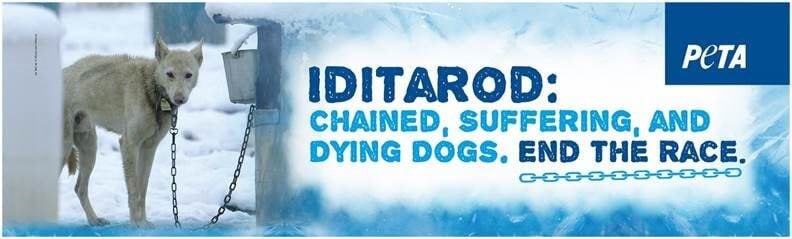
Dogs in the Iditarod are forced to run approximately 1,000 miles in under two weeks. On average, they must run 100 miles a day, with only a few brief periods of rest. They’re subjected to biting winds, blinding snowstorms, and subzero temperatures. Many pull muscles, incur stress fractures, or are afflicted with diarrhea, dehydration, intestinal viruses, or pneumonia.
During the 2019 Iditarod, more than 230 dogs were pulled off the trail—likely because of exhaustion, illness, or injury. Just one day after crossing the finish line, Oshi died from aspiration pneumonia—probably from inhaling her own vomit, which is the leading cause of death for dogs who don’t survive the race.
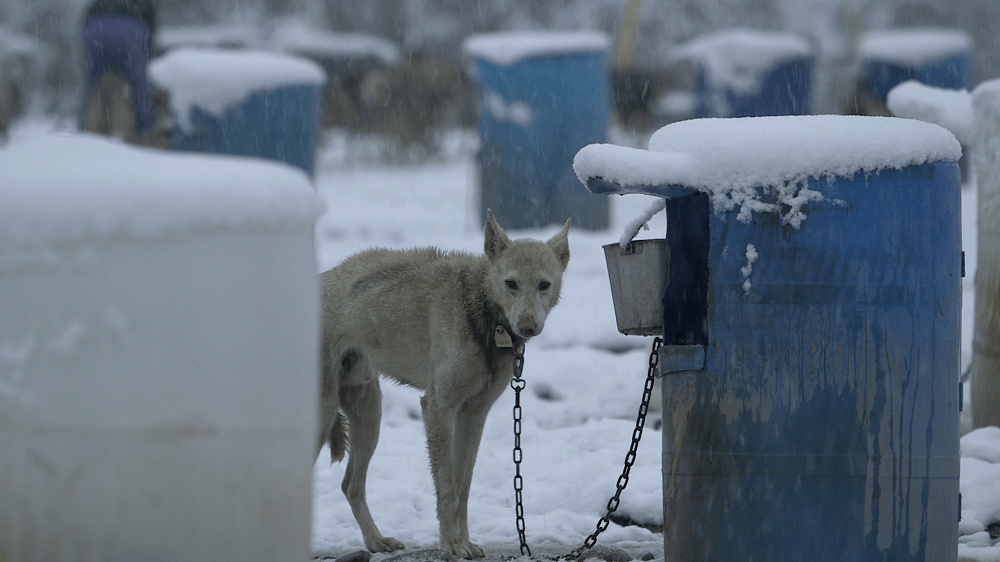
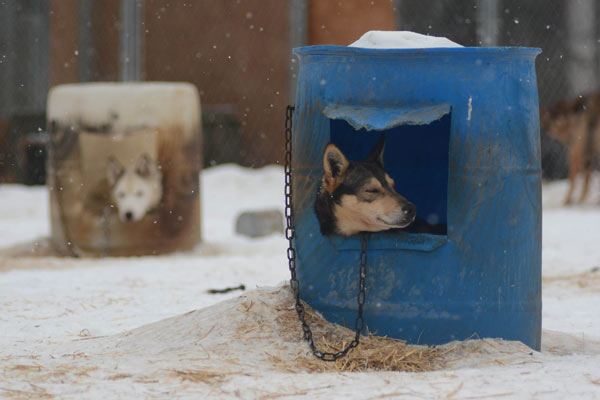
In late 2018 and early 2019, a PETA eyewitness worked at two dog kennels owned by former Iditarod champions and found widespread neglect and suffering. Dogs were denied veterinary care for painful injuries, kept constantly chained next to dilapidated boxes and plastic barrels in the bitter cold and biting wind, and forced to run even when they were exhausted and dehydrated.
Please send e-mails to the following executives urging them to end their support of the Iditarod:
GCI CEO Ronald Duncan at rduncan@gci.com
Matson CEO Matthew J. Cox at mcox@matson.com
Then, use the form below to ask Chrysler and Donlin Gold and its parent companies—Barrick Gold Corporation and NOVAGOLD Resources, Inc.—to sever their ties with this abusive race, in which dogs are run to their deaths.













 Serbian Animals Voice (SAV)