Emergency: Stop the Senseless Killing of Washington’s Wolves
As you read this, Washington Department of Fish and Wildlife (WDFW) sharpshooters are taking to the sky to find and kill another endangered wolf – a member of the Wedge wolf pack – in response to depredation of cattle on grazing lands in Stevens County.
WDFW currently has an active kill order for the Togo wolf pack as well.
Science shows that killing a wolf can increase the risk that wolves will prey on livestock in the future. It is counterproductive and unsustainable.
Yet WDFW has resorted to killing wolves living in this same spot rugged forest land for years. In fact, they killed the original Wedge pack in 2012 for the very same reason. The original Wedge pack was accused of preying on livestock in the Colville National Forest eight years ago and, under Washington’s wolf management plan, the state opted to issue kill orders in an attempt to protect the livestock. The state killed the entire family of six state endangered wolves.
In the eight years since the original Wedge pack was destroyed, not much has changed. Livestock owners still graze their cows on rugged, forested public lands that are better suited for native ungulates, and WDFW is still killing wolves to benefit the profit margins of private businesses. In fact, 26 of the 31 state-endangered wolves that have been killed since 2012 were shot on behalf of the same livestock operator.
While it’s too late to protect the other 31 endangered wolves WDFW has gunned down since 2012, other Washington wolves still need our help.
Please take action to respectfully call on WDFW Director Kelly Susewind to immediately end the assault on Washington’s wolves.
Posted on July 23, 2020 by Serbian Animals Voice (SAV)
Dear friends of the rainforest,
The primatologist Bethan Morgan made a sensational discovery in 2002: she was the first scientist to spot gorillas in the Ebo forest. More than 200 kilometers away from relatives – possibly a new subspecies!
The forest literally has it all: According to current research, the approximately 700 Nigeria-Cameroon chimpanzees are the only ones worldwide who crack nuts with wooden stones and hammers and catch termites with sticks.
In other regions, primates master only one of the two techniques.
For centuries, the population has lived in more than 40 villages in and around the Ebo Forest without endangering it. The locals see him as the land of the ancestors, go hunting there, fish, collect plants in the forest for their nutrition and medicine, and do farming on a small scale.
But nature and people’s livelihood are in danger!
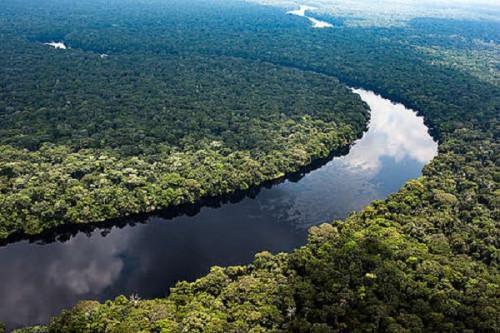
The Cameroon government has converted 150,000 hectares of the Ebo Forest into two logging concessions, an area twice the size of Hamburg.
The population was neither consulted nor informed, and their rights to their ancestral land and their say were ignored.
Logging would result in devastating ecological, social, and climatological damage, as it is often the first step in the extensive destruction of ecosystems.
It is followed by poachers, settlers, and land speculators. Villagers lose their livelihood and are more exposed to new diseases.
The population, scientists, and environmentalists are alarmed and are fighting for the protection of the Ebo forest and the livelihood of the locals.
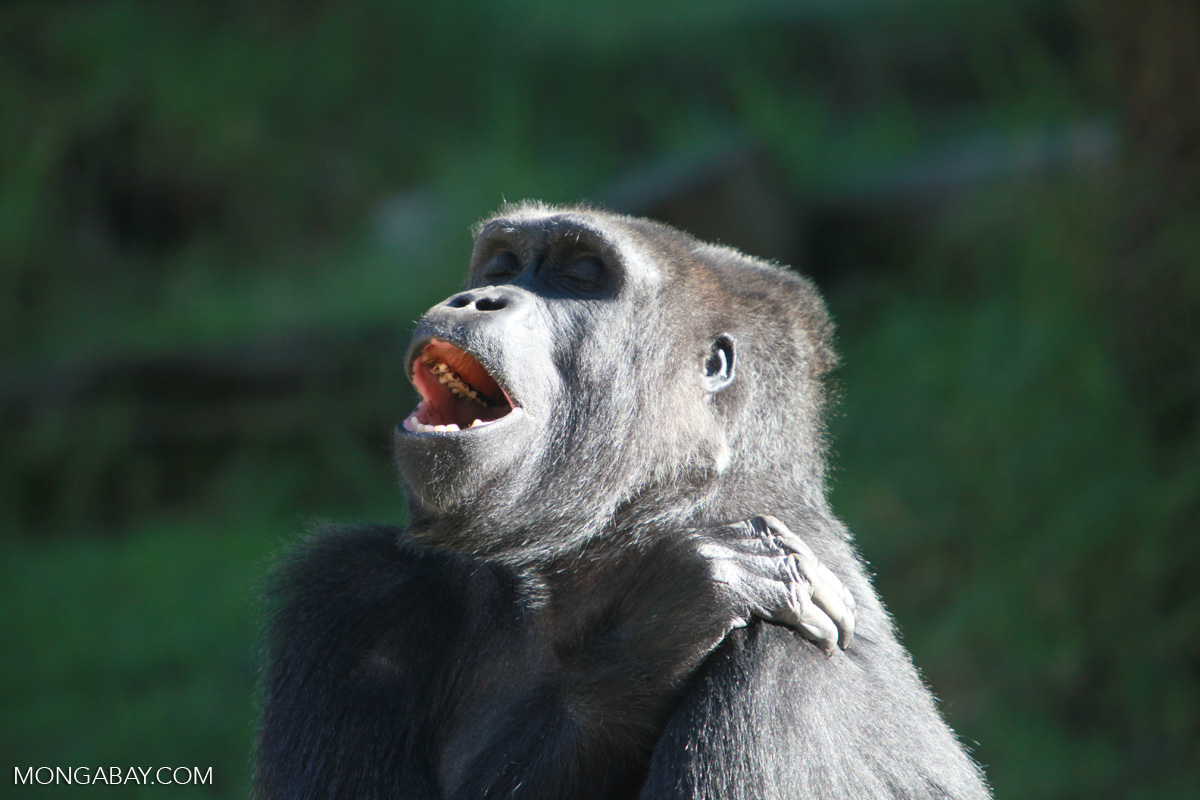
The Ebo forest is home to a mystery population of gorillas, only discovered by scientists in 2002. Two subspecies of gorilla are found in Cameroon, the Western lowland gorilla (Gorilla gorilla gorilla) and a small population of Cross River gorillas (Gorilla Gorilla diehli). Between these two populations, there is a third isolated Ebo population, completely cut-off from other sub-species, with no other populations found within a 200 kilometer (125 mile) radius. Photo by Rhett A. Butler
Background information: More than 160 species of birds live in the Ebo Forest; many of them are endemic and do not occur anywhere else in the world. The same applies to at least twelve plant species known to science. Despite intensive research work, the full range of species is far from being recorded.
And I mean: The animal species are becoming fewer and the human species more and more.
We reproduce without control, with the result that the habitat, existence, and right to life of other species disappear.
We are the plague of this planet.
Actually, if we want to be honest, we have to admit that this planet has a chance of survival only if the human species disappears.
Outbreak at Iowa pork plant was larger than state reported
By RYAN J. FOLEY
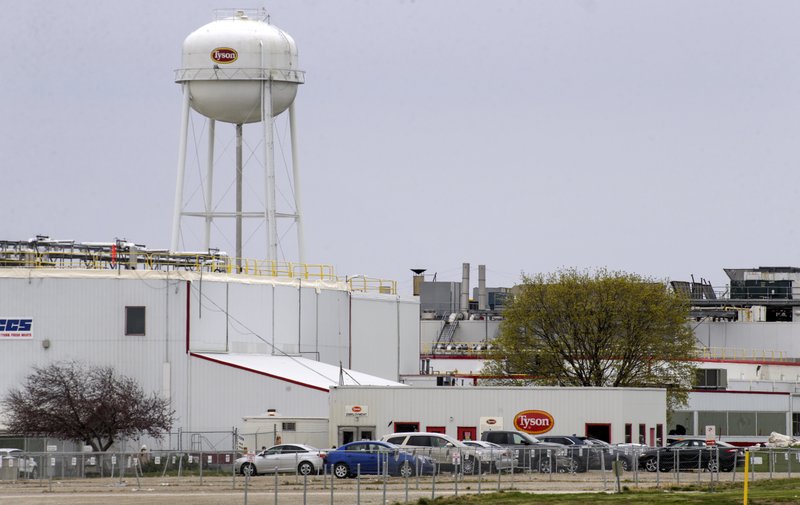
IOWA CITY, Iowa (AP) — The first confirmed coronavirus outbreak at an Iowa meatpacking plant was far more severe than previously known, with more than twice as many workers becoming infected than the state Department of Public Health told the public, newly released records show.
The department announced at a May 5 news conference that 221 employees at the Tyson Foods pork processing plant in Columbus Junction had tested positive for COVID-19.
But days earlier, Tyson officials told Iowa workplace safety regulators during an inspection that 522 plant employees had been infected to their knowledge, documents obtained through the open records law show.
A dozen of the plant’s roughly 1,300 workers were believed to have been hospitalized by then, and two died after contracting the virus, Tyson officials told the Iowa Occupational Safety and Health Administration.
The discrepancy adds to mounting questions that the state health department faces about its handling of public information during the pandemic. The department last week forced out its longtime spokeswoman, who said she was ousted for pushing hard to fulfill media requests and that the agency’s delays and scripted talking points were embarrassing.
The agency has also faced criticism for seeking to charge thousands of dollars for open records requests and for not routinely announcing outbreaks in workplaces, among other things. The department said it has “gone above and beyond to provide up-to-date and comprehensive information” to the public.
The early April outbreak in Columbus Junction was the first of several at meatpacking plants across the state as the virus spread through crowded workplaces.
Republican Gov. Kim Reynolds took a pro-industry approach to managing those outbreaks in Iowa, the top pork-producing state. She worked with executives to continue production even as thousands of workers became infected and some died, and she applauded President Donald Trump’s order to keep such plants open throughout the country.
On May 5, Reynolds said at her then-daily news briefing that the public health department had been compiling data from surveillance testing to track outbreaks, which the state defines as at least 10 percent of employees absent or ill.
She turned over the podium to health department’s deputy director, Sarah Reisetter, who said the Tyson plants in Columbus Junction, Perry and Waterloo and two other workplaces had confirmed outbreaks. Reisetter said the Waterloo plant had 444 positive cases, but county officials said days later it actually had more than 1,000.
As for Columbus Junction, department spokeswoman Amy McCoy said the 221 case figure announced by Reisetter reflected the results of the department’s testing and what it “could verify from our data systems” at the time.
“Keep in mind, we had just established an outbreak definition, and wanted to share the information we had available,” she said. “Since that initial round of testing back in April, the testing reporting process has significantly improved.”
The department never updated the number of confirmed infections in Columbus Junction. Unlike outbreaks at long-term care facilities, the department does not post workplace outbreaks on the state’s coronavirus website.
At the May 5 briefing, Reisetter said that the 221 cases reflected 26 percent of those tested, which would be 850 total tests.
Tyson spokesman Gary Mickelson said the number of infections announced by the state appeared to reflect only the first round of testing at the plant and that additional testing had uncovered hundreds of more cases.
“Coordinating facility-wide testing and obtaining results is a complex process that takes time,” he said.
But it’s unclear why the department would not have the full testing results that Tyson described to Iowa OSHA. The department, along with county health officials, had conducted the mass testing of workers weeks earlier.
Tyson officials said they learned of the first case in Columbus Junction on April 1 and idled the plant four days later after 29 workers tested positive, according to an Iowa OSHA inspection report.
The governor sent 1,100 testing kits to the county for testing during the two-week shutdown. The plant reopened April 20 with new safety measures, and Mickelson said the company isn’t aware of any current infections there.
Iowa OSHA opened an inquiry after seeing media reports that two workers had died from the virus and inspected the plant on April 30, walking through and meeting with several Tyson officials.
“There were 522 positive COVID-19 cases to the best of the company’s knowledge,” the inspection report says.
Tyson’s plant manager told inspectors that communication between the company and public health officials was “not efficient” and that information about the positive cases wasn’t available for days after testing, the report said.
Iowa OSHA did not cite Tyson for any workplace safety violations, saying the company “was trying to follow the best CDC guidance at the given time” and recommendations were rapidly changing.
Posted on July 22, 2020 by Serbian Animals Voice (SAV)
Italy – Animal rights activists rejoice as horror farm is closed
22 July 2020
Essere Animali
Press Release
Bologna, 21 July – Closure of the farm located in the municipality of Senigallia (AN), where in 2018 an undercover investigator from the organisation Essere Animali – hired as a worker – used a hidden camera to film the violent behaviour of staff towards pigs bred for a well-known PDO (‘premium’) circuit.
The news is also being communicated by the same group Essere Animali which, after the broadcasting of the investigation, launched a campaign to demand the farm’s closure. Although the decision to close the business was made by the farmer, for the organisation this is clearly attributable to the release of the shock footage. In fact, from the documents recently received by the Department of Prevention, Hygiene Service for Livestock Breeding and Production of the healthcare department Azienda Sanitaria Unica Regionale (ASUR) of the Marche region, it appears that the farm closed after sending to slaughter the last pigs that were already there when the investigation came to light. The farm is not currently assigned any of the business codes required to pursue the activity of breeding any species of animals regarded as livestock.
The images of the investigation achieved widespread coverage in the media and quickly went viral. In addition to the killing of the sow, who died after 30 minutes of agony following numerous hammer blows to the head, the video shows the use of the electric taser on sick pigs who were unable to move, the cruel handling of animals while they were being moved – with smaller piglets literally being thrown and adults hit on the snout with iron bars – and the presence of hundreds of bodies, left outdoors and piled together in buckets, in breach of health regulations. The hidden camera of Essere Animali’s investigator also filmed some of the workers (those who were not committing these violent acts) protesting at the treatment inflicted on the pigs.
The footage and images caused a tremendous uproar. Two parliamentary questions and one regional question followed, and the then Minister of Health Giulia Grillo also condemned the violence filmed by the investigator. In the days that followed, Essere Animali promoted a large demonstration in the square in Senigallia and launched a petition to ask the relevant institutions to immediately revoke the farm’s permits, a petition that has now been signed by over 280,000 people.
“The images filmed by our investigator revealed a reality of ongoing abuse and violence. Since the release of the investigation, our aim has always been to close the farm and today we can finally say that no more animals will be abused at this horror farm, a result that confirms the importance of our investigations which are a fundamental tool for shedding light on crimes against animals,” says Simone Montuschi, president of Essere Animali.
The closure of the farm does not affect the legal action that the organisation has taken against those responsible for the violence, reported to the Ancona Public Prosecutor’s Office for the alleged crimes of killing animals (art. 544-bis of the Italian Criminal Code) and mistreatment of animals (art. 544-ter of the Italian Criminal Code), as well as for specific violations of the regulations for the protection of pigs. Following the charges, the Carabinieri Forestali responsible for the territory carried out a blitz on the farm, seizing the sledgehammer used to kill the sow, several tasers used in breach of the current legislation, the iron pipes used to beat the animals and the instruments used for the castration of pigs, an operation that was carried out by unauthorised personnel and outside the periods allowed by law.
Posted on July 22, 2020 by Serbian Animals Voice (SAV)
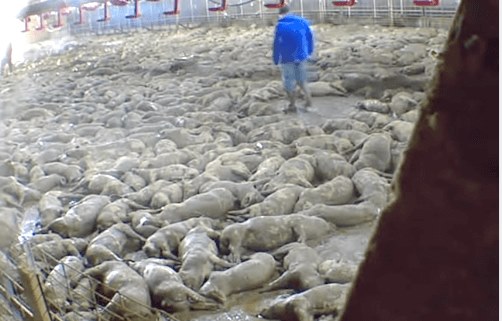
These are the results of industrial “animal production”.
Because they cannot be slaughtered due to Corona, they were cooked alive.
The ventilation in the barn was switched off, lethal steam was generated which heated the barn to 150 degrees.
We remember the Nazi era.
This is the fascist system of animal exploitation, the daily holocaust of the “other” animals.
Once this system is covered and its outrageous acts made public, it is not the criminals who are punished, but those who expose these criminals.
How it happened with the undercover investigation from a barn in Iowa,May 2020, from a DxE Investigation.
The meat consumers themselves know, up to a certain level of awareness, that this crime exists. But the others do the murder, and that`s why those who give the order don’t give a shit about the suffering of the billions of non-human animals.
Committee proposes relocation of Islamabad Zoo elephant to Cambodia
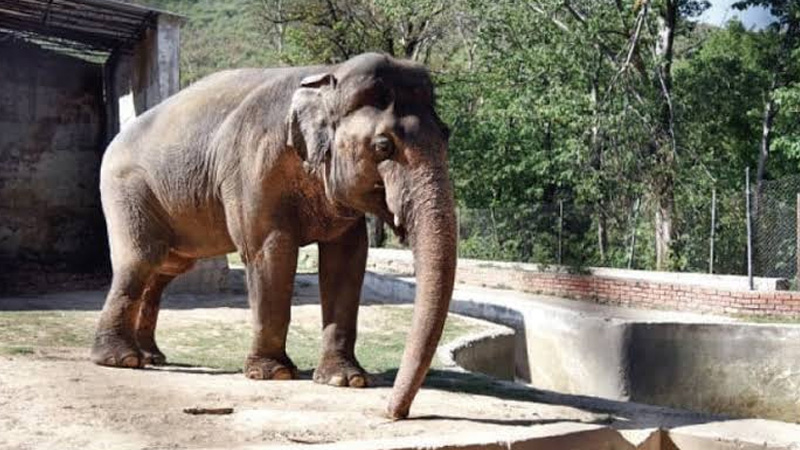
The eight-member experts’ committee has recommended that the 25,000-acre wildlife sanctuary in Cambodia could be a suitable area for relocation and retirement of elephant Kavaan of the Islamabad Marghzar Zoo after giving joy to thousands of visiting children over last several years, according to a press release issued here on Friday.
“The Committee has argued that the sanctuary already houses elephants and is equipped with experts, who have relocated and rehabilitated over 80 elephants so far, would be the best choice,” said Muhammad Saleem, deputy director and a media focal person of the Ministry of Climate Change
The eight-member experts’ committee has recommended that the 25,000-acre wildlife sanctuary in Cambodia could be a suitable area for relocation and retirement of elephant Kavaan of the Islamabad Marghzar Zoo after giving joy to thousands of visiting children over last several years, according to a press release issued here on Friday.
“The Committee has argued that the sanctuary already houses elephants and is equipped with experts, who have relocated and rehabilitated over 80 elephants so far, would be the best choice,” said Muhammad Saleem, deputy director and a media focal person of the Ministry of Climate Change
Islamabad Wildlife Management Board (IWMB) had constituted on June 9 an eight-member committee for relocation of the elephant Kavaan and other animals of the Marghzar Zoo to some other sanctuaries.
Complying with the direction of the Islamabad High Court, Chief Justice Athar Minallah, IWMB notified the experts’ committee, comprising its WWF-Pakistan’s senior director programme Pakistan as its chairman and biodiversity specialist Z. B. Mirza as co-chairman.
The Committee’s other members include Khyber Pakhtunkhwa Wildlife Chief Conservator Dr Mohsin Farooq, Islamabad Zoo veterinary officer Dr Bilal Khilji, Dr Masoodul Haq of Bahria Zoo, Dr Tom Channarong Srisa of Ard Save the Elephant Foundation, Ms Nilanga Jaysinghe of IUCN, co-founder of Save the Elephant Foundation Derek Thompson and representatives from M/o Climate Change as well as the Islamabad Zoo.
A meeting of IWMB, convened on July 13, reviewed various options for safe relocation/retirement of the elephant to comply with the Honorable Islamabad High Court’s judgment issued on May 21.
“The meeting participants were of the view that the re-location options for the elephant Kavaan must be considered after examining all parameters, such as the health of the animal, the logistics, suitability and facilities at the proposed re-location site and the agreement with the new site authorities amongst others.”



 red-ear- monkey in the rainforest of Ebo in Cameroon (© Robbie Whytock, San Diego Zoo Global)