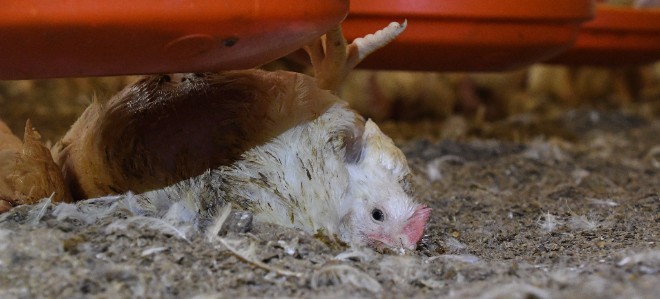
Today we released footage filmed over the past two months on a West Country chicken farm that supplies Faccenda – the UK’s second largest chicken company.
More than 150,000 birds are housed in four giant sheds in crowded, barren conditions to end up on shelves and menus of retailers such as Nando’s, Lidl and Asda.
Some of the distressing scenes captured by our investigators include:
Hundreds of dead chicks being dumped every day for several days, including one who was thrown into a wheelbarrow alive with dozens of dead bodies and left for at least an hour.
A worker kicking birds during daily checksinside the sheds; collecting ill birds and breaking their necks, with some still alive and flapping their wings as he carried them around.
Lame birds in obvious discomfort attempting to walk; birds on their backs slowly dying because they are unable to stand and reach water and birds with red, raw sores from the filthy ammonia-soaked litter underfoot.
Workers violently catching and crating birds for transport to the slaughterhouse, including carrying birds by one leg in violation of Defra’s welfare code.
Our expose featured in The Times and The Independent today, alerting millions of people to the agony endured by chickens raised and killed for meat in Britain.
Please help spread the word by sharing our video with your friends and family, and encouraging them to discover the joys of plant-based food by signing our Love Veg pledge!
Thank you for helping to make the world a better place for animals.
Tesco have so far refused to drop Hogwood Farm as a supplier, and this needs to change!
On Saturday 12th August, Viva! is holding a nationwide Day of Action. It is set to be our BIGGEST yet!
Viva! Campaigns aired undercover footage in the Mirror revealing shocking scenes of cruelty at Hogwood Farm, which supplies Tesco supermarkets.
Tesco claims to take “animal welfare extremely seriously”, but Hogwood was given their seal of approval – showing that supermarket welfare assurances are meaningless!
Our petition to close the farm downis helping us show Tesco that this treatment of animals is unacceptable. With over 31,000 signatures so far, we’ve made great progress. Thank you to everyone who has signed it!
Join us in telling Tesco to dump Hogwood as a supplier by ordering your FREE leaflets or demo pack today.
Order before 8th August to recieve your packs in time!
Our leaflets educate people about the UK’s failure to protect farmed animals and offers people the chance to avoid taking part in this cruelty – by trying vegan.
Please share this email with your friends and help us make this our biggest ever Day of Action!
The Battle of Passchendaele (German: Flandernschlacht, French: Deuxième Bataille des Flandres), also known as the Third Battle of Ypres, was a campaign of the First World War, fought by the Allies against the German Empire.[a] The battle took place on the Western Front, from July to November 1917, for control of the ridges south and east of the Belgian city of Ypres in West Flanders, as part of a strategy decided by the Allies at conferences in November 1916 and May 1917. Passchendaele lay on the last ridge east of Ypres, 5 mi (8.0 km) from a railway junction at Roulers, which was vital to the supply system of the German 4th Army.[b] The next stage of the Allied plan was an advance to Thourout–Couckelaere, to close the German-controlled railway running through Roulers and Thourout.
Further operations and a British supporting attack along the Belgian coast from Nieuwpoort, combined with Operation Hush (an amphibious landing), were to have reached Bruges and then the Dutch frontier. The resistance of the 4th Army, unusually wet weather, the onset of winter and the diversion of British and French resources to Italy, following the Austro-German victory at the Battle of Caporetto (24 October – 19 November), enabled the Germans to avoid a general withdrawal, which had seemed inevitable in early October. The campaign ended in November, when the Canadian Corps captured Passchendaele, apart from local attacks in December and the new year. In 1918, the Battle of the Lys and the Fifth Battle of Ypres were fought before the Allies occupied the Belgian coast and reached the Dutch frontier.
The choice of Flanders over areas further south or the Italian front, the climate and weather in Flanders, the choice of GeneralHubert Gough and the Fifth Army to conduct the offensive, debates over the nature of the opening attack and between advocates of shallow and deeper objectives, have also been controversial. The passage of time between the Battle of Messines (7–14 June) and the Battle of Pilckem Ridge (31 July, the opening move of the Third Battle of Ypres), the extent to which the internal troubles of the French armies motivated British persistence with the offensive, the effect of the weather, the decision to continue the offensive in October and the human cost of the campaign on the soldiers of the German and British armies, have also been argued over ever since.
Casualties
Various casualty figures have been published, sometimes with acrimony but the highest estimates for British and German casualties appear to be discredited.[155] In the Official History, Brigadier-General J. E. Edmonds put British casualties at 244,897 and wrote that equivalent German figures were not available, estimating German losses at 400,000. Edmonds considered that 30 percent needed to be added to German figures, to make them comparable to British casualty criteria.[156] In 2007, Sheldon wrote that although German casualties from 1 June – 10 November were 217,194, a figure available in Volume III of the Sanitätsbericht (1934), Edmonds may not have included them as they did not fit his case. Sheldon recorded 182,396 slightly wounded and sick soldiers not struck off unit strength, which if included would make 399,590 German losses.[157] The British claim to have taken 24,065 prisoners has not been disputed.[158] In 1940, C. R. M. F. Cruttwell recorded 300,000 British casualties and 400,000 German.[159] Wolff in 1958, gave German casualties as 270,713 and 448,688 British.[160] In 1959, Cyril Falls estimated 240,000 British, 8,525 French and 260,000 German casualties.[161]
John Terraine followed Falls in 1963 but did not accept that German losses were as high as 400,000.[162]A. J. P. Taylor in 1972, wrote that the Official History had performed a “conjuring trick” on these figures and that no one believed these “farcical calculations”. Taylor put British wounded and killed at 300,000 and German losses at 200,000.[163] In 1977, Terraine argued that twenty percent needed to be added to the German figures for some lightly wounded men, who would have been included under British definitions of casualties, making German casualties c. 260,400. Terraine refuted Wolff (1958), who despite writing that 448,614 British casualties was the BEF total for the second half of 1917, neglected to deduct 75,681 casualties for the Battle of Cambrai, given in the Official Statistics from which he quoted or “normal wastage”, averaging 35,000 per month in “quiet” periods.[164] Prior and Wilson in 1997, gave British losses as 275,000 and German casualties at just under 200,000.[165] Hagenlücke in 1997, gave c. 217,000 German casualties.[57] Sheffield wrote in 2002, that Richard Holmes’s guess of 260,000 casualties on each side, seemed about right.
On bullfighting I would like to say a few things. Perhaps this is known to most, or perhaps not. Known or not known, the bullfighting is not a tradition, is and remains cowardly murder.
Bull “fight”: animal cruelty and a billion-dollar business!
According to estimates by animal welfare organizations, the annual turnover of the bullfighting industry in Spain is between 1 and 2.5 billion euro. 200,000 jobs are procured in Spain, through the brutal execution of 40,000 bulls.
The professional groups that benefit from this massacre are many: Promoter of the events, simple bullfighting workers, up to the slaughterers, who later smash the sacrifice and sell as meat.
The breeding of the bulls and everything related to it must also be considered. They all want to participate in the big pot of the industry. In addition, bullfighting is a tourist attraction, such as paella and flamenco. The Spanish audience expects from a bullfight an especially good entertainment. One sits, one eats hamburger, and make calls with the cell phone, while down in the arena a living being is brutally massacred. Of the tourists, Americans and Japanese are the predominant proportion of bullfighting visitors. Most tourists go to the bullfight because they consider it a part of the country’s culture.
In 2013, the Spanish government protected the bullfight and since then this bloody massacre has been considered an ” immaterial cultural property ” in Spain. This was one of the greatest cultural shame in Spain, which has also led to economic corruption.
For EU agricultural subsidies, 130 million euros are earmarked each year for the breeders of bulls. 30 million comes from Germany.
The word bull “fight” is wrong, intentionally wrong. There is no fight between equal partners. It is not the battle of a bull against his fellow-species.
A bull is prepared in such a way that he loses the fight against a murder beforehand. The bull is kept in the dark for days before the massacre. Heavy weights are hung around his neck for weeks. To aggravate his vision even more, Vaseline is lubricated in his eyes. His nose is tamped with tampons to make him breathing harder, and needles are put into the testicles to “pinpoint” him with pain. And so they send the “equals” combat partner into the arena!
Where three acts of torture follow:
Act 1: Tercio de Varas (the third of the spit)
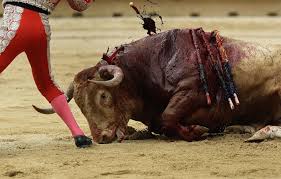
The first act is about the mutual learning of Matador and bull. Again and again the animal is wounded by the Picadors, the mounted helper of the bullfighter, with lances in the neck area and weakened by the blood loss. These targeted stitches in the neck of the bull make him lower his head more and more.
A preparation for the final act.
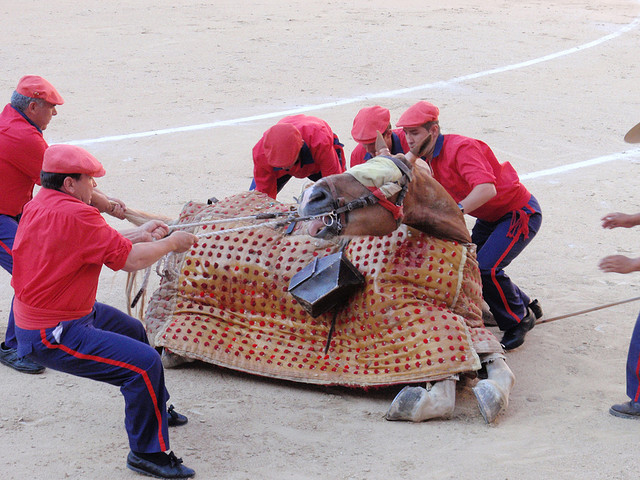
A Picador horse having suffered an injury from the bull
– horses also suffer in bullfights !
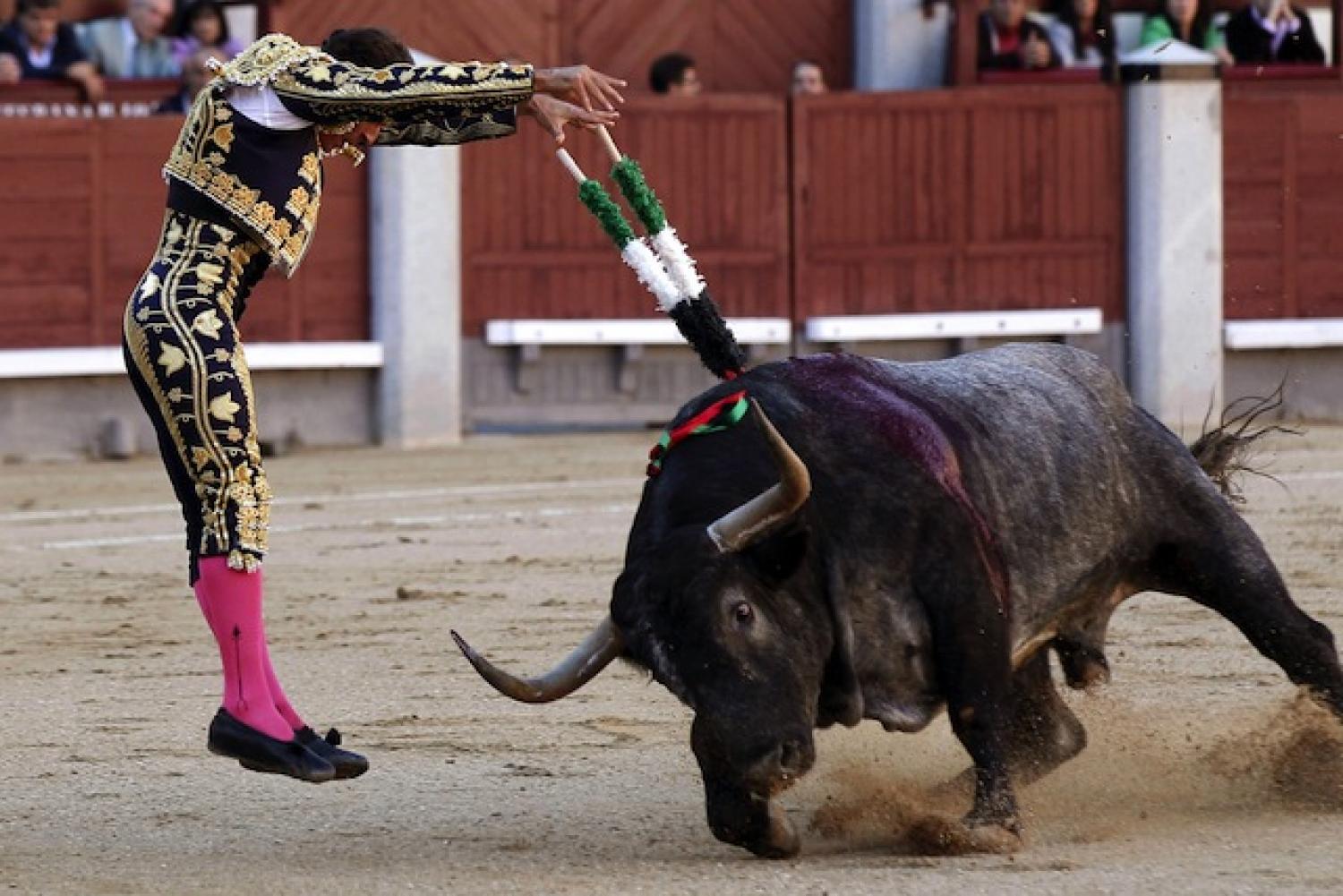
Act 2: Tercio de banderillas (The third of the banderillas) During the second act, sharp rods are stabbed into the shoulders of the Bull by Banderilleros.
This leads him to lose his strength and his aggression level continues to rise. A macabre game with the life of the beast, which is now beginning to struggle for his life.
Act 3: Tercio de Muerte (The third of death)
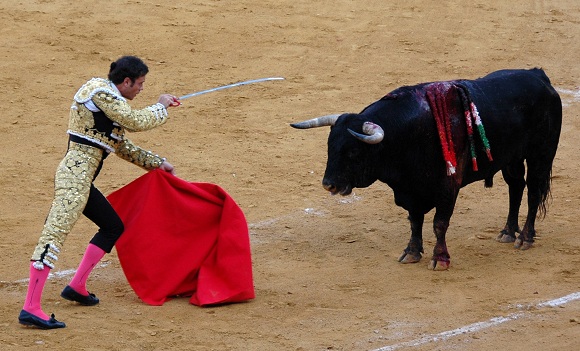
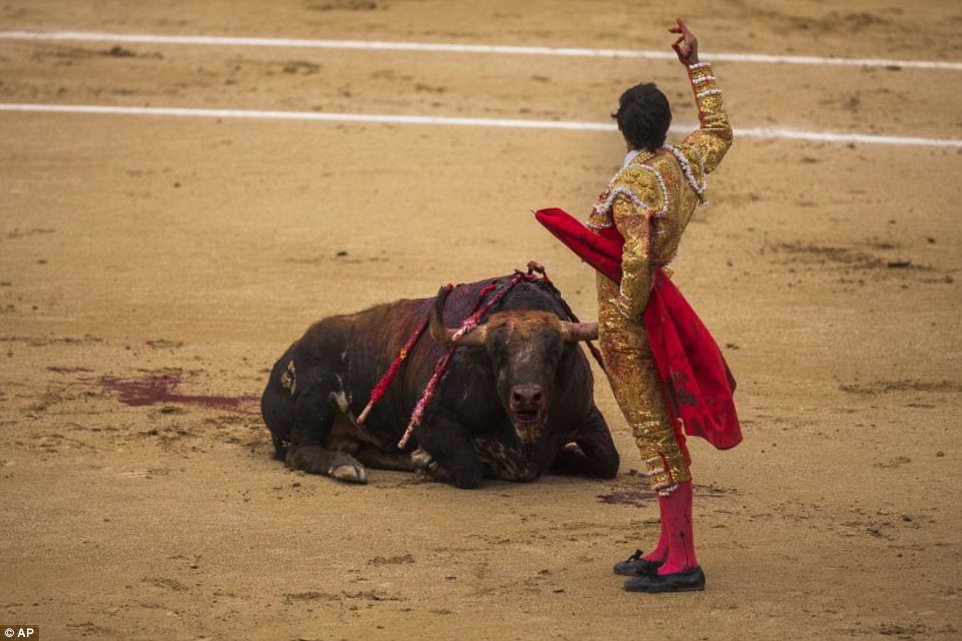
Now the Matador returns to the arena. There is a dance between Matador and his victim. With a deliberate push between the shoulders of the animal he tries to pierce the completely exhausted animal directly into the heart. The cleaner the better.
One has to imagine that the sword is completely inside of it and its organs are broken down. The bull does not fidget now, he is incapacitated, but fully conscious.
In this state the ears and the tail are cut off.
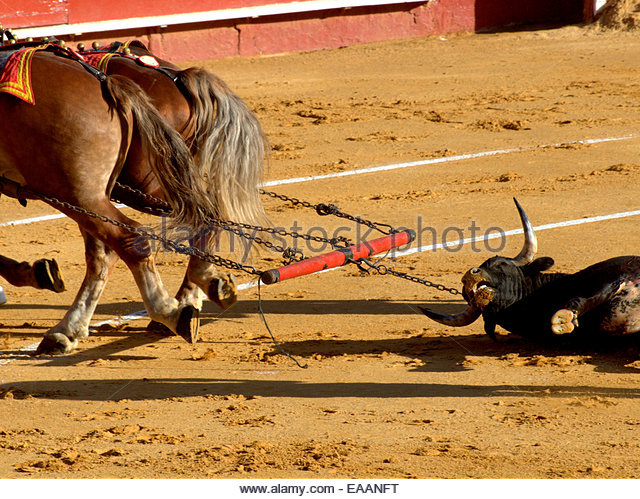
He is also dragged out of the arena by mules. Spanish bullfighting is not a tradition, it is an industry, an industry built on blood and torture.
And as long as these crimes are supported and financed by the EU, as long as the EU is doing corrupt business with bullfighting, animals are massacred and together with them, including civilization in Spain.
Best regards
Venus
The ‘masters of death’ – Tusk and Junker – EU officials turning the other way when it comes to animal abuse and suffering.
News Just In – 28/7/17.
Dear Mark — Founder ‘Serbian Animals Voice’,
Last year, you took action to urge the Spanish Balearic Islands to ban bullfights that subject bulls to cruelty in the name of entertainment.
Because of your compassionate voice, bulls will no longer suffer and die in this community during cruel and outdated blood-sports.
This life-saving victory sends a message to the rest of Spain and the world that there is no future for bullfighting and that spectacles of animal cruelty belong in the past.
Thank you so much for taking action and for caring about animals.
















 Serbian Animals Voice (SAV)