** URGENT **04/05/09 Europe: Last Call Today to Take Action in Europe for Seal Product Trade Ban

  eu-aw-logo  canada

We are only a few hours away from learning the outcome of one of the greatest efforts the ProtectSeals team — together with you — has ever undertaken. And there is still time to help.

This campaign has been a marathon — a fight of more than a decade now, for me — and tomorrow’s vote on a proposed European Union seal product trade ban could mark the beginning of the end of this senseless slaughter. If this proposal is passed, we will be one step closer to a future where baby seals are safe from being clubbed, shot, and skinned before they’ve even taken their first swim.

But even now, we cannot stop. We must make every minute count in the leadup to this vote.

I need your help to ensure that every elected representative walks into tomorrow’s meeting with one focus: passing a strong ban that will stop the cruelty and save the seals. Please, whether this is your first action on behalf of seals or your tenth, stand with us one more time and do the following right now:

1) Sign our petition, and ask everyone you know to sign, too. Remember, the winner of our contest to recruit petition-signers will join me in Canada next spring to visit the seal pups!

2) Write to your Members of the European Parliament. Make it clear that their constituents are counting on them!

3) Send a message to your Environment Minister. Preserving wildlife — including seals — is their responsibility!

I have been carrying this sadness — a burden you have shared with me — for such a very long time. Tomorrow, finally, I hope to rejoice.

Thank you for your continuing support and belief in what we are doing. None of this would be possible without you.

With hope in my heart,

Rebecca Aldworth
Director
Humane Society International/Canada


International Movement Against Bullfights – Please Visit the Web Site

Please support the work and spread the word about the fantastic work Maria is doing.

Visit the excellent website and learn the real cruelty inflicted on the Bulls in the ring and at the ‘Fiestas’ at www.iwab.org 

– Warning: Contains Graphic pictures of animals suffering.

SAV.

INTERNATIONAL MOVEMENT AGAINST BULLFIGHTS

MOVIMENTO INTERNACIONAL ANTI-TOURADAS

MOVIMIENTO INTERNACIONAL ANTITAURINO

MOUVEMENT INTERNATIONAL ANTI CORRIDAS

www.iwab.org

IMAB@iwab.org

Dear Friends,

The bullfight scheduled for the 25th of April did not take place. According to an article the inauguration was postponed for an undetermined time. The article says that this is due to the fact that the owners want to finish the works completely before the inauguration.

The inauguration will take place but the problem is to know when. They won’t give up and there is a complete black out concerning this issue in the Panamian newspapers. It’s impossible to find any article about this.

Please continue to send protests (emails can be find on our website at “Latest Campaigns”).

On the other hand we have bad news concerning Panama, whilst we fought to prevent this inauguration, another bullring with capacity for 2000 persons, was built and inaugurated in the province of Chiriquí, last 18th of April.

Bullring in Panama

24th of April of 2009

Last saturday was inaugurated in Chiriquí (Panama), a small bullring with capacity for 2.000 persons, 

http://www.eltiempo.com/colombia/bogota/ARTICULO-WEB-PLANTILLA_NOTA_INTERIOR-5056047.html

For the Animals

Maria Lopes
Coordinator
International Movement Against Bullfights
www.iwab.org

Crete: Private Animal Shelter Under Threat – Please Read and Send E Mail To Mayor

crete

Please support the efforts of Daphne by copying and dending the sample letter below to ALL the e mail addresses given.  Thanks – SAV

Daphne
 
http://www.facebook.com/people/Daphne-Dimitriadi/724601180
 
www.daphnediforanimals.blogspot.com

BACKGROUND:
This is about the private shelter in Kaina in Vamos area in Crete.This shelter has about 200 dogs and the villagers do not want it there…The mayor is on their side(!) although the shelter is 100% legal.They want the animals out (where?) to the streets so they can shoot and poison them or get them killed by cars(the motorway is nearby)...Tommorow there is a live broadcast on local tv where villagers and the mayor will be facing animal welfare activists and environmentalists.We need thousands of e-mails TODAY sent to Apofdim@dimos-vamos.gr saying that the world supports Linda Lucas and her shelter even threat them that the world will all turn against their municipality in negative advertising

Please send MASS e-mails and tell your friends and relatives to send too. Only this way we can save these poor dogs…

Note that many of them are wounded handicapped and elder animals who need medical attention daily and only Linda Lucas can offer… 

Send your sample letter or a letter of your own to ALL the following:

Apofdim@dimos-vamos.gr, info@minagric.gr,  dimos@chania.gr,  dhmosnk@otenet.gr,  souda@souda.gr,
dimosakr@otenet.gr, platanias@cha.forthnet.gr,
dhkolymb@otenet.gr, sfakia-d@otenet.gr

SAMPLE LETTER:

To Whom It May Concern:

I am outraged yet again regarding this senseless massacre in your community!

I have written previously, my words unnoticed, ignored, just as your animals. You campaign to brutalize animals, and I am sickened over your techniques, which include poisoning, shooting, and crushing by vehicle. Animals, like humans, are sentient, capable of fear, love, pain, and suffering; humans have the obligation and the capacity for empathy, and we must utilize our gifts to protect animals, not greedily slaughter them.

Your blatant disregard of your most vulnerable group of beings is unforgivable, and you only serve to attribute agony and sorrow to your country rather than beauty and giving. Perhaps you believe that, as an official of your community, your actions are beyond reproach. Perhaps you believe the world is blind to your illicit activities. The world, however, is vigilant, and we demand equity and love for your animals. We support Linda Lucas and her shelter!

As such, while you design to destroy the one small oasis of peace for animals, I will promote a boycott of your country and your country products. If a massacre should befall your innocent animals, you will reap the loss of tourism dollars; indeed, it would be financially detrimental for you to continue with your plans to harm these animals and should this occur, you will not only be considered malicious by the global community, but you will also sacrifice vital tourism dollars.

Please do not bear reality to this massacre: support, as we do, Linda Lucas, maintain her shelter, provide for spaying and neutering procedures, accept local and international assistance, criminalize any who abuse animals, and strive to foster an ideal whereby animals are respected, loved, empathized.

Sincerely,

YOUR

Name
YOUR Country

Serbia: Petition for Serbian Animals – Please Sign


Sign our petition ! for all Animals  in Serbia !Thanks !


http://www.thepetitionsite.com/9/peticija-za-srbiju/


ZA ŽIVOTINJE

FOR THE ANIMALS


protest131


protest111


Serbia / Uk: Press Release From (Uk) RSPCA Regarding Serbian Animal Welfare

We would like to  share the following news with you, all of our friends and fellow campaigners around the World.  For several days now we have been debating if this should be posted, as we know there is opposition about this from some Serbian campaigners, especially regarding the involvement of ‘ORCA’ at the meeting.


Yes, we are fully aware of the goings on at ORCA Belgrade in the recent past, and we have posted this information on this site – see links to past news at


https://serbiananimalsvoice.wordpress.com/2008/03/07/activists-4-serbian-animals/


But, we consider that the meeting with President Tadic and the signing of the petition calling for a Universal Declaration of Animal Welfare can only be positive news for the animals of Serbia.  Maybe Serbian politicians are finally realising that, and as we have always campaigned along the lines of, Serbia should not be allowed accession (membership) of the EU until it vastly improves its animal welfare legislation.

We hope that the information given in the Press Release (given below) by the Uk Royal Society for the Prevention of Cruelty to Animals (RSPCA) shows that the link between better animal welfare legislation and EU membership may have finally hit home in Belgrade.

The animal welfare framework law covers all species, and includes research animals, the protection of farm animals, transport and slaughter and the protection of wildlife in captivity, as well as forbidding wild animals in circuses.

Links to both Serbian circus and zoo posts below show that the current situation is dire; and so in our opinion, anything which will change this for the better is worth applauding.  We hope that you agree.

Circus and Zoo links:


https://serbiananimalsvoice.wordpress.com/2008/10/15/prisoners-of-the-medieval-belgrade-zoo/


https://serbiananimalsvoice.wordpress.com/2008/10/05/action-against-circus-belgrade-october-5th-08/


As stated, some campaigners in Serbia are not particularly pleased with the news given below due to ORCA being at the meeting.  But we feel that if new legislation improves animal welfare in zoos and circuses alone, regardless of anything else, then it is a very positive step forward.  One thing can be assured, with implementation of the animal welfare framework law, NGOs will be able to monitor and report failures in the system to the authorities.  Once it becomes an EU member state, Serbia can be formally reported to the Commission if serious failures in legislation implementation are continually seen.  This can result in state prosecutions by the EU Commission if necessary.  Some members of SAV have been involved with similar processes against Uk authorities during the past few years relating to failures in animal welfare legislation implementation, and now have considerable experience of what is required should it be necessary to help giving advice in the future.


We hope that like us, you feel that the news given in this PR below is reason to celebrate for once.


As always, anyone can leave comments on the site; that is down to the individual.  Maybe it will encourage more debate.  We respect every persons views, especially our friends who live and experience the daily troubles of Balkans strays.  All that can be hoped is that the issue will unite campaigners rather than drive wedges between them; there is only one way the future will improve for animals, and that is for cooperation between parties who should all be on the same side – the animals side !!!


SAV.

———————————————————————————————–


Press Release info is as follows:

http://www.politics.co.uk/opinion-formers/press-releases/animal-welfare/president-of-serbia-meets-with-rspca-ahead-of-first-animal-welfare-law-$1290130$366366.htm


President of Serbia meets with RSPCA ahead of first animal welfare law

Thursday, 23, Apr 2009 12:00

Serbia has today signalled its intent to improve animal welfare following a meeting between the country’s president and the RSPCA, ahead of the introduction of new legislation to better protect animals next month .

RSPCA International’s Senior Programme Manager for Europe, Alexandra Hammond-Seaman met President Tadic after Serbia joined a long line of countries worldwide signing a petition calling for a Universal Declaration of Animal Welfare.

Alexandra said: “It was a great honour to meet President Tadic and discuss such a vitally important issue. The Minister for Agriculture, Saša Dragin signed the petition and confirmed that Serbia will be adopting its first animal welfare framework law in May.”

Serbia is a potential country to join the European Union, and this move will allow the country to harmonise with current EU legislation on animal welfare.

The animal welfare framework law covers all species, and includes research animals, the protection of farm animals, transport and slaughter and the protection of wildlife in captivity, as well as forbidding wild animals in circuses.

After the adoption of this law Serbia will adopt the full EU legal framework on animal welfare into national legislation, as one of the prerequisites in the process towards the EU integration.

Alexandra added “RSPCA International has been actively engaged with Serbia for over five years now, by providing assistance and training with issues such as dog population control and stray dog management. We also work very closely with Serbian government agencies and the veterinary profession on improving farm animal welfare in the Country. We look forward to continuing to play a central role in helping to enforce the law.”

RSPCA International attended the meeting with another non-governmental organisation, the Organisation for Respect and Care for Animals (ORCA) which has in the past worked in Serbia to promote responsible pet ownership.

-ends-

RSPCA International

RSPCA International is one of the main organisations assisting in the humane treatment of animals overseas.

·         It advises governments and organisations on animal welfare legislation based on UK and European precedents.

·         It responds to appeals for help with crises caused by natural disasters such as oil spills by sending trained people, veterinary equipment and drugs.


·         It offers help through training and aid improving animal welfare standards in communities and countries where funds and resources are minimal.

In 2008 the RSPCA Overseas Fund distributed more than £600,000 to projects in over 30 different countries. More information can be found online at http://www.rspca.org.uk/international

Universal Declaration of Animal Welfare

The Universal Declaration is an agreement among people and nations to recognise that animals are sentient beings and can suffer, to respect their welfare needs, and to end animal cruelty – for good. The Declaration aims to help establish the world’s first international agreement on animal welfare. The final destination for the Universal Declaration on Animal Welfare will be the General Assembly of the United Nations. More information can be found online at http://www.udaw.org

RSPCA, Wilberforce Way, Southwater, Horsham, West Sussex RH13 9RS Uk


USA: Swine Flu and Factory Farms: Fast Track to Disaster

usa

 http://www.humanesociety.org/farm/news/ournews/swine_flu.html

Swine Flu and Factory Farms: Fast Track to Disaster

April 25, 2009

by Michael Greger, M.D.

The H1N1 swine flu virus in North America currently concerning global public health officials is not the first triple hybrid human/bird/pig flu virus to be discovered.
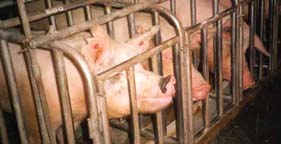
pig1

First Found on a Factory Farm

The first was discovered in a North Carolina factory farm in 1998. Since the 1918 pandemic, an H1N1 flu virus has circulated in pig populations, becoming one of the most common causes of respiratory disease on North American pig farms.[1]

In August 1998, however, a barking cough resounded throughout a North Carolina pig farm in which all the thousands of breeding sows fell ill. An aggressive H3N2 virus was discovered, the type of influenza that had been circulating in humans since 1968.

Not only was this highly unusual—only a single strain of human virus had ever previously been isolated from an American pig population—but upon sequencing of the viral genome, researchers found that it was not just a double reassortment (a hybrid of human and pig virus, for example), but a never-before-described triple reassortment, a hybrid of three viruses—a human virus, a pig virus, and a bird virus.[2]

Intensive Farming is the Problem

Dr. Robert Webster, one of the world’s leading experts of flu virus evolution, blames the emergence of the 1998 virus on the “recently evolving intensive farming practice in the USA, of raising pigs and poultry in adjacent sheds with the same staff,” a practice he calls “unsound.”[3]  “Within the swine population, we now have a mammalian-adapted virus that is extremely promiscuous,” explained another molecular virologist at the time, referring to the virus’s proclivity to continue to snatch up genes from human flu viruses. “We could end up with a dangerous virus.”[4]  This may indeed be what we are now facing.

Within months of the 1998 emergence, the virus showed up in Texas, Minnesota, and Iowa.[5]  Within a year, it had spread across the United States.[6]  This rapid dissemination across the country has been blamed on long-distance live animal transport.[7] 
pig3

Long Way to Go

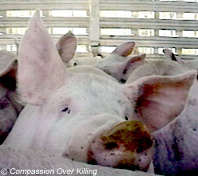
In the United States, pigs travel coast to coast. They can be bred in North Carolina, fattened in the corn belt of Iowa, and slaughtered in California.[8]  While this may reduce short-term costs for the pork industry, the highly contagious nature of diseases like influenza (perhaps made further infectious by the stresses of transport) needs to be considered when calculating the true cost of long-distance live animal transport.

What led to the emergence of the North Carolina strain in the first place? What changed in the years leading up to 1998 that facilitated the surfacing of such a unique strain? It is likely no coincidence that the virus emerged in North Carolina, the home of the nation’s largest pig farm. North Carolina has the densest pig population in North America and reportedly boasts more than twice as many corporate swine mega-factories as any other state.[9]

Agricultural Intensification

The year of emergence, 1998, was the year North Carolina’s pig population hit ten million, up from two million just six years before.[10]  At the same time, the number of hog farms was decreasing, from 15,000 in 1986 to 3,600 in 2000.[11]  How do five times more animals fit on almost five times fewer farms? By crowding about 25 times more pigs into each operation.

In the 1980s, more than 85 percent of all North Carolina pig farms had fewer than 100 animals. By the end of the 1990s, operations confining more than 1,000 animals controlled about 99 percent of the state’s inventory.[12]  Given that the primary route of swine flu transmission is thought to be the same as human flu—via droplets or aerosols of infected nasal secretions[13]—it’s no wonder experts blame overcrowding for the emergence of new flu virus mutants.

Starting in the early 1990s, the U.S. pig industry restructured itself after Tyson’s profitable poultry model of massive industrial-sized units. As a headline in the trade journal National Hog Farmer announced, “Overcrowding Pigs Pays—If It’s Managed Properly.”[14]
pig2

Crowding Breeds Disease 

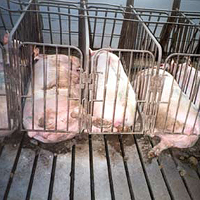
The majority of U.S. pig farms now confine more than 5,000 animals each. A veterinary pathologist from the University of Minnesota stated the obvious in Science: “With a group of 5,000 animals, if a novel virus shows up it will have more opportunity to replicate and potentially spread than in a group of 100 pigs on a small farm.”[15]

Recent Outbreak

The swine flu virus discovered this week in California and Mexico appears to be a quadruple reassortment virus incorporating genes from human and avian flu viruses as well as North American and European strains of swine flu. In Europe in 1993, a bird flu virus had adapted to pigs, acquiring a few human flu virus genes, and infected two young Dutch children, even displaying evidence of limited human-to-human transmission.[16]

Recipe for Disaster 

“Influenza [in pigs] is closely correlated with pig density,” said a European Commission-funded researcher studying the situation in Europe.[17]  As such, Europe’s rapidly intensifying pig industry has been described in Science as “a recipe for disaster.”[18]  Some researchers have speculated that the next pandemic could arise out of “Europe’s crowded pig barns.”[19] 

The European Commission’s agricultural directorate warns that the “concentration of production is giving rise to an increasing risk of disease epidemics.”[20]  Concern over epidemic disease is so great that Danish laws have capped the number of pigs per farm and put a ceiling on the total number of pigs allowed to be raised in the country.[21]  No such limit exists in the United States.

With massive concentrations of farm animals within which to mutate, these new swine flu viruses in North America seem to be on an evolutionary fast track, jumping and reassorting between species at an unprecedented rate.[22]  This reassorting, Webster’s team concludes, makes the 60 million strong U.S. pig population an “increasingly important reservoir of viruses with human pandemic potential.”[23]  “We used to think that the only important source of genetic change in swine influenza was in Southeast Asia,” said Christopher Olsen, a molecular virologist at the University of Wisconsin, Madison. Now, “we need to look in our own backyard for where the next pandemic may appear.”[24]

Dr. Michael Greger is director of Public Health and Animal Agriculture in the farm animal welfare division of The Humane Society of the United States. A physician specializing in clinical nutrition, Greger focuses his work on the human health implications of intensive animal agriculture, including the routine use of non-therapeutic antibiotics and growth hormones in animals raised for food, and the public health threats of industrial factory farms.


1 Zhou NN, Senne DA, Landgraf JS, et al. 1999. Genetic reassortment of avian, swine, and human influenza A viruses in American pigs. Journal of Virology 73:8851-6. http://birdflubook.org/resources/ZHOU8851.pdf.

2 Zhou NN, Senne DA, Landgraf JS, et al. 2000. Emergence of H3N2 reassortant influenza A viruses in North American pigs. Veterinary Microbiology 74:47-58. http://birdflubook.org/resources/Zhou47.pdf.

3 Webster RG and Hulse DJ. 2004. Microbial adaptation and change: avian influenza. Revue Scientifique et Technique 23(2):453-65.

4 Wuethrich B. 2003. Chasing the fickle swine flu. Science 299:1502-5. http://birdflubook.org/resources/WUETHRICH1502.pdf.

5 Zhou NN, Senne DA, Landgraf JS, et al. 1999. Genetic reassortment of avian, swine, and human influenza A viruses in American pigs. Journal of Virology 73:8851-6. http://birdflubook.org/resources/ZHOU8851.pdf.

6 Webby RJ, Swenson SL, Krauss SL, Gerrish PJ, Goyal SM, and Webster RG. 2000. Evolution of swine H3N2 influenza viruses in the United States. Journal of Virology 74:8243-51.

7 Wuethrich B. 2003. Chasing the fickle swine flu. Science 299:1502-5. http://birdflubook.org/resources/WUETHRICH1502.pdf.

8 Shields DA and Mathews KH Jr. 2003. Interstate livestock movements. USDA Economic Research Service: Electronic Outlook Report from the Economic Research Service, June. usda.mannlib.cornell.edu/reports/erssor/livestock/ldp-mbb/2003/ldp-m108-01.pdf.

9 Environmental Defense. 2000. Factory hog farming: the big picture. November.http://environmentaldefense.org/document…armingBigPicture.pdf.

10 Duke University Center on Globalization, Governance and Competitiveness. 2006. Hog farming overview. February 23. http://www.soc.duke.edu/NC_GlobalEconomy/hog/overview.php.

11 North Carolina Department of Agriculture and Consumer Services. 2001. North Carolina agriculture overview. February 23. http://ncagr.com/stats/general/livestoc.htm.

12 Wuethrich B. 2003. Chasing the fickle swine flu. Science 299:1502-5. http://BirdFluBook.org/resources/WUETHRICH1502.pdf.

13 Brown IH. 2000. The epidemiology and evolution of influenza viruses in pigs. Veterinary Medicine 74:29-46. http://BirdFluBook.org/resources/Brown29.pdf.

14 1993. Overcrowding pigs pays-if it’s managed properly. National Hog Farmer, November 15.

15 Wuethrich B. 2003. Chasing the fickle swine flu. Science 299:1502-5. http://BirdFluBook.org/resources/WUETHRICH1502.pdf.

16 Webster RG, Sharp GB, and Claas CJ. 1995. Interspecies transmission of influenza viruses. Americal Journal of Respiratory and Critical Care Medicine 152:525-30.

17 MacKenzie D. 1998. This little piggy fell ill. New Scientist, September 12.

18 Ibid.

19 Delgado C, Rosegrant M, Steinfeld H, Ehui S, and Courbois C. 1999. Livestock to 2020: the next food revolution. Food, Agriculture, and the Environment Discussion Paper 28. For the International Food Policy Research Institute, the Food and Agriculture Organization of the United Nations and the International Livestock Research Institute. http://ifpri.org/2020/dp/dp28.pdf.

20 MacKenzie D. 1998. This little piggy fell ill. New Scientist, September 12, p. 1818.

21 Ibid.

22 Wuethrich B. 2003. Chasing the fickle swine flu. Science 299:1502-5. http://birdflubook.org/resources/WUETHRICH1502.pdf.

23 Webby RJ, Rossow K, Erickson G, Sims Y, and Webster R. 2004. Multiple lineages of antigenically and genetically diverse influenza A virus co-circulate in the United States swine population. Virus Research 103:67-73. http://BirdFluBook.org/resources/webby67.pdf.

24 Wuethrich B. 2003. Chasing the fickle swine flu. Science 299:1502-5. http://BirdFluBook.org/resources/WUETHRICH1502.pdf.

Related Links

What’s a Factory Farm, Anyway?

Avian Influenza: Flu Factories

Welfare Issues with Gestation Crates for Pregnant Sows


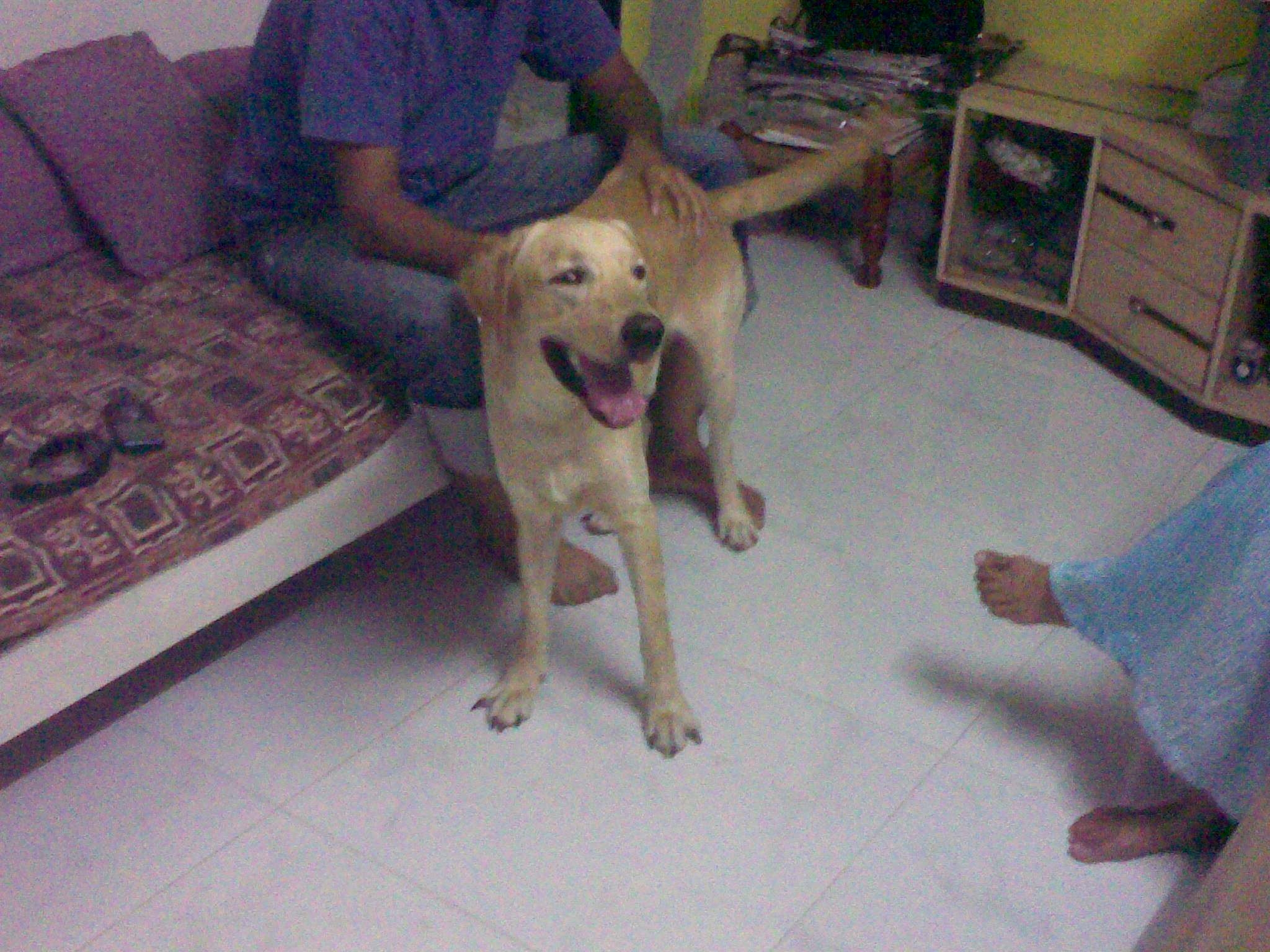
India (Mumbai): Bruno the Lab Needs a New Home – Please Spread the Word

inda00019

———- Forwarded message ———-
From: Sanam Karunakar <

Hi


Attached please find Brunos Pics.. Hes one year old and needs a home.. Up for adoption ..extremely friendly and loving..He is in Mumbai.


Contact – Vibha 9819125575/ Adeeb – 9920932329


Love,
Vibha..


 bruno1


bruno2


bruno3