Posted on May 9, 2018 by Serbian Animals Voice (SAV)
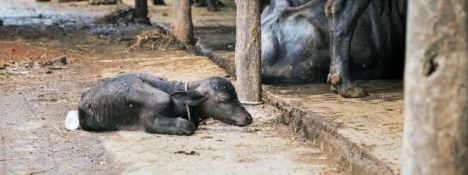
Honored and tormented: An undercover research by Animal Equality in more than 100 Indian dairy companies brings unimaginable animal suffering to light.
Animal Equality has spent more than two years researching 100 dairy farms, 11 live animal markets and eight slaughterhouses in India. The result is the report Honored and tormented – The suffering of India’s “sacred” cows for milk, the most extensive research in the Indian dairy industry so far. This is directly related to the Indian leather industry – and Germany is one of the major buyers of this leather from India.
The recordings of our investigators reveal shocking:
-Cows are inseminated by inexperienced workers with contaminated equipment and unhygienic conditions.
-Due to the emotional stress of cow and calf separation, some animals stop producing milk; These cows are placed by the workers next to dead, straw-stuffed calves. So they should believe that it is their own calf.
-The animals are beaten by workers with sticks and chains, they are kicked and sometimes even sexually abused.
-In none of the farms examined are the cows cared for by veterinarians; they either remain untreated or farmers use their own medication to cut costs.
-On the way to the slaughterhouse, up to 30 animals are loaded on a transporter, which is actually only allowed for a maximum of six animals.
-Traders twist or break the tails of the animals, rubbing chilies into their eyes and ramming sticks into their genitals to force them into slaughter transports.
-In the slaughterhouse the cows and cattle are repeatedly cut through the throat; Hardly a worker kills the animals already with the first cut.
-Many animals are fully conscious during the slaughter process and also experience the subsequent mounting.
Already in 2016, Animal Equality presented the findings of this research to the Indian government and made recommendations on how to ensure a higher standard of animal welfare in the dairy, meat and leather industries. As a result, India’s government initially enacted a number of bans, particularly for live animal markets, to protect cows and buffaloes from extreme but commonplace suffering. However, following resistance from some Indian regions, animal markets have returned to some practices, such as the sale of disused dairy cows for slaughter. In dairy farms and slaughterhouses, torture states still prevail.
We have launched a petition to convince the Indian government to finally take the necessary steps to protect the cows, calves and buffaloes from this agony. Support our claims today with your signature.
Posted on May 8, 2018 by Serbian Animals Voice (SAV)
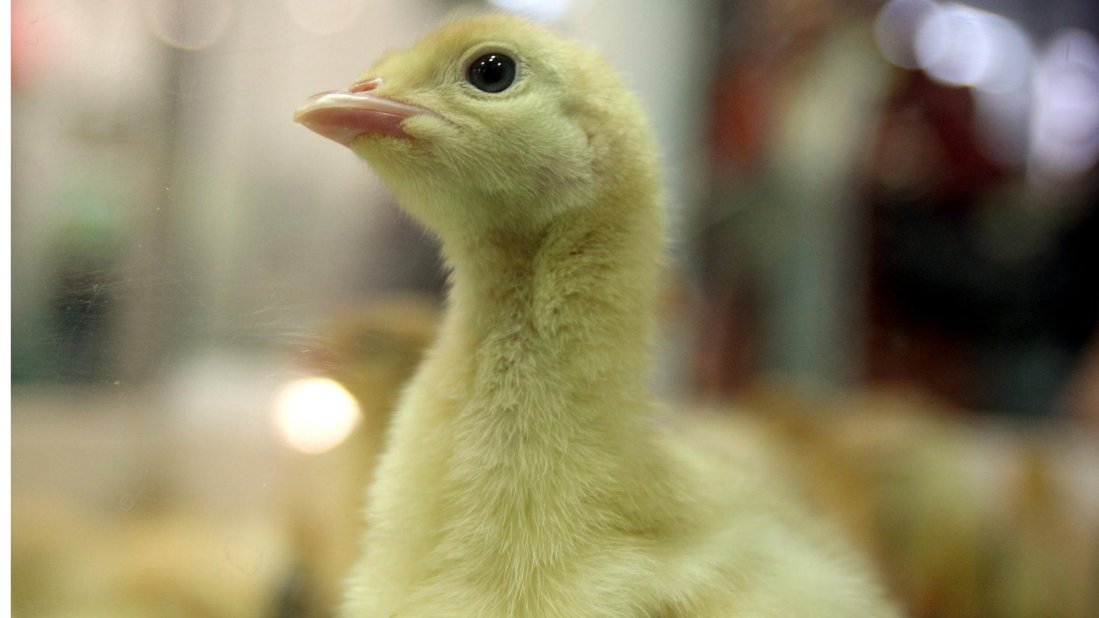
The killing of 20,000 chicks at Brussels Airport causes trouble in Belgium. Several politicians responded on Tuesday outraged that the animals intended for Africa were gassed at the weekend because of a transport problem. The Flemish Greens deputy Bart Caron spoke of an incident as in “Absurdistan”.
The chicks were supposed to be flown to Kinshasa in the Congo. But the departure failed twice for technical reasons, as the news agency Belga reported. Accordingly, the transport container was on the asphalt in the burning sun all weekend. The exporter did not want to take back the container according to media reports. To stop the suffering of the animals, they should finally be gassed on Sunday evening. The airport fire brigade refused and therefore their colleagues from neighboring Zaventem were called and took action.
The action triggered outrage in Belgium. “In any case, the responsible exporter must be held accountable, maybe even the airport itself,” said the “Green” Caron. His non-party colleague Hermes Sanctorum said: “It has come to the point that the most animal-friendly solution to transports is killing.” There is probably no difference between simple Amazon packages and animals. The deputy Jelle Engelbosch of the Flemish nationalist N-VA, however, spoke of a “necessary, urgent decision”. (AP)
My Comment: When PETA compared the lives of animals in farms with the Holocaust several years ago, “sensitive” citizens were schocked!!
This mass murder of 20,000 creatures in Brussels, or more precisely their gassing according to the well-known fascist methods of the Nazis, confirms that animals today are still the victims of a daily holocaust that will never end.
Because, as Isaak Bashevic Singer says: “when it comes to animals, everyone becomes a Nazi.
For the animals every day is Treblinka” . Or Brussels.
Posted on May 7, 2018 by Serbian Animals Voice (SAV)
The influence of Angela Merkel, both in Germany and in the EU, has not brought anything good for the animals. On the contrary, their lackeys have distinguished themselves more as lobbyists in the chemical and agricultural industries. But the era Merkel comes to an end.
We can summarize the mood in the media as follows.
Angela Merkel’s time is over. This is becoming increasingly clear in her international appearances, during which the allegedly once most influential woman in the world fades more and more into a peripheral character.
In American usage, there is the term “lame duck”.
It finds use above all in the political context to describe an incumbent, who has lost all influence and its successor is long in the starting blocks. The last cannot be determined in the case of the German Chancellor, although behind the crumbling façade already some of the competitors appear, which should soon start the race …
Her fruitless trip to the United States, in which the American President was only given a few hours to relentlessly disclose the poverty of the erstwhile powerful woman, has set all the alarm bells ringing in the German executive floors.
Nobody will ever understand what brought the pastor’s daughter from Templin to the crazy idea, that she would be able to compete with someone like Trump, who would be superior to her in all matters, except perhaps her Russian and mathematical skills.
The Chancellor’s last visit was rated by both German and American press as a work routine,
in which nothing went wrong, but at least in the short term should change little.
This applies to both the US and US steel and aluminum trade disputes, as well as the nuclear deal with Iran or NATO defense spending.
Anyway, Merkel, does not matter to the US president, and also in Europe, Macron prefers to do his own thing. Because there is no unity in Transfer Union anyway, Macron reshuffles the EU just without Merkel to the French “Cash Cow”.
Only a few loyalists are remained in Brussels, who need Angela Merkel to fulfill their own political agenda. For these, however, the German Chancellor is of little use. And the allies have become rare. It is a matter of time before Merkel loses her last bastion.
Three more years Merkel cannot cope with this country any more – let’s hope that this will not only be recognized by the powerful entrepreneurs, but eventually by the other stirrup owners as well. For the benefit of Germany and Europe.
Posted on May 6, 2018 by Serbian Animals Voice (SAV)
Anja Hägele can still remember her first assignment. She lay half naked under a plastic wrap in an oversized meat bowl, in the middle of a busy street in Jena. “I was so excited, I did not want to talk to anyone,” says the 35-year-old today. “Then came the TV and I had to go to the camera.” That was in 2006 when she was as intern at Peta. After twelve years and countless missions as a meat, fur animal or half-naked eye-catcher, Hägele is now Petas campaign boss for the German-speaking region.
Hägeles workplace is the headquarters in Stuttgart, South Germany, with 80 permanent employees. If you work here, you eat vegan and do not wear leather, silk or wool. “In terms of employment law, nobody can prescribe that, but I think that’s okay,” says Hägele.
Compared with environmental organizations such as Greenpeace, Nabu or WWF Peta is considered particularly radical. The charitable and donation-financed association fights against mass animal husbandry, zoos, animal experiments and demands vegan nutrition for all people – often with provocative actions. In 2004, a campaign was banned by German and international courts: Peta had compared mass animal farming with prisoners in Nazi concentration camps.
Naked woman skin belongs to the trademark of Peta campaigns. Hägele says she likes to strip off for the good of the animals. “The chance of being reported in the media is higher then, but our society is working that way,” she says. “It’s not sexist to me, after all, I can do what I want with my body.”
But sometimes it even goes too far. When she stood naked behind a shower curtain in a water saving campaign in Amsterdam, a press photographer had his camera under the curtain pushed. “I made it clear that that’s not okay.”
The majority of her professional life, however, takes place in the Stuttgart office. Every day worried citizens, from neighbors complaining about neglected pets, to whistleblowers, denouncing abuses in a Group. If the case is important enough, the campaign engine will start. For example, a few weeks ago, when it became known that a hospital in Halle had pediatric surgeons surgically operated on live pigs for training purposes and died of the surgery.
30,000 activists in Germany, Austria, Switzerland
A typical peta action plan consists of three stages:
– The activists first ask the wrongdoer in writing to change his actions and suggest alternatives. For example, the hospital was encouraged to practice operations on synthetic bodies or human corpses.
– If the addressee does not respond, or responds unsatisfactorily, level two comes: a press release. “Most of them fold at this point,” says Hägele. So also, the management of the hospital. She invited the animal rights activists and expressed her willingness to compromise.
– Stage three failed in this case: an action on the ground and the pillory in the network.
Hägele can rely on a network of more than 30,000 volunteer activists in German-speaking countries. They are contacted and mobilized – to sign a petition, to share posts on social media or as vociferous demonstrators on the ground. “These people help out of love of animals, and we take everyone, from students to pensioners,” says Hägele.
She too has been interested in environmental protection as a child. “I wondered why my dog got so much love, but not pigs.” After graduating from high school, she studied political science and cultural studies with the aim of later working for an environmental ministry or a green NGO. Then she saw on MTV a promotional video of Peta – and applied for an internship.
Peta pays newcomers an annual salary of 30,000 euros at 40 weekly hours. Hägele now earns 40,000 euros as a manager, has 27 days off and flexible working hours based on trust. “We want to reward employees appropriately so that they do not need a second job and are fully committed to animal welfare,” she says. And that also means: in miserable weather, freeze in shopping malls and recruit supporters. In Germany, Europe or even further away.
“I was once arrested in the US,” says Hägele. Peta had not registered the action correctly with the authorities, she ended up in a New York prison cell with nothing more than a yellow bikini. Nevertheless, she says, “I feel privileged to practice my passion as a profession.” This passion even goes so far that Hägele wants to pass her possession on to Peta. “My employer is in my will.”
Posted on May 6, 2018 by Serbian Animals Voice (SAV)
NO Appetite for Extinction.
Major UK food store, ‘Iceland’; has committed to stop using Palm Oil as an ingredient in its own brand foods by the end of 2018.
A great move to save the forests and more importantly, orangutans which have been depleted by rainforest destruction. The equivalent of 146 football pitches being destroyed every HOUR.
Well done Iceland – we only hope others will now follow quickly !
Posted on May 5, 2018 by Serbian Animals Voice (SAV)
Police confiscated 50 young crocodiles at Heathrow Airport
London 4 May 2018
Trapped in transport boxes that are far too small, the police have discovered a total of 50 approximately one-year-old crocodiles at London Heathrow Airport, according to the Magazine “der Spiegel”. Accordingly, ten reptiles each were transported in a container that was designed for only four small animals.
Grant Miller, head of Cites Security Monitoring Unit Cites at Heathrow Airport, told to “der Spiegel”: “It’s just unacceptable for reptiles to be transported that way.”
The year-old reptiles, which arrived on a flight from Malaysia, had fought each other during the journey due to their cramped circumstances.
Each of the five transportation boxes used had room for four crocodiles – but 10-foot-long animals were in each one.
One crocodile has since died.
Originally, according to the report, the reptiles were to be delivered to a breeding farm in Cambridge shire in eastern England were to be bred for meat – but now they are looking for a new home for them and being cared by officials from the Convention on International Trade in Endangered Species (CITES).
Speaking to “Der Spiegel”, Miller continued, “The police action is meant to be a warning to those who want to expose wildlife to such conditions.”
I thought about it a bit:
From crocodiles we still make bags, so brainless people compensate their inner ugliness with external exoticism.
Crocodiles are still kept in the zoo too. There, the animals stew in the sun, lurking in pools of green water while stupid visitors take photos with the inmates of the Zoo Guantanamo’s.
And every frustrated man, who confirmed his potency with the paid murder of safari animals always had a embalmed crocodile as a rug in his apartment.
Today, the modern corpse eaters, the gourmets with exotic desires want crocodiles on their table and belly.
So these otherwise highly sensitive and intelligent animals end up on a farm, where they are treated as breeding objects for the rest of their lives and brutally slaughtered for leather industry gastronomy after about fifteen months.
From a random irony I saw today on the TV station “NAT GEO WILD” a documentary about crocodiles: “In 200 million years of evolutionary history crocodiles have become perfect killers.”
I am quickly researching to find out, which are these perfect „killers “. And become resourceful:
Every year about 1,000 people are killed by crocodiles.
The number does not correspond to a dangerous “killer”!
And how many crocodiles are massacred by perfect “killer human”?
Every year, 30,000 crocodiles are brutally killed alone for handbags!
More than 1.2 million crocodiles are bred in Thailand. In huge breeding and slaughterhouses, the reptiles are processed in bulk to leather and meat.
The precious skin is peeled off, the innards cut out, the meat packaged.
That makes the most money. That is a perfect “killer”, dear NAT GEO!
In German portals for gastronomy I find even expensive offers of “professional killer” for crocodile meat victims:
Crocodile Neck Steaks: 49.96 € / kg
Crocodile Eye-fillet (1 kg) 51.95 € / kg
End of the story: “Indeed man is the king of beasts, because his cruelty surpasses theirs. We live on the death of others. We are walking tombs! “(Leonardo da Vinci)
Posted on May 5, 2018 by Serbian Animals Voice (SAV)
Use Brexit to end fur imports, celebrities including Judi Dench, Ricky Gervais and Andy Murray urge Theresa May
‘Britain’s responsibility to animals does not end at our borders’
Dame Judi Dench, Paloma Faith and Andy Murray are among more than 30 celebrities urging Theresa May to introduce a UK ban on animal fur imports after Brexit.
Fur farming has been illegal in the UK since 2000, but fur from animals such as foxes, rabbits and minks continues to be imported.
According to Humane Society International (HSI), Britain has imported over £650m-worth of fur since the ban on farming.
A letter delivered to the Prime Minister on Monday and signed by 31 high-profile British figures argues “this makes no sense”.
“If fur is too cruel to produce in this country, it’s too cruel to sell in this country.
“We believe that Britain’s responsibility to animals does not end at our borders, but extends globally, to those animals killed to be traded into our country.”
A total ban on imports of animal fur is impossible as long as the UK is a member of the European Single Market, as fur products are still produced in several European countries.
But HSI hopes that Brexit will provide the chance for the government to “close our borders fully to this cruel and archaic trade”.
According to HSI, more than 100 million animals die each year for the fur trade, many of them reared in tiny barren cages, electrocuted, gassed or even skinned alive.
Monday’s letter was written to support the #FurFreeBritain campaign, which calls on the government to extend a current ban on imports of dog and cat fur to all species and is backed by animal welfare charities including HSI, PETA, the RSPCA and Animal Aid.
Signatories include Bill Bailey, Fearne Cotton, Joanna Lumley, Ricky Gervais and Simon Amstell.
An inquiry into the fur trade was launched last week by the Environment, Food and Rural Affairs Committee, which will examine “how the industry can be made more transparent” and look at post-Brexit possibilities for altering legislation around the import of fur.
The inquiry follows revelations last year that a number of major retailers including Amazon, TK Maxx, Boohoo and Groupon were selling products containing animal fur, despite advertising them as synthetic.
Norway pledges to shut down all fox and mink fur farms by 2025
Animal rights groups ‘delighted’ by news but warn more must be done to end trade
Norway’s government has pledged to shut all fur farms by 2025, a move welcomed by animal rights charities.
The country is the 14th European nation to phase out fur farming, according to Humane Society International (HSI), which campaigns against the fur trade.
Norway’s Conservative Prime Minister Erna Solberg made the pledge to shut down all fox and mink farms as part of a deal with the anti-fur Liberal Party, which is now set to join her two-party minority government.
Guri Wormdahl, of the Norwegian Fur Breeders Association, said the organisation was “shocked [and] shaken to the core” by the news.
There are nearly 250 fox and mink farms in Norway, according to the organisation’s website, and mink production is currently increasing, with several new farms under construction. The country currently produces around one million pelts a year.
The number of farms used to be far higher, however. In 1939, Norway was the world’s biggest producer of fox fur and was home to almost 20,000 farms, according to a government report.
In 2013, the Nordic country produced just 3 per cent of the world’s fox furs and only 1 per cent of global mink output, with both markets now dominated by China.
“It’s not a very lucrative business in Norway,” said Sveinung Fjose, of Menon Business Economics and an expert on fur farms. “It wouldn’t harm the Norwegian economy severely” to close it down.
Animal welfare organisations were delighted at the news.
“We are thrilled to see such an unequivocal pledge from the Norwegian government to ban all fur farming,” said Ruud Tombrock, executive director of Humane Society International’s Europe branch.
“We also hope that Norway’s fur farmers will decide to dismantle their businesses before the phase out deadline. Factory farming wild animals for fur in appallingly deprived conditions is unconscionably cruel, so to see a ban on this dreadful trade in a Scandinavian country is truly historic.”
Campaigning charity Animal Defenders International (ADI) also welcomed the news. The group has been at the forefront of the movement to end the international fur trade, which it claims causes the death of more than 110 million animals a year.
In September last year, ADI activists released footage filmed on a Polish fur farm showing two Arctic fox cubs dragged from their cages and electrocuted to death.
The foxes seen on the farm allegedly had bent feet and overgrown claws, which ADI claimed was the result of the animals spending their entire lives standing on floors made of wire mesh.
“Wherever this cruel trade exists, there is suffering and death,” ADI said in response to the news from Norway.
The group was “delighted” at the announcement, but insisted that the closure of fur farms does not mean the demise of the fur industry.
Despite banning fur farming in 2000, the UK continues to export and import large amounts of fur, according to ADI.
“We have been finding an increasing amount of fur either mislabelled or not labelled at all. This is misleading ethical consumers, who assume it is fake because it’s cheap. Consumers don’t know what they are buying,” said Claire Bass, director of HSI UK.
“Ultimately, banning the import or sale of fur is the final nail in the coffin for this industry,” Wendy Higgins, spokesperson for HSI, told The Independent.
“It’s also critical that we continue working with retailers and designers to take fur out of fashion from the top down.”
“There are still far too many celebrities wearing fur. Whether it’s Katie Price in her raccoon dog fur pom-pom hat or Kim Kardashian in a full length fur coat, it glamorises a grim industry and needs to stop.”
Swedish zoo admits killing nine healthy lion cubs because they became ‘surplus’ animals
Only two of 13 cubs born to different litters at animal park have survived past five years
A zoo in Sweden has said it euthanised healthy lion cubs because it could no longer keep them.
Boras Djurpark, an animal park around 25 miles from Gothenberg, admitted it had put down nine healthy lion cubs since 2012.
Bo Kjellson, chief executive of the park, said healthy animals sometimes had to be euthanised if they were rejected by their pride, or cannot be rehomed elsewhere.
“I think they were killed after two years,” Mr Kjellson told Swedish broadcaster SVT.
“At that time we had tried to sell or relocate them to other zoos for a long time but unfortunately there were no zoos that could receive them, and when the aggressions became too big in the group we had to remove some animals. And then it had to be them.
“It’s no secret in any way and we do not try to hide that were working this way. So it’s unfortunately a natural path for groups of lions.”
Mr Kjellson said the zoo was unsure of what would happen to the other lions.
“That we will see in the future. Currently, the group works well, but some of them may become surplus animals, and then we will try to place them elsewhere.
“It could be so that we have to put them to death.”
Only two of the 13 cubs, born to three separate litters, have survived the past five years.
Two lions died of natural causes and the remaining cubs were put down.
Helena Pederson, a researcher in animal studies at Gothenburg University, told SVT the euthanisation of animals in zoos raised the question of whether such institutions should be open.
“It is clear that there is a contrast to the public’s perception of what a zoo is,” she said.
“To kill animals as part of the organisation, I think that upsets quite a few.
“I think we need to contemplate on why it’s important for us to have zoos and if it’s worth the price the animals pay for it.”
London’s historic Old Spitalfields market bans the sale of fur from 2018
‘Real fur is extremely cruel, environmentally-unfriendly and should be confined to the history books’
The historic Old Spitalfields Market in London has announced traders will no longer be able to sell fur from the beginning of theyear.
“Following a review carried out by the Market, we have taken the decision to request stall holders do not offer animal fur for sale from the beginning of 2018,” a statement posted on the market’s Facebook page reads.
“The exact wording and details are still being worked out but we thought we’d share this now.”
The news is being hailed as progress by animal rights activists.
Humane Society International UK (HSI) director Claire Bass said: “HSI is delighted that Old Spitalfields Market has made the compassionate decision to request that its stallholders no longer sell animal fur.
“Real fur is extremely cruel, environmentally-unfriendly and should be confined to the history books.”
Earlier this year, fashion giant Gucci announced it would stop using fur from 2018.
Although fur farming was banned in the UK in 2000, Britain has imported at least £650m worth of fur since then, according to HSI.
The majority of the fur comes from farms overseas, including from China and eastern Europe.
Earlier this year, an investigation by the Humane Society International and Sky News revealed many trusted retailers, including Missguided and House of Fraser, had been inadvertently selling real animal fur instead of fake fur.
Some of the items being labelled as faux fur were actually found to contain cat fur.