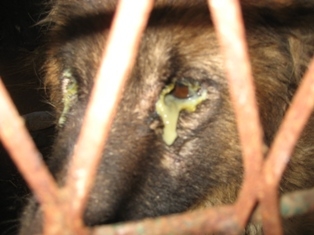
University of Florida horror story
On Jan 10, 2002, capuchin monkey 120V (along with his 4 brothers) was sold into slavery at the University of Florida from the now-defunct Primate Products Inc. in Miami. Documents indicate that UF determined that all but one of these individuals arrived inside their labs already compromised and infected with rubella (German measles). Monkeys living in the wild do not contract measles. This infection is exclusive to nonhuman primates forced to live in captivity and is sometimes fatal. However, left wholly untreated inside UF, little 120V and his 3 brothers are regularly documented as still living with this infection over a decade later. Sometime after his enslavement, sick little 120V was light-heartedly baptized “BOOGER” by vivisector Raymond Joseph Bergeron who continues to get rich from his victims’ misery and blood. For 21 years, Bergeron has been conducting iron chelation “studies” (i.e., he poisons monkeys with heavy metals and then force feeds them chemicals to try to resolve the condition he created). One of UF’s largest benefactors is said to have succumbed to haemochromatosis, an iron-overloading disease and so this “research” is clearly politically- and economically-motivated. Yet Bergeron received close to $700,000 from the NIH (that means from taxpayers) in 2013 alone. And it is interesting to note the words of one of his anonymous colleagues: “…he’s a bastard. Bergeron himself barely ever even looks at the poor creatures, much less ever touches them. He keeps his distance at all times. He hates the animal facilities.” Immediately upon finding himself inside UF’s dungeons, Booger began a gruelling routine of being knocked down, dragged from his cell, restrained, prodded, poked, drugged, poisoned, anaesthetized, undergoing gratuitous operations, and being thrown back in his cell. Perhaps the best part of his life is when he peers out of his cage, momentarily unmolested, to await the next indignities to be visited upon his deteriorated little body. We know that by 2004, little Booger was already a drug addict due to the relentless administration of increasingly-larger doses of ketamine and other tranquilizing agents. While there are no lab charts, daily logs, or veterinary records for a 9-month period between 2004 and 2005, Booger’s documentation indicates that he had developed alopecia by March of 2005. This is a common condition in lab monkeys that is caused by stress and self-mutilation, indicative of the individual’s deteriorating mental health as they are driven insane from their confinement. Now a formal federal complaint has been filed with the USDA for a number of unconscionable and lengthy gaps in which veterinary care appears to have been withheld. The missing records could simply be yet another symptom of the culture of corruption running rampant inside UF to hide the atrocities committed in their labs. Not wanting anymore images of their victims to reach the public, UF has steadfastly maintained that “no images exist” since 2011. We are working diligently to disprove that statement and, thus, prove what we believe is yet another wilful exercise to actively defy and remain in non-compliance with Florida state disclosure laws. Beginning in 2005 and continuing through 2013, he is repeatedly found with vomit in his cell, his body obviously attempting to reject the poisons that he is relentlessly being force fed. Over years, he is repeatedly reported for having a swollen tongue, hands, and feet and is noted to be salivating excessively. Eventually, by 2010, he has lost control of his lower lip conjuring images of a stroke victim, unable to control their muscles that simply sits and drools. There is no escape for little Booger. He is found with significant amounts of blood in his cage from the increasingly-worse self-inflicted injuries. By 2011, he begins throwing his faeces at his tormentors. He cannot escape his torment. Perhaps he is escaping into inevitable madness. Despite the fact that Bergeron has discovered absolutely nothing of relevance in over 2 decades, Booger, who has already withstood over a decade of terror at his direction, was just re-approved and re-funded in January for another 3years in hell. At the end of this study, he may be sold or be allowed to be adopted by Jungle Friends, a nonhuman primate sanctuary in Gainesville. We will do everything in our power to see that “Booger” and his fellow prisoners are released. But it is of the utmost importance that we stop this concentration camp and never again allow them to replace any monkey with new and terrified victims.
New methods without animals
As some countries and companies roll out new rules to limit animal testing in pharmaceutical products designed for people, scientists are stepping in with a new way to test therapeutic drug candidates and determine drug safety and drug interactions – without using animals.The development of “chemosynthetic livers,” which could dramatically alter how drugs are made, was presented at the 247th National Meeting & Exposition of the American Chemical Society (ACS), the world’s largest scientific society. Mukund Chorghade, Ph.D., noted that the EU enacted new regulations in 2010, known as REACH, that aim to dramatically reduce the use of animals in testing. But the development of new pharmaceuticals still depends heavily on the time-consuming and expensive process of animal testing. “Researchers in drug discovery make small quantities of new potential drug compounds and then test them in animals,” said Chorghade, who is chief scientific officer of Empiriko Corporation and president of THINQ Pharma. “It is a very painstaking, laborious and costly process. Frequently, scientists have to sacrifice many animals, and even after all that, the results are not optimal.” Typically, when researchers are onto a new compound ….they test it on animals to see if it’s toxic before taking it into clinical trials with human subjects. They figure this out by metabolic profiling. That is, after giving an animal a test drug, the experimental compound does its designated job in the body until the liver breaks it down. Then researchers try to detect the resulting, minute amounts of molecular by-products, or metabolites. It’s these that are often responsible for causing nasty side effects that can derail an otherwise promising therapeutic candidate. This is where Empiriko’s patented chemosynthetic liver technology (Biomimiks™) comes in. Chorghade has developed these stand-ins, which are catalysts that act similarly to a group of enzymes known as cytochrome P450. Catalysts are substances that speed up processes that otherwise wouldn’t happen or would occur slowly. Many of these cytochrome P450 enzymes break down drugs in the liver. So rather than using lab animals, researchers could figure out metabolic profiles of drugs by mixing them in test tubes with chemosynthetic livers. Chorghade’s team at Empiriko has already demonstrated how Biomimiks™ works with several pharmaceutical compounds. “These chemosynthetic livers not only produce the same metabolites as live animals in a fraction of the time,” Chorghade said, “but they also provide a more comprehensive metabolic profile, in far larger quantities for further testing and analysis.” Other possible applications are cropping up for these chemosynthetic livers. One of Empiriko’s scientific advisors suggested the use of Biomimiks™ to detoxify blood for liver transplant patients. Biomimiks™ could also be used in the near future to predict side effects when multiple drugs are taken together. In a case study, Chorghade and collaborators looked at two drugs commonly taken together, one for high cholesterol and the other for type 2 diabetes. They found that the cholesterol drug sped up the breakdown of the other one, which could potentially lower its effectiveness. The chemosynthetic livers aren’t yet approved to take the place of animal tests. But Chorghade is optimistic. His group has tested more than 50 drugs so far to show that the catalysts accurately mimic how the human body processes them. He said that they’re working to get that number up to 100, which is what the U.S. FDA requires for regulatory approval.
Animal testing ‘fundamentally flawed’
The flagship journal, Nature, has called on the research community to tighten animal research planning and analysis. It is, for instance, common for results of tests in one animal species not to predict the same result in another. Yet animal models are still expected to accurately predict reactions in human beings. Sadly, the 11.5m animals used in EU laboratories in 2011 are testament to the fact that tradition and faith in what was described as the ‘high-fidelity fallacy’ in 1959, namely that results in one mammal will predict what happens in humans, persists. Change is needed. Part of the solution lies in decisions taken by research funders, whether these are public, at EU or national level, private charitable organisations or companies. Several flagship research projects have already switched to new technologies that rely on the use of human cells, organs and systems integrated with advanced computational techniques to initiate a new ‘systems toxicology’. Several animal models of disease are now receiving the same kind of critical evaluation. Animal models of stroke and asthma, diseases that afflict millions of people worldwide, have consistently failed to deliver new therapies and the need for new approaches is increasingly being recognised. New funding opportunities are becoming available. Commercial companies specialising in providing in vitro analytical techniques are thriving. Public funding can also be channelled through regional development budgets, as we see in the UK’s centre for alternative testing and in-vitro monitoring (CATIM) project, which provides lab space and resources for small companies through the University of the West of England. AXLR8, the EU coordinated research programme to accelerate the transition towards more predictive, non-animal approaches in toxicology, is just one example of how the EU can lead the world in research excellence when it is guided by good science rather than an unthinking reliance on traditional approaches. In toxicology, we now realise that the animal tests first developed in the 1920s are not fit for purpose. The human cell tests, high-throughput robot systems and powerful new computer programmes replacing animal test approaches mark a bold new era in safety testing based on human biology-based approaches capable of elucidating chemical reactions at the cellular level, rather than broad and misleading extrapolations from mice to men. As new generations of scientists emerge, and new technologies are developed that exceed our wildest expectations of what’s possible, more and more we will see science challenging its traditions, replacing animals and in so doing, improving the quality of our biological understanding and prediction of safety of chemicals and the effectiveness of new medicines. Full article: www.theparliament.com/latest-news/article/newsarticle/animal-testing-is-outdated-and-fundamentally-flawed/#.UwhyzM40_D4
Filed under: GENERAL NEWS - International / National / Regional | Leave a comment »