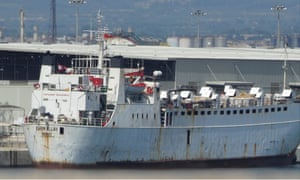
Spain: Cattle stranded at sea for two months are likely dead or ‘suffering hell’.

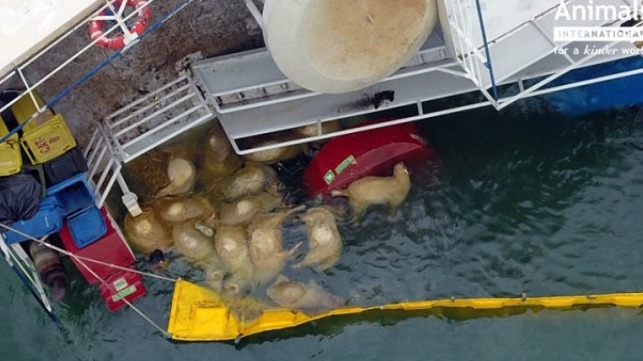
The cattle ship Karim Allah docked in Tarragona, Spain, 2020.

The cattle ship Karim Allah docked in Tarragona, Spain, 2020. Photograph: Animal Welfare Foundation/Tier Schutz Bund Zurich

WAV Comment – BIG thanks to ‘The Guardian’ (London) for sticking with, and reporting on this incident so very well over the last few months.  Click on our live export tag  Live Transport – World Animals Voice to read all the previous news from the Guardian (and more) about this most disgusting business in sentient beings.

Cattle stranded at sea for two months are likely dead or ‘suffering hell’ | Environment | The Guardian

Cattle stranded at sea for two months are likely dead or ‘suffering hell’

Two livestock ships have been refused entry to multiple countries on health grounds since leaving Spain in December

One of two livestock ships at sea since mid-December with thousands of cattle on board is now at the Spanish port of Cartagena, but the fate of its cargo is unclear.

The two vessels left from different ports in Spain before Christmas to deliver their cargoes of animals, but were each refused entry by various countries including Turkey and Libya, owing to suspected outbreaks onboard both ships of the bovine disease bluetongue.

Spain’s government and the country’s largest association of beef producers, Asoprovac, have both said the cattle came from areas free of bluetongue.

On Tuesday, the Spanish news agency EFE reported that although Turkey had originally agreed to take the cattle, satisfied they were bluetongue free, the animals were rejected on arrival because of disease fears.

A Spanish government source confirmed that the Karim Allah, carrying a reported 895 calves, was anchored just outside the Spanish port of Cartagena. The other ship, Elbeik, carrying 1,776 animals, continues to sit at anchor in Turkish waters off the coast of Cyprus.

Silvia Barquero, the director of Animal Equality Spain, said she understood that many animals were already dead and any still alive would be “suffering a real hell”.

Official veterinary inspections of both ships had been due to take place late last week in Cyprus and Sardinia, but neither ship approached shore to allow vets on board.

On Tuesday, a spokesperson for Spain’s agriculture ministry described the ships’ plight as a “failed operation by a Spanish exporter, who was going to sell the animals in Turkey, then tried unsuccessfully to sell them in Libya”. The spokesperson did not respond to questions about animal numbers, conditions on the ships or possible next steps.

The spokesperson added that the Karim Allah, “now arriving in Cartagena, left Spain with animals that had the corresponding health certificates and which were from areas free of bluetongue. The animals therefore left the port of Cartagena in good health.”

Last week, the ministry said the Elbeik, which left from the Spanish port of Tarragona, was also carrying cattle from bluetongue-free areas.

Maria Boada Saña, a vet with NGO Animal Welfare Foundation, said she feared that at least 100 animals on the Karim Allah were already dead.

“The Karim Allah arrived Sunday night at Cartagena, sailing away from a planned veterinary inspection Saturday morning in Sardinia,” she said.

She added that a Spanish agriculture ministry source said that although the ship was in Spanish waters, it had not yet requested entry to Cartagena port.

“That means we have no idea right now if animals are alive or dead,” said Boada Saña. “Other sources, though, have told me the Karim Allah has not asked for animal feed. To me, the way it sailed away from an inspection, the way it is waiting and not asking for food probably means most of the animals are dead.”

Dead animals would have to be removed from the ship by hoist and the operation could take at least a day, or much longer, depending on numbers, said Genoa-based lawyer Manuela Giacomini.

In a related development, a Spanish government source confirmed that Cartagena port had temporarily suspended the departure of livestock ships until the Karim Allah docks. The vessel continues to be anchored in front of the harbour and the decision to enter the port was up to the owner of the ship, the source added.

Prof Kristen Stilt, director of Harvard’s animal law and policy programme, who is writing a book about the transport of live animals, said it was an inherent risk with live transport that the animals would be rejected at their destination port.

Once labelled as rejected, Stilt said it was “very likely that no other country [would] accept them, as we are now seeing with the two vessels at sea with calves from Spain”.

Another problem for crew and livestock, she said, was the absence of an international arbiter that could assess claims of disease and make a binding determination. The result, she said, was “usually catastrophic in terms of loss of animal lives”.

Dutch MEP Anja Hazekamp said “the only way to stop animal cruelty related to animal transport” was to introduce a total ban on the export of live animals outside the EU.

“Both vessels concerned have EU certificate approvals, which means that they can load European animals and send them to third countries, such as Libya, Lebanon, Egypt and Saudi Arabia,” she said. “In total there are around 80 vessels with such a certificate.”

Sign up for the Animals farmed monthly update to get a roundup of the best farming and food stories across the world and keep up with our investigations. And you can send us your stories and thoughts at animalsfarmed@theguardian.com.

Spain: Cartagena Port Suspends Exports of Livestock.

Read the full story at:

Spain: Cartagena Port suspends exports of livestock following Bluetongue disease incident. – World Animals Voice

USA: URGENT! WI WOLF HUNT OPENS TODAY: HERE’S WHAT YOU CAN DO.

From:

FRIENDS OF THE WISCONSIN WOLF & WILDLIFE

URGENT! WI WOLF HUNT OPENS TODAY: HERE’S WHAT YOU CAN DO

URGENT! WI WOLF HUNT OPENS TODAY: HERE’S WHAT YOU CAN DO – Friends of the Wisconsin Wolf & Wildlife (wordpress.com)

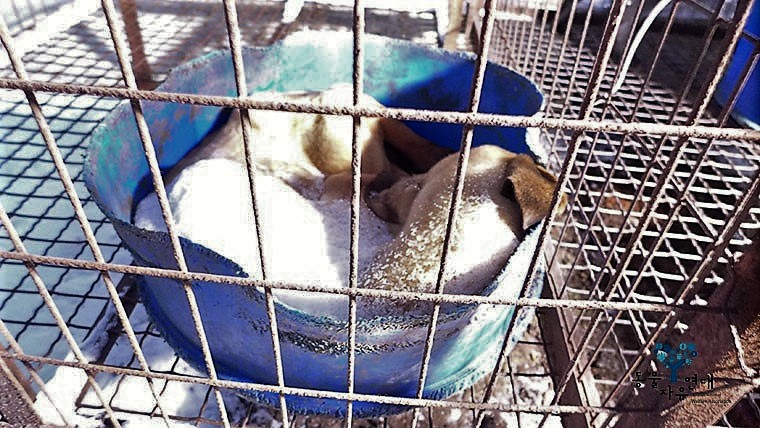
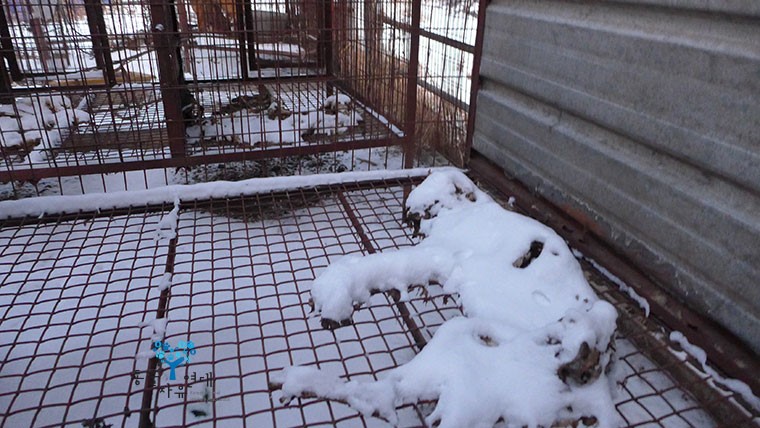
South Korea: Dogs Left to Starve and Freeze to Death on Dog (Meat) Farms.

South Korean Meat Dogs.

View the latest newsletter and actions to take via the following links.  \Please watch the video as it shows the reality of what a disgusting animal abuse situation this is.

Dogs left to starve and freeze to death on dog farm in Yeoju, South Korea – Stop the Dog and Cat Consumption in S. Korea! (koreandogs.org)

https://r.newsletter.koreandogs.org/ajc350odtht7e.html?utm_source=sendinblue&utm_campaign=_Dogs_left_to_starve_and_freeze_to_death_on_dog_farm_in_Yeoju_Take_action_to_stop_the_unimaginable_cruelty_TODAY!_&utm_medium=email https://r.newsletter.koreandogs.org/ajcsf8odtht7e.html?utm_source=sendinblue&utm_campaign=_Daegu_Chilseong_Dog_Meat_Market_slaughters_dogs_while_you_wait__Help_stop_the_cruelty_to_our_loving_friends!_&utm_medium=email

Below – ‘Mr Do Nothing – but give False Promises’

Australia / Namibia: People power stops new live export business in its tracks.

From our campaigner friends at Animals Australia.

People power stops new live export business in its tracks

A plan to begin exporting live animals from Namibia to Kuwait has been quashed thanks to a united, global effort drawing attention to the suffering caused by the trade.

The idea that when one door closes another opens, is mostly reassuring. But when it comes to the global live export trade, this universal truth is the reason we need to remain ever vigilant. You see, as countries have become clued-up to the cruelty inherent to live export — and widespread opposition to it — live exporters have found it harder to shore up business.

When Australia restricted sheep exports during the dangerous northern summer months, exporters knocked on Romania’s door. And Animals Australia was there. When Romania began questioning the trade, they went to South Africa. Again, we were already there. When South Africa’s NSPCA took the battle to stop the trade all the way to the High Court, it was abundantly clear: this global trade in animal cruelty is well and truly matched by a global effort to stop it.

From Australia to New Zealand to Brazil to South Africa and to dozens of countries throughout Europe — there is a powerful, international collaboration of groups and individuals working together to save animals from this ruthless industry.

And it’s a compassionate effort that has just paid off in Namibia, with new plans to begin live export from the Southern African nation put on hold indefinitely.

The business plan put forward by Tradeport Namibia proposed to import 70,000 live sheep, 50,000 goats and 5,000 cattle from South Africa and Botswana for live export from Namibia to Kuwait.

As exposé after exposé has revealed — it’s a sea journey fraught with risk for the animals who would be confined in cramped and stressful conditions for weeks before facing terrifying fully conscious slaughter upon arrival.

A rapid-fire public and media education campaign was launched in Namibia to highlight the reality of live export for the animals. In its submission objecting to the business plan, Namibia’s SPCA noted that the trade undermines Namibian laws and standards and that allowing live export would:

And the warnings have been heeded. In announcing that plans to export live animals would be ‘put on ice’, Tradeport Namibia noted the strong opposition, locally and internationally, to the export of live animals and that the company did not want to be involved in a business that will attract widespread outrage.

A united global front is turning the tide on live export. We don’t always win, but we are always there. And every action you take to support these efforts takes us another step towards shutting the door on this industry, for good.

Check it out in full via:

People power stops new live export business in its tracks | Animals Australia

Regards Mark

Power to all the good people !

Romania: Secret decks found on ship that capsized killing thousands of sheep.

WAV Comment – we are covering a lot at the moment re live exports.  This is not current news but goes back to November 2019 when the ‘Queen Hind’ sank shortly after leaving the port of Midia in Romania; allegedly carrying 14,600 destined for slaughter in Saudi Arabia.

For information; it would appear that several secret decks were found on the vessel during attempts at salvage; and that in fact, many more sheep had been carried to those declared officially.  Naturally, Romania has denied this, and the EU being the EU, has dragged its heels in every respect with regard to getting official information about this.

The only information to emerge since the sinking has been the discovery of secret compartments onboard with dead animals inside, by the company hired to remove the ship from the water.

Read more at:


https://www.theguardian.com/environment/2020/nov/27/romania-accused-of-silence-over-ship-that-capsized-killing-14000-sheep


We have no faith in the Romanian system or what its government says.  They are certainly not the best animal welfare nation on the planet.  With our experience in live animal transport, we would have no surprise whatsoever that additional (secret) decks were fitted into the vessel; simply to increase numbers and to obtain more profit.  Was overloading due to the secret decks the reason that the Queen Hind capsized shortly after leaving Midia, we ask ?

Have a read of the information and links to that we have supplied below.  If we ever witness the EU taking action against Romania regarding this incident then it could be considered progress.  When everyone keeps quiet and ‘below deck’ about the realities, it could be said that there is a cover up.  Please read the info and make your own decisions.

Despite promises from the Romanian government that the results of the capsize will be published on the Ministry website; our search today (24/2/21) has still revealed nothing.

Regards Mark

Extra Decks Found on Capsized Livestock Carrier


Secret decks found on ship that capsized killing thousands of sheep

Discovery by salvage divers off Romania raises new questions over EU exports of live animals

Secret decks for extra animals have been found in a livestock carrier that sank off the Romanian port of Midia in November drowning thousands of sheep, according to the company carrying out the massive salvage operation.

Only 180 sheep survived out of the 14,600 initially believed to have been onboard the Queen Hind, which was carrying them from Romania, the EU’s biggest exporter of the animal, to Saudi Arabia.

But the revelations about secret decks are likely to increase the death toll by several thousands, and raise fresh questions on whether overloading was to blame for the capsize.

The vessel was left on its side in the water as it sank not far from port, with sheep corpses piling up around it. Images of the tragedy made headlines worldwide and led to renewed calls by animal activists to impose a ban on live exports from Europe to non-EU countries, particularly the Middle East and north Africa.

The Romanian national daily Adevărul reported on Sunday that the firm that won the auction to bring the vessel to shore, Grup Servicii Petroliere (GSP Offshore), made its first attempt on Saturday but operations were halted after the crane’s cables were unable to bear the load.

Gabriel Comănescu, GSP’s president, was quoted by Adevărul as saying that “during the operation, the divers entered the water, [and] found additional decks.

These additional decks also have animals on board”.

Comănescu added: “There are decks not included in the cargo plan, they are undeclared. It is the problem of the authorities to find out why they were loaded and why they were not included in the cargo plan. It’s a big question. There is a much larger load than over 14,000 sheep.”

Gabriel Paun, of Animals International, said the revelation “confirms our initial suspicion that the vessel capsized because of overloading”. He added: “We are outraged that this came out from the company bringing the vessel back to the shore and not from the Romanian government itself.”

Animals International said it will file complaints to the EU commission and the Romanian prosecutor’s anti-corruption department.

“[GSP] came with the right equipment last week and they tried to lift it up with a crane and bring it to the shore,” Paun said. “They had calculated that the ship was full of water and animals, so they were prepared to lift more [weight] but still the cables broke.”

He had been told that the head of the company had sent down divers to investigate, and discovered secret decks loaded with thousands of animals.

Brian da Cal, UK director at the animal welfare organisation Four Paws, said he feared that the death of thousands of sheep could have been avoided.

“The allegations regarding hidden decks on the ship are of huge concern and strengthens our calls for an outright ban of long-distance transports of live animals and a maximum of eight hours transportation duration. No matter how strict the rules may be and how tragic this accident is, mass deaths like this are becoming more common.”

He said Four Paws was able to rescue 254 sheep from the half-sunken ship but several died later of exhaustion and injuries – 180 survived and are now being kept in a location north of Bucharest.

Paun said: “We’re saying that Romanian authorities are not to be trusted because this vessel has been inspected by the Romanian government [and] they’ve missed the extra decks which were not in the cargo plan.”

Paun said Romania exports about 3 million sheep annually. European live animal exports rose from a value of $1bn (£800m) in 2000 to $3.3bn in 2018.

An official from the Romanian national veterinary and food safety authority, in comments carried by Adevărul, appeared to dismiss the allegations and said the vessel was heavier because “dead sheep do not have the same weight as the live ones”.

A border police spokesman also dismissed the story as speculation.

The Guardian has contacted MGM Marine Shipping, the management company behind the Queen Hind, for comment. The Romanian embassy was also approached.

Secret decks found on ship that capsized killing thousands of sheep | Romania | The Guardian

More…

https://www.maritime-executive.com/article/extra-decks-found-on-capsized-livestock-carrier

Extra Decks Found on Capsized Livestock Carrier

Salvors working on the capsized livestock carrier Queen Hind claim they have found extra decks on the vessel.

The Palau-flagged Queen Hind capsized shortly after departing the Port of Midia in Romania on November 24 last year. While the crew escaped safely, only 180 of 14,600 sheep were saved. Salvors Grup Servizi Petroliere (GSP) claim that there could have been more sheep lost, as divers found that the extra decks had animals on board.

Divers were sent to investigate after cranes were unable to lift the vessel as planned. Cables snapped under the extra weight which could mean that several thousand more sheep were onboard than previously reported. The salvors claim the extra decks were not documented on the cargo loading plan.

The claim that extra sheep were on board has been disputed. Local media reports cite an official saying that the salvors may not have accounted for the extra weight of water-logged sheep; the salvors dispute this. Additionally, it has been noted that exact counts of sheep are not made at boarding.

The Guardian reports Gabriel Paun, a spokesperson for Animals International, saying the vessel was suspected to have capsized due to overloading. Animals International plans to make a formal complaint to the European Commission about the case.

https://safety4sea.com/secret-decks-found-on-capsized-livestock-carrier-off-romania/

Secret decks found on capsized livestock carrier off Romania


More than two months after the livestock carrier ‘Queen Hind’ capsized and sank off Romania taking down over 14,o00 sheep, the company tasked with the ship salvage has discovered secret decks that could accommodate a higher number of animals. This has created allegations that the sheep death toll was higher than thought.

Casualties | 05/02/20

The livestock carrier was heading from Romania to Saudi Arabia, when it overturned just off Midia Port, Romania, on 24 November, with approximately 14,600 sheep and 22 crew members onboard. The crew was saved but only 180 sheep survived.

However, the recent revelations by the salvage company on extra decks are likely to increase the death toll by several thousands, and raise fresh questions on whether overloading was to blame for the capsize, The Guardian reports.

In particular, the salvage firm Grup Servicii Petroliere (GSP Offshore), halted operations Saturday, after the crane’s cables were unable to bear the load, the Romanian national daily Adevărul reported.

As such, the divers entered the water and found additional decks, which also had animals onboard, Gabriel Comănescu, GSP’s president, was quoted as saying.

There are decks not included in the cargo plan, they are undeclared. It is the problem of the authorities to find out why they were loaded and why they were not included in the cargo plan. It’s a big question. There is a much larger load than over 14,000 sheep,

…he stressed.

Meanwhile, this news re-surges initial suspicions that the incident occurred due to overloading.

In light of this, animal welfare organization Animals International said it will file complaints to the EU commission and the Romanian prosecutor’s anti-corruption department.

love is share

One of the secrets of happiness is being able to share.
Human animals have yet to learn

regards and good night, Venus