269 Libération Animale: “The whole system must be changed, not only a law article”

🏴 BLOCKADE OF VANLOMMEL SLAUGHTERHOUSE (BELGIUM)/ WE DO NOT FIGHT FOR THE ADVENT OF VEGAN CAPITALISM BUT FOR THE LIBERATION OF ALL OPPRESSED INDIVIDUALS!
📷 Blockade of Vanlommel slaughterhouse on July 20, 2020 (on the visual, we read:

« We don’t want to veganize the world, we want another world! »)

Despite the repression against the activists, direct actions by autonomous and anarchists groups like blockades, liberations and sabotages must continue.

The are various symbols and structures of the speciesist domination that can be targeted, it is a question of daring and putting into practice our ideas, complicities, knowledge, and ingenuity in terms of strategy.

This offensive perspective of the “269 Libération Animale” collective endorses anti-speciesism as a political struggle.

It is a struggle for animal liberation but more generally against all systems of domination. Praxis is inherent in this vision of anti-speciesism, – revolutionary – and built with the oppressed unlike many “animal rights’ associations” that shed light on humans and compassion.

We think that we cannot lead the anti-speciesist struggle without direct confrontations against the speciesist system itself and we do not consider the State and capitalism as allies in this struggle. Indeed, strategies involving them always lead to authoritarian measures that strengthen the control of the State on the lives of the animals like laws and decrees that reform the speciesist system instead of abolishing it.

This cooperation is fake, does not reflect our values, and is a complete betrayal of the animals.

We want to use direct action in order to impact directly the speciesist system of domination and capitalist production tools. We do not aim to raise public awareness but to cause concrete impacts: economic damage, liberations, geographical activism with the creation of sanctuaries.

We refuse to collaborate with the institutional and capitalist power hoping to get little reforms that allow big associations to win members and followers but that abandon our comrades to their fate!

The whole system must be changed, not only a law article.

For more…at https://worldanimalsvoice.com/2020/12/09/269-liberation-animale-the-whole-system-must-be-changed-not-only-a-law-article/


And I mean…«We don’t want to veganize the world, we want another world! »
We already have another world.
But it’s not this one, which we want.
We have allowed our rights to be withdrawn to freedom of expression, information, and security related to Corona.
We have no choice but to do what this system requires of us.
Because at the moment, any resistance is futile and risky.

How are we supposed to change the whole system of animal exploitation then?
Most of the animal rights activists are totally apolitical and system compliant, and no longer willing to participate in direct actions.

I mean the thesis of the group “269 Liberation Animale”- which has 350 members is theoretically very correct.
I just lack the magic wand to implement it in reality.

My best regards to all, Venus


Petfluencer market worth millions

We all know them – the Instagram accounts that are all about animals. Dogs, cats, hedgehogs, and even foxes pose in front of the camera and get lots of likes for it.

At first glance, it doesn’t seem like much is wrong with the cute animal images.

But unfortunately, there is often animal suffering behind the photos.

For many pet-fluence owners, it’s not just about sharing their animal roommates with the world, but also about making money with it.

They conclude advertising deals, for which the dog is placed next to food cans, the cat is put in a backpack or the hedgehog is placed next to a water bottle.

Social media like TikTok, YouTube, and Instagram don’t stop at pets either. Domestic and wild animals are increasingly being used as “pet-fluencers”.
The animal counterparts to influencers delight millions online – and turn over millions.

The other side of the coin: animal cruelty is often hidden behind success.
Some Instagramer earns so much money with it that they have become self-employed and photograph and post their animals full-time.

How are the animals really doing?

Actually, every animal lover should be aware that animals are not and do not want to be photo models.
With pet-fluence, no spontaneous snapshots are posted, but the animals are staged, draped, disguised, and even brought into dangerous situations for them.

For example, it scares a hedgehog to death if it is held next to a cat – its “predator” – for a photo. And all to amuse the followers and for profitable advertising deals.

Some costumes even limit their movement extremely and they would like to shake them off immediately. Animals also don’t understand why they have to hold out in an unnatural position until the perfect photo has been taken.

Animals just want to lead a species-appropriate life in peace.

Petfluencer: Die erfolgreichsten Tiere auf Instagram - Blick

Wild animals and exotic animals have no place in living rooms or on Instagram. These include, for example, hedgehogs, monkeys, foxes, and exotic species of cats.

The trade-in of these animal species is particularly cruel: Many animals are caught in the wild and the majority of them die during transport. Until the animals are bought, they are kept in cages in captivity and often suffer from housing-related diseases.

For more…at https://worldanimalsvoice.com/2020/12/08/petfluencer-market-worth-millions/


And I mean…Influencers were yesterday – now the age of pet-fluencers has dawned.

Animals speak to our emotions – and the advertising industry knows that too.

Jiffpom’s earnings don’t reveal owners, but an estimate by UK personal finance website Lovemoney could make Jiffpom over $ 150,000 per post.
The social media analysis tool from InfluencerDB, on the other hand, rates a post by the dog at an average of at least 45,000 US dollars in media value.

Unlike human models, “pet-fluencers”  don’t have to be flawless to be successful.

On the contrary: Often it is precisely flaws such as overbites, flat snouts, deformed legs, sail ears, and bulging eyes that make an animal known.

Especially animals with striking, supposedly cute blemishes, often from torture breeding.

These include e.g. French bulldogs, pugs, and short-legged cats. Those who present these animals on social media and stage them as “stars”, in turn, encourage other people to purchase such an animal themselves – and help support torture breeding.

A kind of animal abuse has been reached when you humanize animals when you disguise them and do that for amusement.
In many cases, torture breeding and comparatively ugly animals are successful on Instagram. These animals suffer from protruding teeth or staring, they have trouble breathing and they cannot chew normally.

And yet the success with the followers makes the advertising medium so sought after that an entire branch of agencies and consultants has established itself.

Animal suffering doesn’t always have to be obvious.

Always take a close look – also on the Internet and social media.

Be critical! And weigh up for yourself: Where does animal suffering or cruelty begin for you, what is ethically justifiable?
Always remember: animals have feelings too.

They feel pain, shame, and grief like us humans – and they have a right to their dignity.

In whatever form: Animal suffering is neither “cute” nor “cool”, but a terrible condition for those who have to endure it.

My best regards to all, Venus


Germany and its perpetrator-friendly justice!!

No charges against criminal egg thieves in Schleswig-Holstein, Germany:

In April 2020, nature lovers had observed two people collecting a whole basket full of eggs in a black-headed gull colony on Molf- lake (Rendsburg-Eckernförde district).

The police, who were called immediately, were there quickly and caught the two men in the act.

The photo shows the two egg thieves in action,

a sign at the Molf- lake, that says:
“Landscape protection area
Driving on the lake with any watercraft is prohibited.
Likewise, swimming to the seagull islands in an area of 50 meters from the islands”

and a black-headed gull from our archive.

 

The main perpetrator freely admitted that he had illegally stolen gull eggs from the bird colony for years in order to eat them.
Nevertheless, the public prosecutor’s office has now closed the case – because of “lack of public interest” (!!!)

Local conservationists have been looking for the egg thieves for a long time, and endangered black-headed gulls and lapwing breed in the colony – reason enough actually to accuse the repeat offenders of poaching.
The procedure has now been handed over to the responsible district administration.

We hope that the perpetrators have not yet got completely off the hook of the judiciary, because the case was handed over to the district administration for punishment as an administrative offense, and it is to be hoped that a hefty fine will be imposed there, at least.

https://www.facebook.com/Komitee.CABS

And I mean…There is only one explanation: the authorities got something from the eggs.
Maybe there is no public interest in the gull eggs, but for the eggs of the authorities… an active one!

My best regards to all, Venus

England: Share our dramatic End Factory Farming short film.

https://viva.org.uk/


Share our dramatic End Factory Farming short film

Mark, join our second action and help expose what’s happening behind the closed doors of one of Britain’s worst pig farms

We confronted the owner of this place, watch to see what he had to say for himself!

It’s vital to the pigs at Flat House Farm that we get our film seen by as many people as possible!! So please share our video far and wide. 

No matter whether you’re vegan, vegetarian, or a meat-eater, you are sure to agree that this cruelty has to end!

Shocked by those conditions? 
Send us a quote or, even better, a reaction video of your friends after they’ve watched our film! Ask them how it makes them feel to see this and what shocked them most. 

Thank you for helping Viva! to End Factory Farming Before It Ends Us with our huge week of action.


The „world’s highest garbage dump“-Everest!

A series of newly-published studies based on a National Geographic expedition to Mount Everest in 2019 provides a shocking picture of how human activity is impacting the highest point from sea level on Earth.

One of the studies even found microplastics just below the summit, at 8,440 meters (approximately 27,690 feet).

„Mt. Everest is somewhere I have always considered remote and pristine,“ University of Plymouth scientist and National Geographic Explorer Dr. Imogen Napper, who was the lead author on the plastics study, told EcoWatch in an email.
„To know we are polluting near the top of the tallest mountain on earth is a real eye-opener – we need to protect and care for our planet.“

Microplastics at the Top of the World

Napper’s study, published in the journal One Earth Friday, found microplastics in every snow sample taken from Mount Everest. The findings join a growing body of research showing the extent of microplastic pollution in even the most remote corners of the planet.

„These are the highest microplastics currently ever discovered,“ Napper told EcoWatch. „Although it sounds exciting, this means that microplastics have been discovered from the depths of the ocean all the way to the highest mountain on earth.“

There has been growing awareness in recent years of the buildup of trash on Mount Everest left behind by tourists and climbers.

In 2019, the Tibet Autonomous Region Sports Bureau said it removed 9.3 tons of waste, and China closed its Everest base camp to tourists to prevent more pollution.

Some media outlets have even begun to refer to the mountain as the „world’s highest garbage dump.“

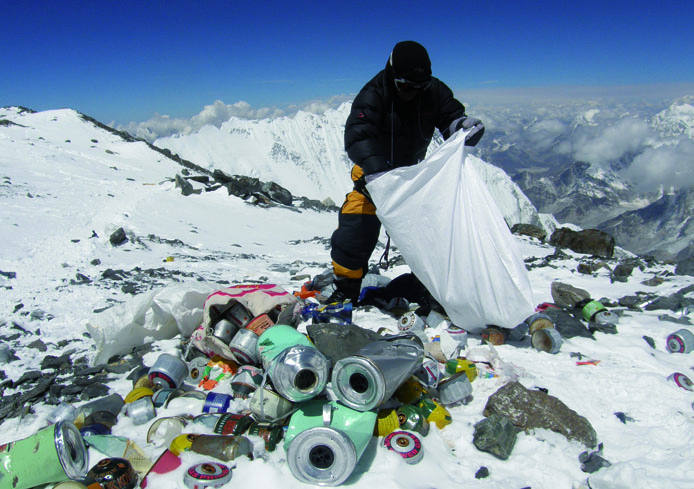
This picture was taken on May 23, 2010, shows a Nepalese sherpa collecting garbage, left by climbers, at an altitude of 8,000 meters during the Everest clean-up expedition at Mount Everest.  (Photo credit should read NAMGYAL SHERPA/AFP/Getty Images)

However, Napper’s study is the first to focus on the accumulation of microplastics on the mountain specifically. Microplastics are plastics less than five millimeters in length that typically slough off of larger plastics as they degrade. Their small size means they are easily ingested by animals by mistake and are also extremely difficult to clean up.

Napper’s team found more microplastics collected near the base camp, where climbers tend to congregate.

But they still found five microfibers at the mountain’s „balcony,“ the highest point they studied. Those fibers numbered one clear acrylic fiber, one red polyester fiber, and three blue polyester fibers.

In general, many of the microplastics found on Everest were fibers that could have been brought by climbers.

„There are a lot of promising developments in the industry at the moment. We need to keep up the momentum, and ensure that athletic gear is tested and evaluated before use,“ Napper told EcoWatch.

„Solutions need to deliver a positive account, not create a future issue.“ Napper said.


For more…at https://worldanimalsvoice.com/2020/12/07/the-worlds-highest-garbage-dump-everest/


And I mean… In 2018 alone, China has already collected more than eight tons of garbage from Mount Everest, including more than two tons of human excrement. 30 climbers had laboriously picked up the garbage.

Tibet and Nepal in view of the growing mountains of rubbish are tightening the obligations for tourists

Since 2015, mountaineers in Tibet have had to collect at least eight kilos of rubbish on their way to the summit.
If they come back empty-handed, they have to pay $ 100 per kilogram.

Similar rules also apply in Nepal. There is even a fine of up to $ 4,000.

But if one takes into account that a climb to Mount Everest – according to the magazine “Der Spiegel” – costs up to 100,000 dollars, the fines of a few hundred or thousand dollars are peanuts.

Therefore many accept the penalties instead.

And buy the right to litter and destroy the highest point on earth at 8,848 meters with their abandoned tents, broken climbing equipment, empty oxygen bottles, and their feces.

My best regards to all, Venus


USA: Grubhub Orders For Meat Alternatives Have Skyrocketed 463% In 2020


Grubhub Orders For Meat Alternatives Have Skyrocketed 463% In 2020

Grubhub’s annual ‘Year In Food’ report also shows the popularity of vegan-friendly products have increased by 13%

Grubhub Orders For Meat Alternatives Have Skyrocketed 463% In 2020 (plantbasednews.org)

Orders for meat alternatives have skyrocketed by 463 percent in 2020, according to Grubhub.

The figures come from the American delivery site’s annual Year In Food report, which ‘details the top trends of 2020’.

‘Most vegan-friendly State’

It also found that popularity for vegan-friendly products spiked by 13 percent, a slower increase than the year before where they were up by 27 percent. 

The most popular vegan orders were tofu spring rolls, which were 263 percent more popular this year than last, plant-based burgers which were 251 percent more popular, as well as Black Bean Tacos, Vegan chocolate cake, and Vegan ramen.

New York was listed as the most vegan-friendly state, followed by California, Oregon, Massachusetts, and Illinois. 

Vegan orders

In the UK, vegan delivery orders have also skyrocketed over the last year. 

Deliveroo recently announced its plant-based orders had spiked a staggering 115 percent from 2019 to 2020. 

In a statement sent to Plant Based News, commercial manager and vegan category lead at Deliveroo Elena Devis said: “It’s fantastic to see that Deliveroo customers are embracing the growing choices of vegan dishes available on the platform. 

“Year on year we’ve seen huge growth in demand for plant-based food. And it is our goal as a company to be the go-to platform for healthy and vegan options.”

Canada: COVID-19 outbreak declared at mink farm in B.C.’s Fraser Valley.

COVID-19 outbreak declared at mink farm in B.C.’s Fraser Valley

(1) COVID-19 outbreak declared at mink farm in B.C.’s Fraser Valley | Globalnews.ca

Health officials have declared a COVID-19 outbreak at a mink farm in B.C.’s Fraser Valley.

In a media release Sunday night, Fraser Health said eight people at the farm had tested positive, and that it was screening employees and contact tracing.

READ MORE: Culled minks with COVID-19 mutation rise from their graves in Denmark

Affected staff were self-isolating, it said.

The health authority did not identify the community or the farm.

A spokesperson for the health authority said “the information bulletin is all we have to share at this time,” when asked for more specific information.

The farm has been ordered to stop transporting animals, products and goods from the farm under the BC Animal Health Act, Fraser Health added.

WorkSafeBC is contacting other mink farms to discuss requirements under their COVID-19 safety plans, it said.