Target: Donna Kaspar, District Attorney of Houston, Texas
Goal: Seek the maximum penalty possible for man who allegedly beat his puppy with a crow bar before dragging him down the road.
An eight-week old Labrador puppy, named Mud, was reportedly beaten with a crow bar after his owner had duct taped the poor puppy’s muzzle.
According to witnesses, the owner, 58-year-old Dwain Riley, coaxed his timid puppy outside by dangling treats in front of him.
Witnesses say that Riley then tied the puppy by the neck to his vehicle before duct-taping his muzzle and beating him with a crowbar. He sped 10 – 15 miles per hour with poor Mud dragging behind.
The injured puppy barked and managed to wrestle free and a neighbor was able to grab the dog and take him to safety.
These would be the actions of an extremely cruel, violent person who has no business owning animals. Please add your signature to the petition below to demand that Riley receive the maximum penalty and be banned from owning animals if convicted of this crime.
PETITION LETTER:
Dear Ms. Kaspar,
A puppy was reportedly beaten with a crowbar, then tied to the back of a vehicle and dragged. The owner had allegedly duct taped the dog’s muzzle beforehand. The puppy survived and managed to run free.
We, the undersigned, are calling on you to make sure that no other animal has to suffer this extreme violence. Please see to it that the owner is given the maximum possible penalty and banned from owning animals if found guilty.
Posted on August 1, 2017 by Serbian Animals Voice (SAV)
SAV Comment – Kevin Pietersen is a very well known England cricket player. Well done him for speaking up in support of the animals and against hunting.
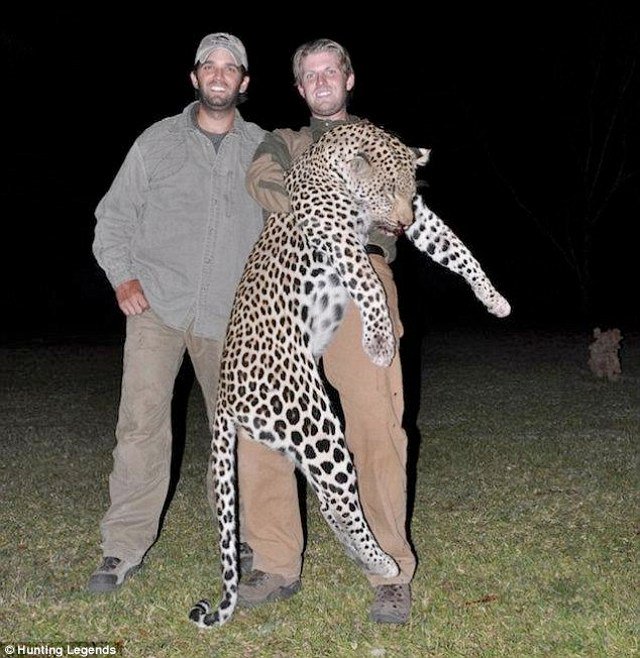
Above – ‘Dim’ and ‘Dimmer’ Trump.
———————————————
Arsenal owner Stan Kroenke branded ‘scum’ by Kevin Pietersen, who urges fans to ‘drive him’ out of the club
Exclusive: The American billionaire is facing a fierce backlash after launching a television channel that documents trophy killings of endangered animals
The former England cricketer, who is raising awareness about illegal poaching of rhinos in South Africa, has also called on Arsenal supporters to do everything they can to ensure majority shareholder Kroenke is “driven out” of the Premier League club.
Kevin Pietersen – A Voice Speaking Out Against Hunting.
“I find it sickening that anyone could want to endanger these animals whatsoever, but for someone to turn it into a TV show for entertainment absolutely boils my blood,” Pietersen exclusively told The Independent. “The guy, and those who contribute and support those practices, are scum.
“Enough is enough. These stunning animals are being slaughtered to the point of extinction and for anyone to celebrate it is absolutely repugnant.
“I’ve had so many messages from Arsenal fans telling me they hate him as much as anyone, so if that’s the case, he has to be driven out. I don’t know about you, but I wouldn’t want this person representing something I love.”
These animals don’t have a voice, but we do.
If we don’t do anything, no-one will.
Kevin Pietersen
Kroenke faced a heavy backlash following revelations in The Times that his company, Kroenke Sport Entertainment, is responsible for the UK launch of My Outdoor TV [MOTV] through its entity Outdoor Sportsman Group.
The channel will screen shows that follow hunters across the globe, primarily in Africa where big-money hunting trips are available, and involve various ways of killing wild animals that includes by bow and arrows and by guns.
One programme shows a presenter shooting a critically endangered African elephant before the bull turns and charges at him. Two more shots are heard before the animal falls to the ground and dies.
“There’s no other feeling in the world quite like walking up on your bull elephant,” the man says to the camera.
Another show, called Dark Continent Quest, features huntress Jana Waller and her travels across the world killing animals with a bow and arrow. One episode shows Ms Waller killing a hartebeest in South Africa, with the arrow hitting the animal before it runs away. Ms Waller and her guide, John Faul, wait for the animal to bleed to death before approaching it.
“It’s a good shot. Definitely, some liver and some lungs hit,” says Mr Faul while the animal is still alive.
Ms Waller adds “the shot was a little far back for me, but one shot did it,” before holding up the hartebeest’s “beautiful heart shaped horns”.
It has caused a wave of criticism aimed at Kroenke, particularly from Arsenal supporters given that the American billionaire owns 67 per cent of the club’s shares. The channel has also been dubbed the “Netflix of the hunting world” by its supporters, who are willing to pay $9.99 [£7.60] a month for the subscription.
Posted on August 1, 2017 by Serbian Animals Voice (SAV)
We divide every day “5000 by Friday”!!
I don`t know how it goes to you every morning, but when I start the PC, my nerves get a hard blow. There is not a day when a new torture version of humans does not appear on animals on the Internet. We think we’ve seen it all, but every day we see cruelty that our eyes cannot bear. Because of these infinite human crimes against animals, the question arises:
Who is my fellow human being?
With whom do I live together?
But above all, I am tormented by the question: can I expect these people to change at some point?
Can I hope that I can win them through education, undercover documentation, information on the rights of animals?
And as paradoxical as it may seem, world-wide results in animal protection are often the result of an illogical and inconsistent basis.
I would like to share a personal experience:
It was a winter evening in 2011 in the pedestrian zone of the city, next to where I live. We had an info stand exclusively for signatures set up for the 8hours campaign. It was cold and there were few people. Suddenly I saw a very elegant lady, who came to see me from the department store.
She was wearing a fur coat and had an expensive leather bag. There was a Mc Donald Hamburger in her hand. “Give me the list, I want to sign, too,” she said, taking the pen.
Ha! I thought, “I do not have to beg!” The lady has signed. “Yes, but you also eat meat,” I said politely. “So what?” she said, “That I eat meat does not mean that animals must suffer”!
Oops !!
At this moment I thought of the joke with the psychiatrist:
The insane doctor asks his patient: “what is 2 and 2”?
He says: “5000”.
“Well, yes,” says the doctor, and he asks the next patient “what is 2 and 2”?
He says “Friday”.
Then the doctor asks the third one: “what is 2 and 2”?
And he answers: “4” !! “
Yes! And how did you get it? “
” Very easily! I’ve divided 5000 by Friday “!!
So, it is also in animal protection, the result counts. I estimate that 60 to 70% from the 1.2 million signers at th
at campaign, were carnivores. The illogical motives of these people have brought us 1.2 million votes!!
I think we need to develop a new mass strategy for animal protection. It is an illusion to believe that people do good only when they are logically and morally convinced.
The Battle of Passchendaele (German: Flandernschlacht, French: Deuxième Bataille des Flandres), also known as the Third Battle of Ypres, was a campaign of the First World War, fought by the Allies against the German Empire.[a] The battle took place on the Western Front, from July to November 1917, for control of the ridges south and east of the Belgian city of Ypres in West Flanders, as part of a strategy decided by the Allies at conferences in November 1916 and May 1917. Passchendaele lay on the last ridge east of Ypres, 5 mi (8.0 km) from a railway junction at Roulers, which was vital to the supply system of the German 4th Army.[b] The next stage of the Allied plan was an advance to Thourout–Couckelaere, to close the German-controlled railway running through Roulers and Thourout.
Further operations and a British supporting attack along the Belgian coast from Nieuwpoort, combined with Operation Hush (an amphibious landing), were to have reached Bruges and then the Dutch frontier. The resistance of the 4th Army, unusually wet weather, the onset of winter and the diversion of British and French resources to Italy, following the Austro-German victory at the Battle of Caporetto (24 October – 19 November), enabled the Germans to avoid a general withdrawal, which had seemed inevitable in early October. The campaign ended in November, when the Canadian Corps captured Passchendaele, apart from local attacks in December and the new year. In 1918, the Battle of the Lys and the Fifth Battle of Ypres were fought before the Allies occupied the Belgian coast and reached the Dutch frontier.
The choice of Flanders over areas further south or the Italian front, the climate and weather in Flanders, the choice of GeneralHubert Gough and the Fifth Army to conduct the offensive, debates over the nature of the opening attack and between advocates of shallow and deeper objectives, have also been controversial. The passage of time between the Battle of Messines (7–14 June) and the Battle of Pilckem Ridge (31 July, the opening move of the Third Battle of Ypres), the extent to which the internal troubles of the French armies motivated British persistence with the offensive, the effect of the weather, the decision to continue the offensive in October and the human cost of the campaign on the soldiers of the German and British armies, have also been argued over ever since.
Casualties
Various casualty figures have been published, sometimes with acrimony but the highest estimates for British and German casualties appear to be discredited.[155] In the Official History, Brigadier-General J. E. Edmonds put British casualties at 244,897 and wrote that equivalent German figures were not available, estimating German losses at 400,000. Edmonds considered that 30 percent needed to be added to German figures, to make them comparable to British casualty criteria.[156] In 2007, Sheldon wrote that although German casualties from 1 June – 10 November were 217,194, a figure available in Volume III of the Sanitätsbericht (1934), Edmonds may not have included them as they did not fit his case. Sheldon recorded 182,396 slightly wounded and sick soldiers not struck off unit strength, which if included would make 399,590 German losses.[157] The British claim to have taken 24,065 prisoners has not been disputed.[158] In 1940, C. R. M. F. Cruttwell recorded 300,000 British casualties and 400,000 German.[159] Wolff in 1958, gave German casualties as 270,713 and 448,688 British.[160] In 1959, Cyril Falls estimated 240,000 British, 8,525 French and 260,000 German casualties.[161]
John Terraine followed Falls in 1963 but did not accept that German losses were as high as 400,000.[162]A. J. P. Taylor in 1972, wrote that the Official History had performed a “conjuring trick” on these figures and that no one believed these “farcical calculations”. Taylor put British wounded and killed at 300,000 and German losses at 200,000.[163] In 1977, Terraine argued that twenty percent needed to be added to the German figures for some lightly wounded men, who would have been included under British definitions of casualties, making German casualties c. 260,400. Terraine refuted Wolff (1958), who despite writing that 448,614 British casualties was the BEF total for the second half of 1917, neglected to deduct 75,681 casualties for the Battle of Cambrai, given in the Official Statistics from which he quoted or “normal wastage”, averaging 35,000 per month in “quiet” periods.[164] Prior and Wilson in 1997, gave British losses as 275,000 and German casualties at just under 200,000.[165] Hagenlücke in 1997, gave c. 217,000 German casualties.[57] Sheffield wrote in 2002, that Richard Holmes’s guess of 260,000 casualties on each side, seemed about right.