Posted on February 8, 2020 by Serbian Animals Voice (SAV)
Police officer shot a free-running dog on the Highway 29 with a submachine gun. Previously, ten officers (!!!) tried to capture the animal.
A free-running stray dog temporarily blocked traffic on Highway29 near Rastede near Oldenburg (Germany) and caused a lot of work for the police. The animal did not want to be caught on Thursday (February 6, 2020) and switched from one lane to the other.
The highway was temporarily blocked (25 Minutes).
Attempts to sedate the animal from a rifle with stun arrows failed, the police said after the operation. “The arrows hit, but had no effect,”said a spokesman. That was probably due to the dog’s high adrenaline level. Ultimately, an officer shot the animal with a submachine gun.
After the targeted killing of these free-running dog the police explained their procedure in a Facebook post.
The officials responded to massive criticism on social networks. The decision to kill the animal was based on the considerable risk to the affected road users on the A29.
Before the fatal shot, police said ten officers tried to capture the animal. “There were no alternatives, unfortunately nothing else was possible,” said the spokesman. “The use of firearms is always the last option here”, the Facebook post emphasizes.
“Despite the closure of the motorway, it could not be ruled out that the animal could have caused a serious accident. Please understand. No police officer likes to do this, and we’re really sorry for the dog”(police statement on Facebook)
The dog was neither aggressive nor had behaved incorrectly.
A submachine gun is of course always a quick fix so that car traffic is not held up too long.
Blocked for 25 minutes the highway? Really?? For every shit construction work is blocked the Highway forever!
but for a dog only 25 minutes?
10 officers failed to catch a medium-sized stray dog ???! Not even with a blanket or something like the police do in America?
Then we should rather have doubts about what the police can do, if it can’t even catch a dog in an open area without killing him.
The traffic was already shut down, so no driver was at risk, and the dog had obviously managed to get through the highway fence into the forest (where he was then shot).
He would never have run back on the highway.
And yet, someone shoots him.
With shooting they are always quick, they always shoot down immediately. And always the wrong or the weak ones!
If you want to become a police officer in Germany, it is enough if you have a fascist conviction and criminal energy. It was murder.
Where does your local high street café get their pork from? 5 of the 6 high street café chains we surveyed get their pork from factory farms. Pester Pig takes revenge on a heartless couple who order factory-farmed bacon sarnies! You can help free pigs from chains by liking and sharing this video.
Tell DEFRA to ban low welfare imports
We’re calling on the UK government to ban the importation of pork produced in conditions that would be illegal in the UK. Sign the petition today:
UK supermarkets & high street chains source from the very cheapest pork producers across the EU and perhaps in future from the USA, forcing our farmers out of the industry or to get bigger with ever more intensive and cruel conditions. Pigs reared in UK factory farms (an intensive farming system that is permitted under the Red Tractor labelling scheme) have to endure permanent indoor confinement in barren, overcrowded pens for their entire lives. Mother pigs are kept in narrow metal cages so small they cannot even turn around for five weeks in each pregnancy.
The Solution
To enable our farmers to improve their pig standards and survive, the government needs to ban the importation of pork produced in cruel conditions that are illegal in the UK. This would stop supermarkets & food chains competing to source the cheapest pork raised in the lowest standards of welfare and give UK farmers the freedom to increase their welfare conditions in accordance with UK consumers’ demands.
Pork labelled RSPCA Assured, Free Range and Organic has been raised in significantly better standards than the UK Red Tractor labelling scheme and minimum UK,EU and US standards. Pigs on high welfare farms, either outdoors or indoors with plenty of straw, are less stressed so more contented and healthy . They have enough room to roam and express natural instinctive behaviours such as rooting, nesting and playing.
The Pig Welfare Survey
Three-quarters of the 60 high street supermarkets & food chains surveyed by Farms Not Factories sell pork from factory farms. The vast majority of these don’t offer a single high welfare alternative.
Please sign our petition telling DEFRA MPs to enable our farmers to improve their pig standards and survive.
We’ve prepared an email for you, however it’s much more powerful to write in your own words. A personalised salutation (Dear + MPs name) and a sign-off (Sincerely, + your name) are automatically added.
Posted on February 7, 2020 by Serbian Animals Voice (SAV)
Painful mutilation, such as dehorning, is common practice in the dairy industry. The horn systems of the calves, which are only a few weeks old, are burned out – mostly without anesthesia.
At least two burns are inflicted on the animals with full pain sensation. Burns, we know from personal experience, are still painful even after days. That is why we can speak of cruelty to animals here.
Dehorning is a practice that is carried out in the meat and dairy industry and can be very traumatic for small calves due to the immense pain it causes.
This process is usually carried out with a hot iron rod.
There are two kinds:
One is powered by the rod, which is heated with electricity (240 volts), and the other is heated by a gas burner.
Each of them destroys the horn that creates the skin at its base and completely denatures the animal.
The farmer uses disposable gloves when performing this gruesome exercise, keeping the calf’s ear out of the reach of the stick, but heating the stick to unscrew the animal until it gets scorching hot.
Then they put the burner tip under pressure on the horn.
When the burnt hair starts to smoke, then they twist the bar with a twist of their wrist. The application of heat continues, the heat can be transmitted through the thin bones of the skull and the calfs of the calves are damaged.
The worst? Many farmers are not “experts” and practice this practice without experience, especially in villages.
The dehorning process ends when the farmer sees a copper-colored ring around the base of the horn.
The pictures in the video show how cows are fixed with their heads between bars and their horns are cut off with huge pliers. Blood runs over their head.
My comment: The Animal Protection Law in Germany actually provides for a ban on amputations, including a ban on dehorning, but of course there are “exceptions”.
If it is stated that dehorning is necessary to avoid the risk of accidents or injury, the farmer “must” intervene.
There are already breeds that are born genetically without horns.
Nice!! you might think, but in the end it is absurd that humans breed animals so that they are efficient, square, practical and good.
Because the milk and meat mafia wants it that way.
It has nothing to do with nature anymore.
Pigs should all be the same size so that the bolt gun can be put on better and chickens should be of a uniform size so that they can be better placed in the holders upside down and their heads can be separated at the same place.
The animals are adapted to factory farming instead of accepting that animals were created to be free and not to serve us as captives.
If we don’t want to eat and have everything, we wouldn’t have to solve the problems we create ourselves. Our perverse, criminal relationship to animals proves every day of the new how underdeveloped we, human animals are on our moral.
Posted on February 7, 2020 by Serbian Animals Voice (SAV)
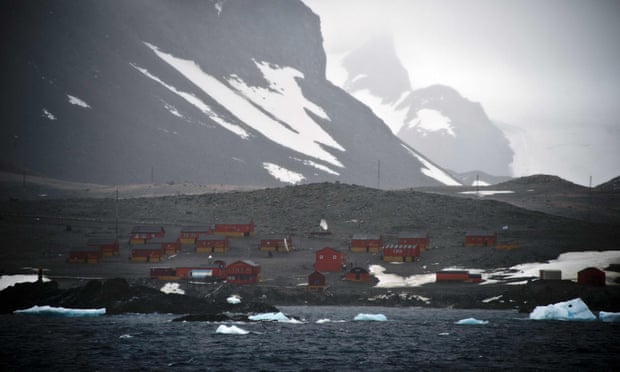
The Argentinian Esperanza base in Antarctica – seen in March 2014 – recorded its hottest day on record on Thursday. Photograph: Vanderlei Almeida/AFP via Getty Images
Antarctica logs hottest temperature on record with a reading of 18.3C
A new record set so soon after the previous record of 17.5C in March 2015 is a sign warming in Antarctica is happening much faster than global average
Antarctica has logged its hottest temperature on record, with an Argentinian research station thermometer reading 18.3C, beating the previous record by 0.8C.
The reading, taken at Esperanza on the northern tip of the continent’s peninsula, beats Antarctica’s previous record of 17.5C, set in March 2015.
A tweet from Argentina’s meteorological agency on Friday revealed the record. The station’s data goes back to 1961.















 Serbian Animals Voice (SAV)