Posted on March 10, 2020 by Serbian Animals Voice (SAV)
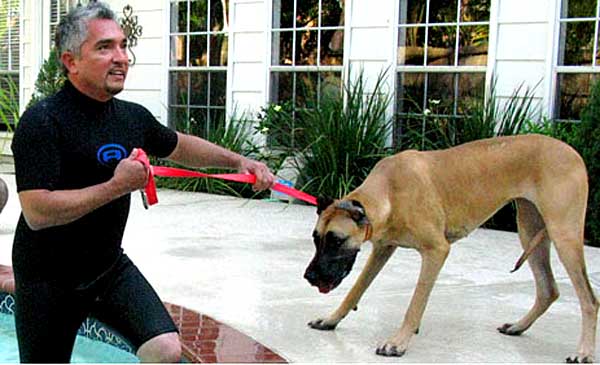
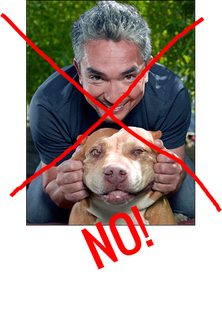
The self-proclaimed “dog whisperer” became known for his TV series of the same name. To help dogs with behavioral problems, their owners keep turning to Cesar Millan. We explain to you why this is not a good idea.
1. Cesar Millan’s “tools” Millan uses electric shock and strangle collars so that the dogs do what he wants. The result is mostly scared and panicked animals.
2. Pressure and violence
Cesar Millan works with the approach of wanting to be a pack leader. That’s why he uses intimidating and violent training methods that can turn dogs into time bombs.
The Hanover Administrative Court (Germany), has clarified why Millan’s methods are not compatible with the Animal Welfare Act.
3. Disrupted trust relationships
Even if Millan speaks of “communication and understanding”, he does everything to make the dogs react out of sheer fear. A relationship of trust between dog and person cannot develop if dogs are punished and mistreated.
4. Outdated methods
Millan’s methods, which are based on the pack theory, are ancient and have long been considered outdated. Dogs are family members and should be treated as such.
5. Merchandise contrary to animal welfare
Cesar Millan sells an endless strangle collar and a dog crate, which he recommends for “storing” the proteges – not just for transport, but also for the night or when the keeper leaves the house.
When you take in a dog, you also have to be able to spend the time looking after it.
6. Cruelty to animals on video
There are many videos on the Internet that show that Cesar Millan terrifies the dogs and puts animals at risk. In such a video, he “trains” a dog that has already killed a pig. He lets go of the dog without a leash or muzzle on a pig that is held by an assistant. At least one animal is injured by the dog.
7. No glimmer of proper dog training
Reputable dog trainers work with positive reinforcement and, unlike Cesar Millan, have a successfully passed specialist examination. Despite interpreters in Lower Saxony (Germany),Millan did not pass them.
Please do not attend any shows and certainly not the Cesar Millan “dog school” and also clarify your surroundings about the animal torturing methods of the self-proclaimed “dog whisperer”.
Some information about Cesar Millan…The story of Cesar Millan is often told as a typical story of how one of washing dishes becomes a millionaire! about a young man who breaks away from a simple life on a Mexican farm and crosses the border to realize the American dream. That is exactly what happened.
He became known to millions of viewers worldwide as the Dog Whisperer over the course of nine seasons on the National Geographic Channel.
When he was 13 he had planned to be the best dog trainer in the world and he didn’t want to do it in Mexico. Inspired by the immaculately trained dogs he saw in television reviews of Lassie and The Adventures by Rin Tin Tin, Millan had his sights set on Hollywood and was convinced that his talents would be very welcome there.
Using the first English sentence he ever learned (“do you have application for work?”), Millan managed to arrange some part-time hours in a local dog groomer’s office.
The owners were instantly impressed with his assertive handling of larger, aggressive dogs that had previously been impossible to control.
Millan saw the value in this and, after moving to Inglewood, decided to start charging for a group dog-walking service.
He quickly attracted attention with his unusual (and very much illegal) style of walking his group off leash, quickly earning a reputation as “the Mexican guy who can walk a pack of dogs.
He has been known to millions of viewers worldwide as Dog Whisperer for nine seasons and up to 2002 on the National Geographic Channel.
The incident with Gator, the Labrador, is not the only allegation of animal cruelty that Millan has faced.
Producer FLODY SUAREZ alleges his Labrador GATOR was nearly choked by a collar and forced to run on a treadmill at Millan’s Los Angeles-based Dog Psychology Center, resulting in painful injuries.
According to legal papers filed at the Los Angeles Superior Court, Gator had to be rushed to a vet an hour after being dropped off at Cesar Millan’s Dog Psychology Centre.
The dog was reportedly “bleeding from his mouth and nose, in an oxygen tent gasping for breath with severe bruising to his back inner thighs.”
The Dog Psychology Centre was unavailable to comment and a spokesman for the National Geographic Channel said it had not been served with a lawsuit.
In his book “Be the Pack Leader”, Cesar Millan explains that he simply gives pleasure and is such a wonderful exhilaration to control a dog and to be able to command him to stay on foot and to do this and that.
How great when the dog crawls on the ground in fear when it approaches. So the desire to dominate. I am born Alpha, the pack leader, the leader of the pack, Millan’s motto.
My motto about Millan is that he’s a shit Charlatan.
And if you share his methods and principles, I would highly recommend psychotherapy.
You can read our brief summary of CITES below; and then make your own decisions on how effective it is regarding the protection of animal species. We quote one statement here which may put things into perspective:
A 2019 analysis in the journal Science found that in nearly two-thirds of cases, CITES protections lag after a species is determined to be threatened by international trade. For example, while pangolins were finally added to Appendix I in 2017, an estimated million were trafficked between 2000 and 2013. Of the eight species of pangolins, half are endangered or critically endangered. The vast majority of animals that are in the wildlife trade are not protected by CITES.
With China responsible for not having regulations for live animal market conditions, or animal welfare standards in general; and also the global shutdown due to the result from this of Coronavirus; we really have to ask questions about the real point of China belonging to CITES. We would like to have something positive to say about China and CITES, but we also say is CITES not often a two week meeting, with lots of pats on the backs, but members going back home and then doing very little, or nothing nationally as a result ?
Again, we simply say 4 words; – they are ‘China’; ‘Pangolins’, ‘Markets’ and ‘Coronavirus’.
The world is currently full of experts on the tv and radio spreading all the doom and gloom about Coronavirus – maybe if China had paid more attention to livestock and animal welfare legislation in the past; then the world would not now be in the global shutdown that it is.
China and the rest of the world; get a grip; have and enforce legislation that stops things like this happening.
CITES should protect elephants and pangolins. Stopping the ivory trade is more than welcome; stopping the Chinese trade in Pangolins for food and ‘wonder cure’ medicines is another – what faith in CITES ?
Mark.
CITES
CITES – the Convention on International Trade in Endangered Species of Wild Fauna and Flora – is an agreement between governments designed to ensure that international trade in wild animals and plants does not threaten their survival. … The CITES Secretariat is administered by the UN, in Geneva, Switzerland
With 178 Member States, CITES is one of the world’s most powerful tools for biodiversity conservation through the regulation of trade in wild fauna and flora.
Roughly 5,800 species of animals and 30,000 species of plants are protected by CITES against over-exploitation through international trade. They are listed in the three CITES Appendices. The species are grouped in the Appendices according to how threatened they are by international trade.
China was a member on the CITES Standing Committee for over 10 years, and representatives from China have also served as members on the CITES Plants and Animals Committees. … But China also plays an active role in CITES affairs at the international level.
On February 24, 2020, the Chinese government moved to make permanent the temporary ban on the trade and consumption of live wild animals for food. The Standing Committee of the National People’s Congress, the country’s top legislative body, issued a decision that lays the groundwork for amending China’s Wildlife Protection Law, which governs the use of wildlife, to permanently criminalize wildlife as food. The decision further stipulates that the trade of wild animals for medicine, pets, and scientific research will be subject to “strict” approval and quarantine procedures.
They are listed in the three CITES Appendices. The species are grouped in the Appendices according to how threatened they are by international trade. They include some whole groups, such as primates, cetaceans (whales, dolphins and porpoises), sea turtles, parrots, corals, cacti and orchids.
CITES has plenty of critics. Some say conservationists flock to the two-week meeting every few years, fiercely debate the fate of endangered animals, and then go home, patting themselves on the back for a job well done.
Meanwhile, the actual enforcement of the CITES regulations is left to the countries themselves—some of which don’t have the resources or political will to enforce regulations.
A 2019 analysis in the journal Science found that in nearly two-thirds of cases, CITES protections lag after a species is determined to be threatened by international trade. For example, while pangolins were finally added to Appendix I in 2017, an estimated million were trafficked between 2000 and 2013. Of the eight species of pangolins, half are endangered or critically endangered.The vast majority of animals that are in the wildlife trade are not protected by CITES.
If a party violates the convention, CITES can respond with sanctions, which prevent a country from trading in CITES-listed species. But countries are rarely sanctioned and the process can become highly politicized. What’s more, because CITES membership is voluntary, a country could simply leave CITES rather than accept sanctions.
In the United Kingdom:
UK – The spread of coronavirus should prompt a new UN taskforce to tackle the illegal wildlife trade, peers and MPs say.
In a letter to The Sunday Telegraph, campaigners argue that the current system is not fit for purpose and allows criminals to make billions from the theft and sale of wildlife, to the detriment of human health.
At the moment, trade in wildlife is regulated on a national level by the laws of each country, but is only regulated on an international level by a trade body; the Convention of International Trade in Endangered Species (Cites).
The current system has no legal teeth internationally as it is simply an agreement between countries on what they will accept in trade.
The new taskforce would include specially-trained police at borders to confiscate illegally traded wildlife and imprison those responsible. It would also have added prosecuting powers and support countries with their own policing to combat the trade within their borders….
Posted on March 9, 2020 by Serbian Animals Voice (SAV)
As the lady says – Australia should be ashamed of this !
Sheep Farmer Accused of Koala Massacre in Portland, Victoria
Posted on 4 February 2020 at 6:21AM by PETA Australia
At least 40 koalas have been found dead and more injured after a sheep farmer in Victoria bulldozed a blue gum plantation to turn the land into pasture on which to graze animals.
As reported by The Age, documents completed by forestry contractors indicated that there were 72 koalas on the property when the area was logged in November. In the wake of Australia’s bushfires, more animals moved onto the property looking for food among the fallen trees. More than 100 koalas are believed to have been present when the bulldozers moved in last week to clear the ground.
Keith Troeth, who manages the property, told media that this is “not the big hoo-ha it’s been made out to be”.
“We made every effort to do it professionally, we made every effort to minimise any fatality,” he said.
But what Troeth doesn’t seem to understand is that even one koala death is one too many.
As fires continue to claim bushland, we should be planting trees to renew the precious lost habitats of our native animals, not ripping them down to make way for other animals to graze so we can eventually run a blade across their throats, eat their flesh, and wear their skins.
Land-clearing is often blamed on urban development, but animalagriculture is actually the major culprit.
For example, a 2017 government report detailing land-cover change in Queensland revealed that 395,000 hectares of bushland – home to countless animals and essential for our nation’s biodiversity – were cleared in just one year. According to the Statewide Landcover and Trees Study, the majority of vegetation clearing in recent years has been for conversion for grazing purposes (over 90% of total clearing).
Australia already has some of the highest extinction rates on the planet. Now, in the wake of catastrophic bushfires which have claimed the lives of so many more animals, it’s imperative that we put what’s ethical before what’s profitable.
Posted on March 9, 2020 by Serbian Animals Voice (SAV)
On Tuesday, the speech by ex-US Vice President Joe Biden, who was on stage with his wife and sister in Los Angeles, was disrupted.
Women with posters that read “LET DAIRY DIE” protested while Biden was confident about his chances of winning.
The protesting women interrupted Joe Biden’s speech very briefly. They were carried away by folders in the background.
The ex-vice president turned to see what was going on, but then continued to speak in the speech – without mentioning the protest (see video embedded above).
“Let Dairy Die” is the slogan of animal rights activists who belong to the “Direct Action Everywhere”group and advocate vegan life.
In mid-February, activists from the same group interrupted an event by Bernie Sanders.
According to organizers, the women were arrested.
On its Facebook page, “Let Dairy Die” writes: “The dairy industry is one of the cruellest forms of animal exploitation, and our rulers support it. Mother cows are torn away from their babies after birth and they go through a cycle of coercive measures until their production levels reach a level It drops to levels where they are no longer “profitable” and then they are sent to slaughter. Young cattle are killed for veal (if they are male) and exploited for milk production (if they are female). We have to face this injustice to draw attention!”
According to the US media, agriculture is not a major concern in the program of Democratic presidential candidate Joe Biden.
And I mean…With a record level of almost 47.0 million tons of meat a year, one can imagine how difficult it is to steer this society towards veganism and to tackle the strong meat advertising.
We thank the animal rights activists Let Dairy Die and promise that we will report wherever and whenever they organize such great activities.
Posted on March 9, 2020 by Serbian Animals Voice (SAV)
PETA’s international affiliates have documented cruelty to sheep at dozens of wool farms around the world, including in Argentina, where an eyewitness saw workers hack apart conscious lambs and start to skin some of them while they were still alive and kicking at a facility in the Ovis 21 network – Patagonia’s wool supplier at the time.
A gut-churning PETA video exposé reveals that life is hell for lambs and other sheep exploited for so-called “responsibly sourced” wool on so-called “sustainable” farms. A witness found workers in Argentina hacking into fully conscious lambs, starting to skin some of them while they were still alive and kicking, and otherwise mutilating, abusing, and neglecting lambs and sheep on farms in the Ovis 21 network—Patagonia’s wool supplier.
UPDATE: Update: On August 17, 2015, after hearing from more than 50,000 people, Patagonia announced that it was dropping Ovis 21 as a supplier, but will continue to sell products made from wool.
Workers picked up gentle lambs and—while they were fully conscious—tied their legs together, plunged knives into their throats, and sawed through their necks. Blood poured from the wounds as they kicked with their only free leg. Workers then snapped their heads backwards, apparently trying to break their necks.
Even after all that, some of the lambs still managed to cry out and gasp.
Minutes later, some lambs were still alive and kicking when a worker drove a knife into their legs to start skinning them. Eventually, they were hacked apart. Their organs were carved out of their bodies and their severed heads dumped into a bloody tub.
All this happened in full view of other lambs. They were just feet away and cried out in what must have been terror and severe distress. Older sheep—used for their wool, then no longer wanted—were lined up, tackled, and dragged away to be shipped to slaughter.













 Serbian Animals Voice (SAV)