Posted on October 27, 2020 by Serbian Animals Voice (SAV)
26 people were arrested after locking down this Smithfield* slaughterhouse in LA — as actions happened around the world for #RosesLaw, an Animal Bill of Rights.
*Smithfield Foods, Inc. is the largest pork producer in the USA and is headquartered in Smithfield, Virginia / USA. The company belongs to the Chinese WH Group based in Luohe, Henan / China, which is the largest pig breeding and pork processing group in the world.
Smithfield is proud to operate itself the entire value chain of meat production, i.e. fattening, slaughtering, and further processing into meat products.
The multinational company produces 14 million piglets per year and processes 27 million pigs into various meat products. In 2006 this was a total of 2.7 million tons of pork and 635,000 tons of fresh beef, which were marketed under brand names such as Smithfield, Butterball, John Morrell, Gwaltney, Patrick Cudahy, Krakus, Cook’s Ham, and Stefano’s.
Smithfield has offices in 26 states and 9 countries, and sales in 44 countries worldwide. US government agencies have found Smithfield systematically violating workers’ rights (Wikipedia).
Posted on October 27, 2020 by Serbian Animals Voice (SAV)
23/10/20
Press Release
Government backs Animal Welfare (Sentencing) Bill as it takes crucial step forward
Plans which will mean animal abusers could face up to five years in prison move a step closer.
The Government is backing legislation for tougher prison times for those who cruelly mistreat animals, as plans to introduce more stringent sentences move a step closer today (Friday 23 October 2020).
The Bill, introduced in Parliament by Chris Loder MP in February, will see the most serious perpetrators of animal cruelty face up to five years in prison, up from the current maximum of six months. Today, the Bill will have its Second Reading in the House of Commons, backed by the Government.
These tougher prison sentences would be among the toughest sanctions for animal abuse in Europe, strengthening the UK’s position as a global leader on animal welfare.
The Bill follows a public consultation in 2017, in which more than 70% of people supported the proposals for tougher prison sentences for those guilty of animal cruelty offences. This could include dog fighting, cruelty towards domestic pets or gross neglect of farm animals.
Chris Loder, MP for West Dorset, said:
It is high time as a nation that we take the lead on global standards for animal welfare and hand down tougher custodial sentences for those who inflict the worst kinds of cruelty on innocent animals.
My Bill, which I’m pleased has cross-party support and is fully endorsed by the RSPCA and other animal welfare charities, delivers a strong message to animal abusers that their behaviour will no longer be tolerated. We need to get it on the statute book and send a clear signal to potential offenders there is no place for animal cruelty in this country.
Animal Welfare Minister Lord Goldsmith said:
There is no place for animal cruelty in this country and this crucial piece of legislation will bring in more stringent sentences for animal abusers who commit the most heinous crimes, cementing our role as a global leader in animal welfare.
In addition to supporting this Bill, we are taking steps to ban primates as pets, crack down on the illegal smuggling of dogs and puppies, and we will be making good on our commitment to end excessively long journeys for slaughter and fattening of farm animals.
I would like to thank Chris Loder MP for introducing this vital Bill. We will do all we can to support its swift passage through Parliament.
RSPCA chief executive Chris Sherwood said:
We’re thrilled that The Animal Welfare (Sentencing) Bill has passed through this stage and that we’re one step closer to getting real justice for abused and neglected animals in this country.
In the three years since the Government pledged to increase the maximum sentence under the Animal Welfare Act from six months to five years, immediate custodial sentences have been imposed on 132 individuals following RSPCA investigations into cruelty and these included horrendous cases such as a dog who was kicked to death by her owner and a man who bit off a kitten’s ear.
Tougher sentencing would give courts more flexibility to impose longer prison terms on those people guilty of the most serious offences to better reflect the severity of the crimes and to act as a stronger deterrent to others.
The Second Reading of the Animal Welfare (Sentencing) Bill is due to conclude on 23 October. The Bill will then go to Committee Stage, with Report Stage and Third Reading following this, before transferring to the House of Lords for further scrutiny.
You can track the progress of the Animal Welfare (Sentencing) Bill and read debates on all stages of the Bill’s passage on the Parliament website.
Posted on October 27, 2020 by Serbian Animals Voice (SAV)
Alternative to animal experiments: new applications for organoids from human intestinal tissue
26 October 2020
Researchers at the Technical University of Munich (TUM) have cultured so-called intestinal organoids from human intestinal tissue, which is a common byproduct when performing bowel surgery. These small ‘miniature intestines’ can be used for molecular biological examinations and allow for a direct application of research results to humans, thereby making animal experiments redundant.
The human intestine is vital for both digestion and absorbing nutrients as well as drugs. For any type of research that involves intestines, scientists require research models that reflect the physiological situation inside human beings with the highest possible accuracy.
Standard cell lines and animal experiments have certain disadvantages. One main issue is the lack of applicability of the results to humans. Now, a multidisciplinary research team covering the areas of nutritional science, general medicine, and chemistry has demonstrated how a modern in vitro model — made from human intestinal biopsies — can answer various questions regarding the molecular processes inside the human gut.
“When studying diseases or performing drug screenings, it is critical to have access to a human test system such as human organoids in order to prevent obtaining species specific test results,” said Tamara Zietek, who is part of the Chair of Nutritional Physiology at TUM.
She added that, “over the course of the last few years, organoids have become one of the most promising in vitro models due to their high physiological relevance; they also present a human-based alternative method to animal experiments.”
Posted on October 27, 2020 by Serbian Animals Voice (SAV)
Dear Mark
It’s been 55 days since the Gulf Livestock 1 capsized with the loss of 41 crew members, including two New Zealanders, and almost 6,000 cows. This tragedy led to the government announcing a temporary ban on live export and yet another review into this cruel and unnecessary trade.
Last month, Agriculture Minister Hon Damien O’Conner gave the okay for New Zealand to resume exports ‘conditionally’ on 24 October despite the risks. Disappointingly, that day has come.
The live export ship, Yangtze Fortune, will dock at Napier port on Tuesday 3 November and plans to take thousands New Zealand cows on a long and stressful sea journey in unnatural conditions. The majority of animals live exported from New Zealand are sent to countries with lower animal welfare standards than our own and sometimes no animal protection laws at all. This means our animals are being farmed and slaughtered in ways that are illegal in here New Zealand.
The only way we can truly help these animals is to get a permanent ban on live animal export. And we need your help.
The Gulf Livestock 1 disaster has highlighted the risks both humans and animals are forced to endure on live export ships. Tens of thousands of Kiwis have called for a ban on this cruel practice and we won’t stop until our Government leaders align the law with our Kiwi values by permanently banning live animal export.
Prime Minster Jacinda Ardern herself has questioned whether the cruel live export trade should be allowed to continue and has highlighted the fact that the trade is problematic, especially where animal welfare and New Zealand’s reputation is concerned.
Take action for animals by writing to the Prime Minster, Jacinda Ardern to echo her concerns about this trade and urge her to ban live animal export permanently.
We know caring people like you want to see an end to live export. And together we will continue to put pressure on our Government until this cruel trade is permanently banned.
Thank you for your support – together we will get a ban on live export.
Debra Ashton Chief Executive Officer
P.s Join the more than 30,000 people who have already called for a ban on live export from New Zealand. Together, we can stop this cruel trade.
Posted on October 26, 2020 by Serbian Animals Voice (SAV)
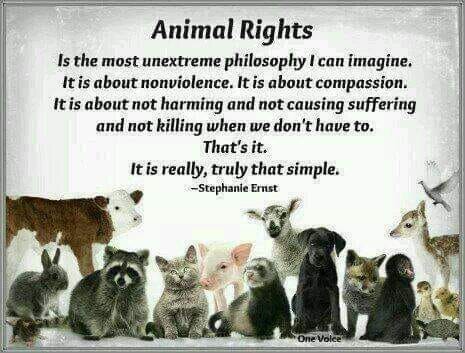
In a world full of ignorance, indifference, and terror towards the weak, fighting for animal rights is not a feat.
It is a moral duty.
Wherever man exercises the fascist right of the strongest and sacrifices an animal for his own ends, he not only commits an injustice but a crime.
Posted on October 26, 2020 by Serbian Animals Voice (SAV)
Is there currently a ladybug plague in Germany? (!!!)
In any case, these small insects can be seen everywhere. There is a reason for that.
They hang from house walls, sit in window frames or crawl around in apartments in the bathtub: at the moment, ladybugs are not only found in gardens and on plants. Whole swarms are currently spreading in completely new habitats.
Ladybird plague 2020: Insects are looking for winter quarters from October
But how does it come about? According to a report by the editorial network Germany (RND), the small insects are currently looking for suitable winter quarters again.
To do this, in October and November – at the beginning of the cold season – they set off in large swarms to warmer regions.
Actually, the ladybirds are mostly drawn to European countries, where the winter is rather mild. Due to the mild autumn days in Germany, the spotted beetles are also looking for a roost here.
Many ladybugs now fly around in swarms in this country. This is particularly noticeable because the insects often rest on their journey – the walls of houses or the windows of apartments, among other things, serve as resting places.
To one or the other, it may seem like a ladybug plague. Because especially if you leave your window open for a few hours, you have to expect the bugs to get lost in the house or apartment.
But be careful: the insects cannot overwinter inside the living space, they need cool, frost-free rooms for their winter rest.
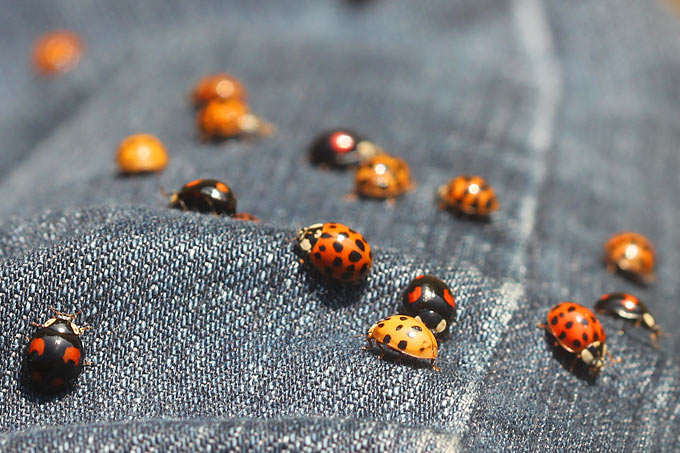
The harlequin ladybird from Asia is now more common than the native species in many regions of Germany.In autumn, the beetles sometimes unite to form large swarms in order to look for winter quarters together.Here some have settled down on the photographer’s pants for a break.– Photo: Helge May
Suitable winter quarters for ladybirds are piles of leaves, dead wood, moss blankets, tufts of grass, and cracks in piles of stones. There the beetles stay in their winter quarters until the next spring and lapse into rigidity.
Between March and April, when the temperatures rise, they leave their winter quarters again.
But if you feel disturbed (!!!) by the current accumulations of ladybugs in your own four walls, there are a few simple ways to get rid of the insects. Important: Ladybugs are absolutely harmless to humans – they should not be killed when they are disposed of.
A fly screen can prevent the bugs from nestling in the window frame.
There are also scents that keep the insects away. These include bay leaves, lavender, and vanilla.
By the way: The current plague of ladybirds mainly consists of beetles from Asia.
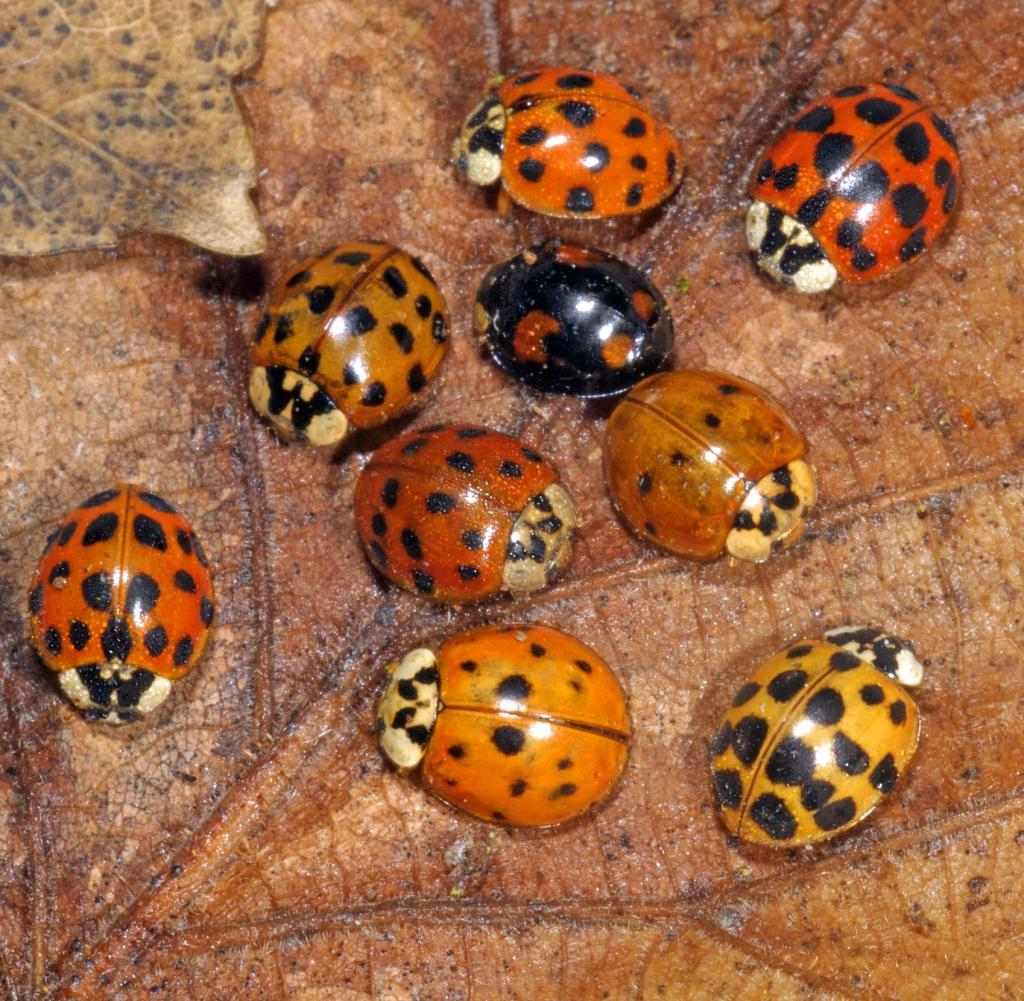
The species of the so-called harlequin ladybird was initially not native to Germany but has spread more and more in recent decades. The appearance of the insects ranges from orange without spots to black with red spots. Its wings are light yellow to dark red.
The Asian ladybug usually has 19 black spots.
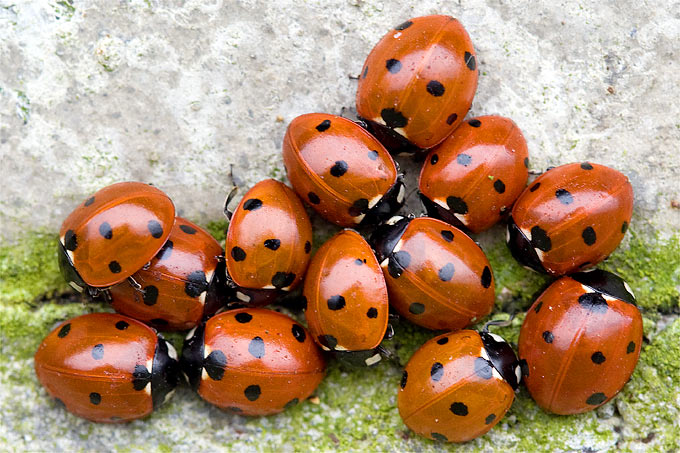
The seven-spotted ladybird is primarily native to Germany. In Central Europe alone, he and his relatives do it in over 70 different ways. There are about 6000 species of the ladybird family worldwide.
And I mean...No! I don’t feel bothered and I have a lot of red flying visitors at my house.
Most people talk about the ladybird plague, the media join in as always.
We have destroyed the climate, the seasons are no longer right, most animals lose their concept because of us.
Animals are just trying to adapt to this disaster, to survive, and we call their response “plague”.
I see only one plague, human plague 2020.
What are we doing? We pollute the environment.
We build roads and new settlements over forests and greenery
We are building everything with supermarkets plus fat parking spaces! We produce so much waste that the seas will soon die …
But … we perceive the over-presence of ladybugs as a plague!
We are the most harmful and stupid species on the planet.
Posted on October 26, 2020 by Serbian Animals Voice (SAV)
Last week, Trump attempted an insult by saying Joe Biden would “listen to the scientists.”
Phew. Doesn’t that sound like a breath of fresh air?
Not only have our scientists at the Center for Biological Diversity Action Fund endorsed Joe Biden, but for the first time in its 175-year history, Scientific American has endorsed a presidential candidate in Joe Biden. Recently Nature followed suit, saying: “Joe Biden’s trust in truth, evidence, science and democracy make him the only choice in the U.S. election.”
We are working together to create a wave of change that will remake our nation and protect our environment by electing leaders like Joe Biden and Kamala Harris.
For the future,
Dianne DuBois
Campaigner Center for Biological Diversity Action Fund CenterActionFund.org





 Serbian Animals Voice (SAV)