Posted on July 7, 2020 by Serbian Animals Voice (SAV)
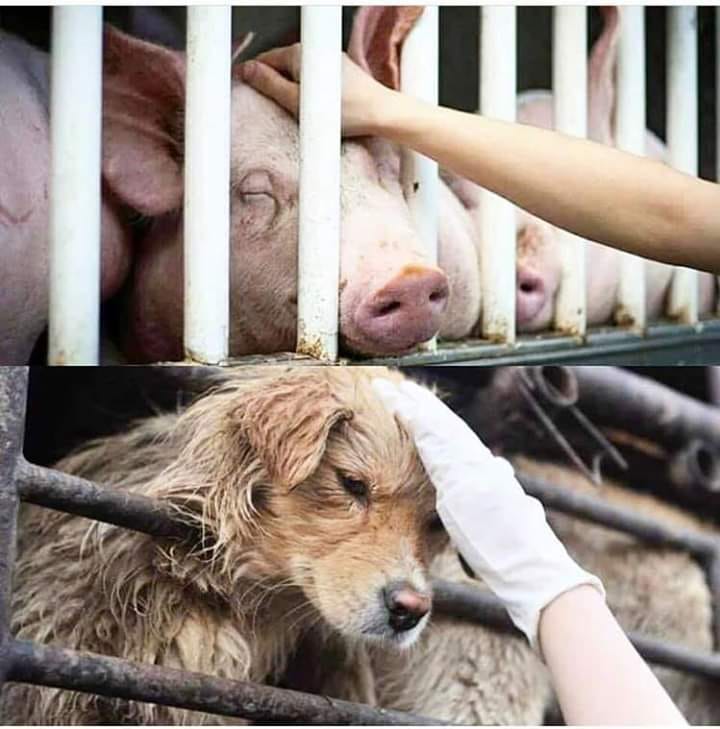
This is how we want to see animals and not otherwise!
Is there anything nicer than sharing life with happy animals?
Who love you, are loyal to you and never betray you?
And live with each other in peace and respect?
Maybe we should learn a bit from their dignity, cleverness, loyalty; that would make the life of human animals more valuable and happier.
It is deeply shameful that we, as the only animal species, still do so much violence to the “other” animals.
Posted on July 6, 2020 by Serbian Animals Voice (SAV)
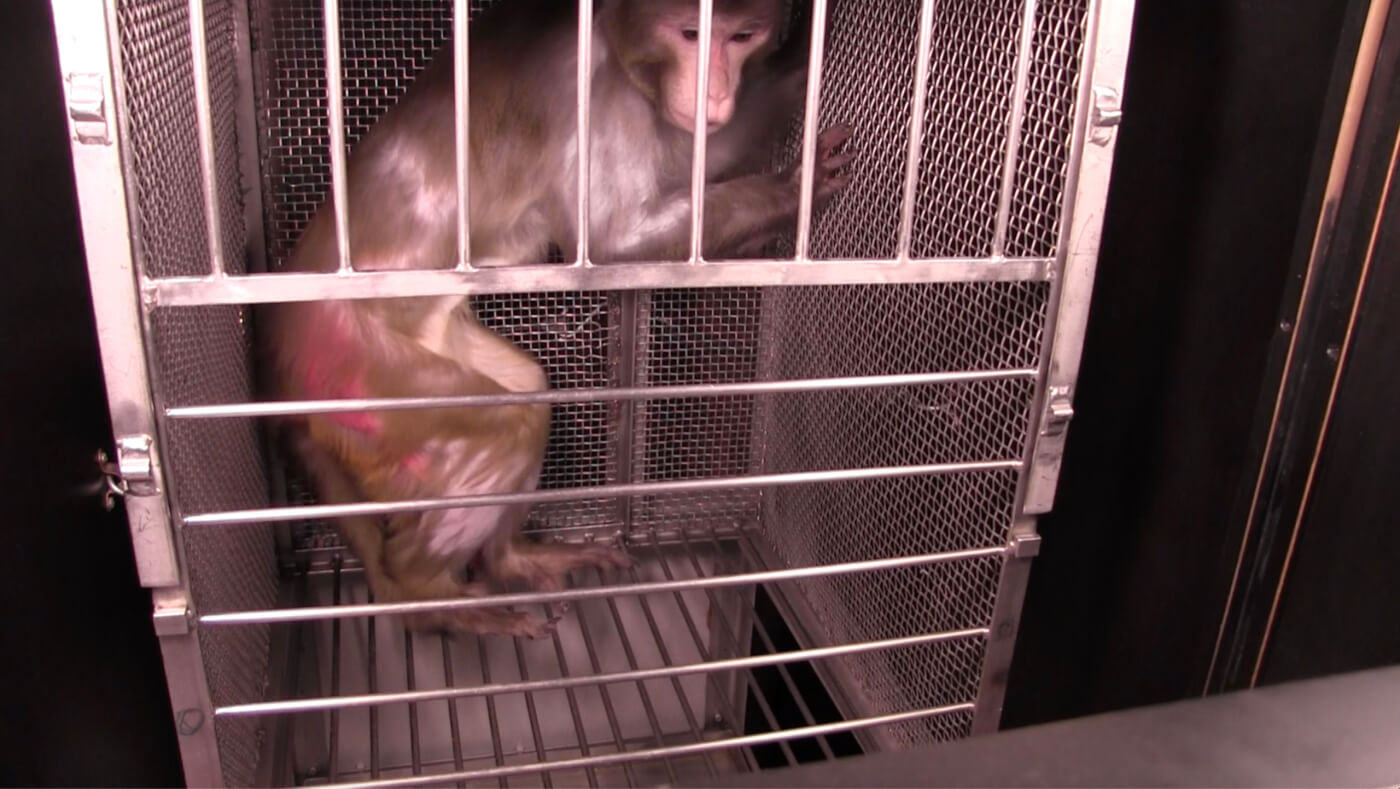
She saws open her victims’ skulls then injects toxins to burn brain cells, or suctions out parts of the brain. She sews them back up then places them in a small cage that probably reeks of the previous victim’s fear.
She then deliberately provokes their worst fears, just to see how they’ll react.
When she’s through with them, she kills them.
She’s Elisabeth Murray, and she calls herself a scientist.
Her victims are monkeys. She gets millions of your tax dollars to keep repeating this horror.
PETA has obtained 43 hours of never-before-seen video of Murray’s twisted “emotional responsiveness” tests on dozens of monkeys at a National Institutes of Health(NIH) laboratory in Bethesda, Maryland.
The videos were recorded between February 2016 and November 2017.
Blood money and lots of it, for nothing…
….This is not how we succeed. Take action now: Join PETA honorary director and Hollywood A-lister Anjelica Huston, who wrote a letter asking that the funding for these cruel experiments stop, and let NIH know that you won’t stand for this pointless cruelty.
Please use the form below to demand that our government stop these experiments and immediately shut down this lab!
My comment: It is hard to believe that governments leave the research in the hands of such money-hungry dilettants.
Obviously, the animal testing system with all its consequences for humans and animals is out of control.
Animal testing is senseless, expensive, dangerous, and cruel.
And the worst thing: this shit is financed with our money without asking us.
The alternative methods have not yet been implemented, but let’s say this: Animal research is not going well, more and more companies are committed to animal-free research.
We are uncompromising against animal testing.
A bad, cruel method remains a bad cruel method.
We have to be patient and persevere, participate in petitions and demonstrations, remain active against this senseless torture.
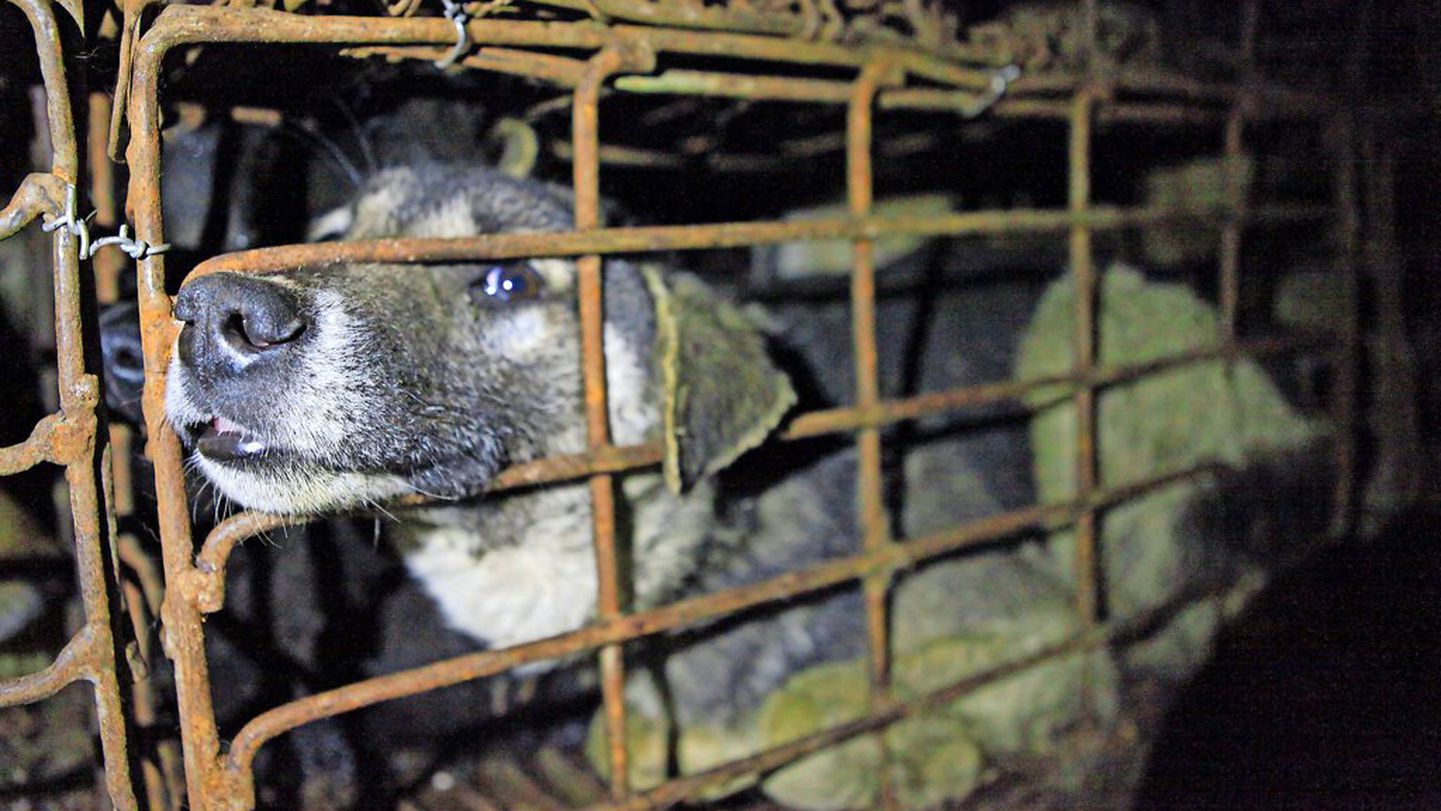
Evala is a two week festival where thousands of men gorge on dog meat for two weeks. Thousands of dogs are also slaughtered so wrestlers at the festival can rub dog fat on their body before entering the competition arena. For thousands of men eating dog meat is considered their secret weapon to gain the essential attributes of each dog they eat, such as: loyalty, courage, intelligence, endurance, cunning, faithfulness, strength, etc. It is falsely believed eating dog meat will transfer the dog’s attributes to the dog eater, giving them supernatural powers over their opponent.
Evala festival takes place each year from the last week in June to the end of the first week of July. Competing in Evala is a mandatory three year initiation ceremony to prove themselves as fully fledged members of the community. It’s a ritual passage for men over 18 years old to pass from boyhood to manhood.
To refuse participation in initiation ceremonies means being driven out by your family, elders and the entire community at large. It is a crucial step in what forges the young man to take on adult responsibilities.
For the first week thousands of young men go into isolation to gorge on dog meat for seven days. They continue to eat dog for the second week as they compete against each other in mandatory wrestling. Just before each competitor enters the wrestling arena a dog is killed for it’s body fat to be rubbed onto the wrestler to make his body slippery, so his opponent cannot seize him.
Rabies is a serious problem across Africa and dogs at Evala are not health checked prior to slaughter or consumption. [No accurate data is available on the number of people who may have died of rabies in connection to Evala.
Tribes from hundreds of miles come to Evala to compete against each other. As more tribes take part, more dogs are brutally slaughtered for dog meat and dog fat.
Huge crowds gather around the favored wrestlers cheering them on to the tune of drums, flutes and other instruments. The show of strength is to mimic how the man would defend his community if needed. Because Evala is a sport, the loser is also on show to prove his dignity in defeat.
The ultimate winner of Evala receives the equivalent of the keys of the community – Togo style. Showered in admiration his new found privileges are vast. Evala expert Blanzoua says:
“He wins the right to consult a witch doctor about a loved ones sickness. He wins the right to take up arms to protect the community in case of attack. He is allowed to get married and raise a family. When he dies he will be buried in an adult’s tomb instead of a child’s tomb. One is not born an Evalon (the singular for Evala), one becomes it. To do so, one has to go through the initiation process.”
Evala is becoming a lucrative marketing network for businesses and tourism to make money from. It started off in nine Kabye districts quickly spread across Kozah province borders. The Yaka district in the Doufelgou province also practices it and at least 13 other districts: Lama, Pya, Tchitchao, Yad, Bohou, Kouma, Sarakawa, Landa, Djamd, Yaka, Tchar, Soumdina and Lassa.
Fight Dog Meat will keep exposing what is taking place to these animals. Collectively we all have to keep yelling to let the governments know that we KNOW what is happening! Turning away or sitting quietly does not end the trade. We’re helping local volunteers have a louder voice on a world platform. Ultimately it’s the voice of the country’s own people whom their government will eventually be forced to listen to, for positive change for animals. With your help and support Fight Dog Meat will continue to pressure governments from the sidelines. We will not be quiet and will not back down. Animal protection laws are needed!
Fight Dog Meat will continue to bring you reports from dog and cat meat countries and the wonderful work their rescuers are doing despite no animal protection laws.
Thank you for reading,
Michele Brown
Founder,
Fight Dog Meat.
Fight Dog Meat is a Registered Charity. We work with a number of animal rescue teams in dog and cat meat countries, including Vietnam and China. Due to Covid-19 flight cancellations Fight Dog Meat has a number of rescued meat dogs in hospital and in rehabilitation in Vietnam. Until international flights start up again we’re under great financial strain to maintain our rescued animals.FDM is still accepting critically injured meat dogs; if we don’t they will die! Many of our dogs have some of the worst injuries in the meat trade. Please consider helping us during this special time.
If you would like to help the animals and rescuers we work with in dog and cat meat countries, please consider a small donation.
Posted on July 5, 2020 by Serbian Animals Voice (SAV)
On the Greek island of Santorini,donkeys and mules are used as taxis to carry tourists up and down more than 600 steps to the old town of Firá several times a day.
Despite international outrage when an eyewitness report published by PETA in 2018 revealed that the animals were denied water and shade and many had painful wounds, a new PETA video exposé reveals that the suffering and abuse continue.
Santorini officials refused to run adverts from PETA which highlight the suffering of donkeys and mules used as “taxis” on the Greek island.
PETA Germany has refused to be silenced and has bombarded neighboring ports, ferries, taxis, buses, billboards, and cargo bikes with a powerful campaign.
Over 100 adverts reading “Help stop cruelty: please don’t ride the donkeys and mules!” are now visible in the popular Greek coastal towns of Rafina and Piraeus.
The campaign follows a recent PETA eyewitness exposé revealing that handlers drag animals down steps and whip and hit them with sticks to make them continue walking.
Open Sores and Bloody Injuries
Donkeys and mules were observed suffering from open sores, raw skin, and bloody injuries caused by their ill-fitting and makeshift saddles.
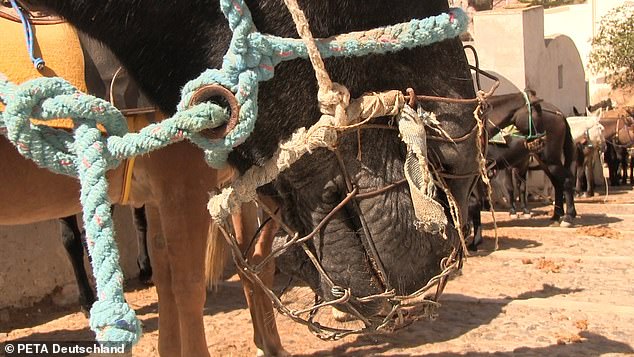
Some animals were forced to wear tight muzzles with sharp wire ends that could easily injure them as well as humans.
Under these laws, animals must have access to water and protection from the weather, but many of those used for rides are tied to a wall or rail for hours in the blistering summer sun with no access to water whatsoever. Some try desperately to find shade.
These conditions are illegal but apparently tolerated by the authorities.
And I mean…around 360 donkeys and mules stand at the port of Santorini every day and wait for the large cruise ships full of tourists to take them around 600 steps from the port to the small town. Their owners sell the ride on the animals for five euros as a special experience and make good money with the holidaymakers.
For years, animal rights activists on the island have complained that the animals have to work too long, carry too heavy loads, get too little to eat and drink – and have been exposed to the scorching sun for too long. But nothing has happened since then.
On the contrary: animal rights activists are not popular on Santorini.
In 2018, when they demonstrated against the cruel shuttle service, they were brutally attacked by donkey transport operators.
Animal rights activists say: ” the business with tourists is just the tip of the iceberg of criminal acts. We are currently gathering incriminating evidence against local authorities. ”
Meanwhile, the local slave keepers refuse to restrict their donkey rides. They claim that their booming business even maintains the endangered original tradition of Santorini (!).
The abuse of the animals continues because no keeper has been punished so far.
Fires in Brazil’s Amazon rainforest rose by almost 20% in June – a 13-year high for the month, according to government data.
With such an increase at the start of the dry season, there are concerns that this year’s fires could surpass 2019’s disastrous blazes.
Activists say the coronavirus pandemic is exacerbating the problem.
They believe arson is likely to be even less monitored while authorities are stretched.
Many forest fires in the country are started deliberately by illegal loggers and farmers wanting to quickly clear ground.
Brazil has the world’s second-highest coronavirus death toll, after the US, and there are also concerns that increased smoke could have a damaging effect on the breathing of virus patients.
In June, the country’s National Institute for Space Research (INPE) recorded 2,248 fires using satellite imagery, as opposed to 1,880 fires in June 2019.
The burning usually increases throughout July, August and September.
“We cannot allow the 2019 situation to repeat itself,” Mauricio Voivodic, executive director of the World Wildlife Fund NGO in Brazil, told the Folha de Sao Paulo newspaper, accusing the government of inaction.
Last year’s fires peaked in August, with 30,901 – threefold the number for the same period the previous year.
The 2019 fires led to protests domestically and internationally, with threats of financial penalties from foreign governments, and broad condemnation of President Jair Bolsonaro’s environmental policies.
The president has been criticised for slashing the Ministry of the Environment’s funding, and encouraging business over conservation.
Posted on July 5, 2020 by Serbian Animals Voice (SAV)
Dog meat trade Nagaland in India announces the end
In a groundbreaking decision, the Indian government of Nagaland ended the brutal dog meat trade.
The decision announced today by the cabinet will end the import, trade, and sale of live dogs and dog meat.
Animal welfare organizations have been campaigning for years to end the Indian dog meat trade and welcome this decision as an important turning point in ending the cruelty of the Indian trade in hidden dog meat.
It is estimated that around 30,000 dogs are smuggled into Nagaland annually, where they are sold in living markets and beaten to death with wooden clubs.
The animal rights activists’ campaign to end the dog meat trade started in 2016 with an investigation that revealed shocking video footage of dogmeat death pits in Nagaland.
Dogs were beaten to death in front of each other and beaten several times in protracted and painful deaths.
Alokparna Sengupta,Managing Director of Humane Society International,India, said: “The suffering of dogs in Nagaland has long cast India in a dark shadow, and this news marks an important turning point in ending the cruelty of the Indian dog meat trade.
Our own investigation in Nagaland found that terrified dogs have suffered horrific deaths in some of the worst inhumanities to animals HSI / India has ever seen. And the dogs we saved from this trade over the years had to learn to trust people again after the cruel treatment they endured. “
Dog meat is banned in India by the 2011 Food Products Standard and Additives.
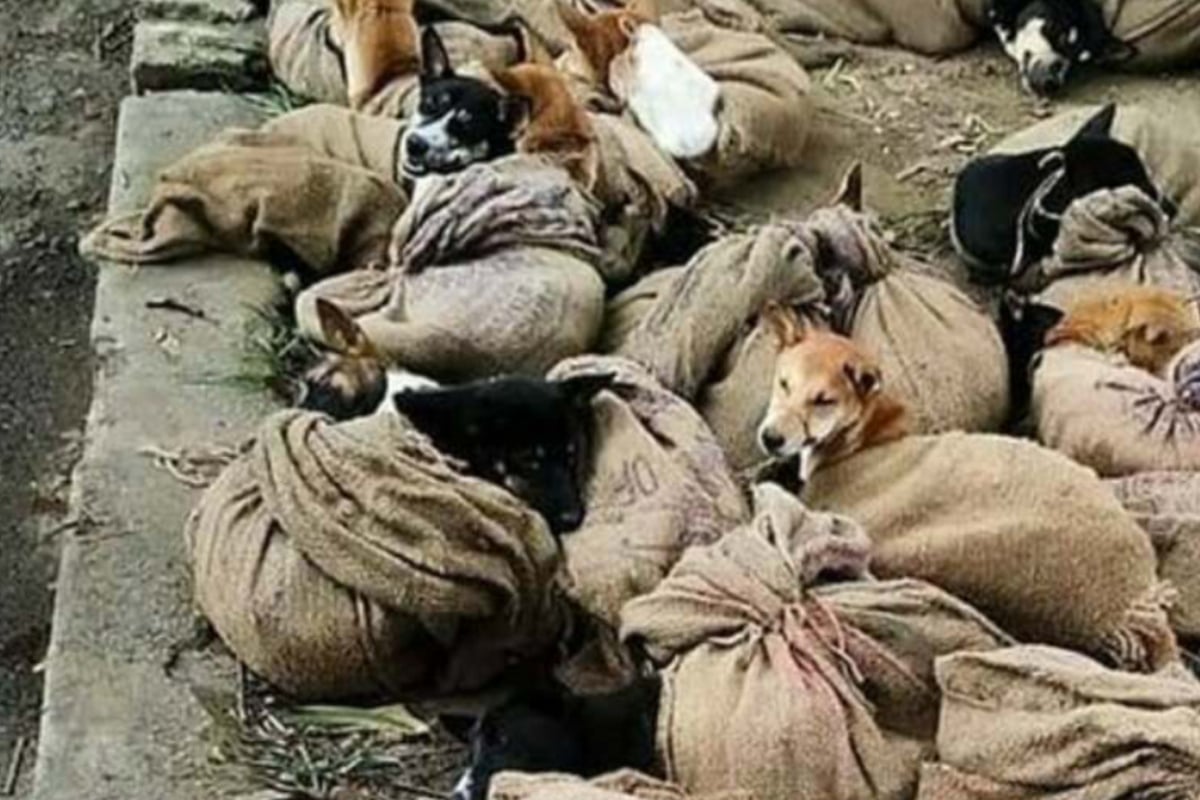
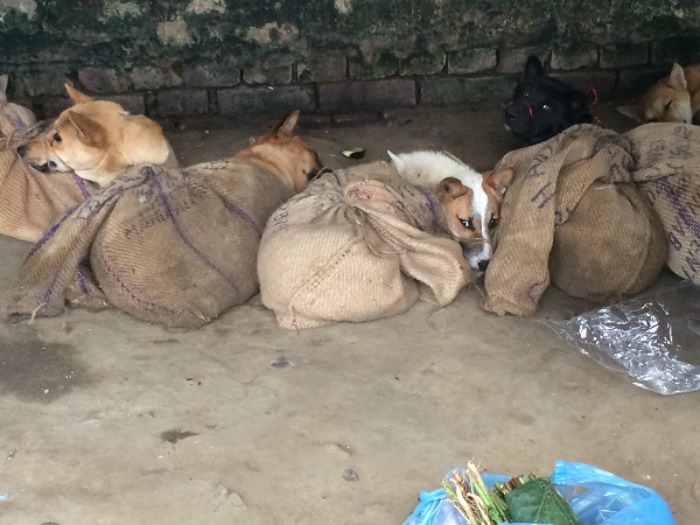
However, this is insufficiently enforced, and in the states of Nagaland, Mizoram, Tripura, and Arunachal Pradesh thousands of dogs are used every year illegally captured from the street or stolenfrom houses and cruelly transported from neighboring states in burlap to be brutally slaughtered for consumption to be beaten to death.
Earlier this week, the Indian MP Smt. Maneka Sanjay Gandhiurged the Nagaland government to stop trading and eating dog meat after he received new photos of the trade from an animal welfare organization based in Nagaland. The appeal resulted in more than 125,000 people writing to the Nagaland government.
And I mean…We are very happy about the government’s decision to abolish the brutal trade in dogs.
It is a small success but a step further in the right direction. Our heartfelt thanks!
However, we must not forget that millions of “other” animals are brutally murdered every day. They’re animals too.
A pig is not bred to be grilled and a pet to painting.
We have been manipulated by the media for decades to determine what is “normal” and what is not “normal” when it comes to our food.
Every murder of animals is not normal.
If we want to do our job properly and consistently, we have to see all the victims that meat consumption demands, on an equal footing, and judge none of them as wrong and the other as the right one to eat.
Posted on July 4, 2020 by Serbian Animals Voice (SAV)
Mark (WAV) and Phil (CIWF) campaigned together for years regarding the live export of animals from English ports. They are still friends and communicate on current animal issues when necessary. Although (I am) not religious; I find this article by Phil interesting – and feel that it should be included in our posts. I have included the link below should you wish to see the pictures, and have also included the un amended article also..
COVID-19 – STOPPING THE ABUSE OF SENTIENT ANIMALS – BY PHILIP LYMBERY
Philip Lymbery is the Chief Executive of Compassion in World Farming and Chair of Eurogroup for Animals. He is author of the books Farmageddon and Dead Zone. Here he describes how Covid-19 demonstrates why we must ban wildlife markets and improve farming standards if we are to prevent the next pandemic or Farmageddon.
In early April whilst most of the world was coming to terms with the horror of the Covid-19 pandemic, Compassion in World Farming, along with some 200 other organisations, signed an Open Letter to the World Health Organisation (WHO).
We called upon the WHO to take actions including recommending that governments worldwide institute a permanent ban on live wildlife markets, drawing an unequivocal link between these markets and their proven threats to human health.
Covid-19 is just the latest example of an infection that has made the leap from animals into humans – and when infections do this, they can be particularly deadly. Three out of four new or emerging infectious diseases in people came from wild animals, including Severe Acute Respiratory Syndrome (SARS), Ebola, MERS and HIV.
The risk of transmission of new and deadly diseases is heightened by the ways in which wild animals are typically farmed or captured and exacerbated by the inhumane and unhygienic conditions in wildlife markets, where close proximity provides the perfect opportunity for pathogens to spread between humans and animals.
Whilst our call for action has received widespread support, it has also received criticism on the grounds that wildlife trade bans might risk increased illegal trade, increased involvement of organised crime and be detrimental to livelihoods. Frankly I’m astonished by such arguments. I could not agree more with Jill Robinson, Founder and Chief Executive of Animals Asia, who has spent over three decades investigating the wildlife trade and wildlife markets. Responding to criticisms of the Open Letter to WHO, Jill commented, “The trade is already controlled by organised crime. Far better to spend millions or even billions on defeating and ending this crime and ending the trade now, rather than the trillions in the next pandemic caused by the very same dysfunctional and largely corrupt components of the wildlife trade”.
During my own investigations around the world, and particularly in Asia, I’ve seen the suffering of wild animals, caged and confined in markets. I’ve been forced to watch as they’ve been treated with no more regard than would be afforded vegetables or tin cans.
In the 1970s Peter Roberts, Compassion in World Farming’s founder, feared that by adopting a violent attitude to Nature, man would find himself “threatened on all sides by disease, hunger and pests”. Today the world faces an onslaught of health issues, often linked to the abuse of animals, both wild and farmed. The Coronavirus tragedy, like SARS before it, is demonstrating to the world how treating animals as mere commodities is like playing Russian Roulette with peoples’ health.
Reconnecting with our Humanity to Animals
A key component of reducing the risk of devastating diseases tomorrow is to reconnect with our humanity for animals today. Our cruel abuse of animals, both wild and farmed, is damaging our health and will continue do to so unless we fundamentally reassess our relationship with animals and recognise our ethical obligations to treat them with respect.
As a first step, I’d like to see governments around the world acting to ban wildlife markets and instituting the other measures called for in the Open Letter to WHO, as a matter of urgency. There are many examples of successful bans that have been combined with measures that address cultural practices and provide alternative livelihoods for those in need, for example the ban on dancing bears in India.
As we move away from wet markets and the use of wildlife for food, some will call for these food sources to be replaced by factory farming. But this too is a hot house of disease linked to the emergence of deadly diseases, including highly pathogenic Avian and Swine flu strains. Indeed, I fear that factory farms may be the source of the next global pandemic.
Everyday we understand more and more how the health of animals and people are closely intertwined. As Albert Schweitzer once said, “Until he extends the circle of his compassion to all living things, Man will not himself find peace”.
Factory Farming – A Health Crisis for the Future
With the world gripped by the worst pandemic in a lifetime, questions are starting to be asked about how our treatment of animals is storing up health crises for the future.
Whilst Covid-19 is thought to have its roots in wildlife, future pandemics may be triggered by the way animals are factory farmed. The sad fact is that factory farming is not only extremely cruel, but also a major public health risk. Keeping animals packed into cages and confined provides the perfect breeding ground for disease. Factory farms are a ticking time-bomb for future pandemics.
Hundreds of coronaviruses are in circulation, most of them amongst animals including pigs, camels, bats and cats. Sometimes those viruses jump to humans – called a spill-over event – and can cause disease. When SARS (Severe Acute Respiratory Syndrome) emerged from China in 2002, it swept across the globe – largely through air travel – causing deadly illness. More than 8,000 people fell ill and 774 died, numbers surpassed by Covid-19 within two months. The 2009 Swine flu pandemic was linked to the factory farming of pigs in Mexico. Within a year, according to the WHO, the virus was linked to over 18,000 deaths worldwide.
Three out of four new or emerging infectious diseases in people come from animals, including Swine flu, Avian flu, HIV, Ebola, MERS and SARS. They are known as zoonotic diseases. The Wuhan coronavirus is the latest example of an infection that has jumped from animals into humans – and when infections do this, they can be particularly deadly.
Breeding Grounds for New Pandemics
The caged, crammed and confined conditions of factory farms provide the ideal breeding ground for new and more deadly strains of virus. Swine flu and highly pathogenic Avian flu being just two examples. When faced with a disease crisis involving farmed animals, the industry’s reaction is to fall back on locking animals inside. After all, if they are confined indoors then they are surely protected in ‘biosecure’ units that can keep out vectors of disease transmission.
What is overlooked is that those very same ‘biosecure’ intensive farm buildings are the cause of the problem. The perfect breeding ground for disease. The hothouse where new and more dangerous strains of disease emerge, often with devastating consequences for both animals and people alike.
Playing Russian Roulette with our Earth
Keeping too many animals in too small a space, often in darkened, filthy and crowded conditions, provides viruses like Avian Influenza the conditions they need to spread rapidly. As they replicate at speed, mutations can occur in the virus’ DNA, causing new strains to emerge. This allows new and deadlier strains to form and spread quickly. So, contrary to the myth levied by the industrial farming industry, keeping animals indoors simply increases the risk of disease.
The coronavirus tragedy, and Swine flu a decade earlier, have shown that treating animals as mere commodities – be they domesticated or wild – is like playing Russian Roulette with peoples’ health.
One Health, One Welfare
What I’ve come to see is that a key component of reducing the risk of devastating diseases tomorrow, is to reconnect with our humanity for animals today. The coronavirus epidemic is not a warning, but a potent demonstration of what is going wrong, what life could become. A global lifestyle that just months ago seemed invincible, suddenly seems extremely fragile. The way that the wellbeing of people, animals and the environment are interlinked have become increasingly clear. Factory farming is a public health disaster waiting to happen and it is clear that future generations will be well served by its abandonment.
Your help is vital. Thank you for your support in our movement to end factory farming. For animals, people and the planet, let’s take action today.











 Serbian Animals Voice (SAV)