Global pizza chain Pizza Hut recently launched a full vegan menu in all locations across Australia.
The menu features four pizzas: Vegan Mediterranean, Vegan Deluxe, Vegan Cheese Lovers, and Vegan Margherita. The restaurant also offers vegan cheesy garlic bread, which joins its existing vegan-friendly garlic bread and Spud Bites. A vegan ice cream cone has also been added to the dessert menu.
The new vegan options come a year after the company first tested vegan options in the country. In May 2018, Pizza Hut trialled vegan cheese—made by local vegan company Dairy Free Down Under—as an option for its pizzas at two locations in New South Wales, Australia.
Earlier this year, the chain debuted a dedicated vegan menu in 253 locations in the United Kingdom.
Starting February 2020, the University of Helsinki—the oldest and largest university in Finland—will no longer serve beef for lunch.
The school’s food provider UniCafe—which serves approximately 1,000 lunches daily—made the decision to remove beef from the menu in a bid to fight the climate crisis and revealed that the move would reduce its carbon footprint by 11 percent annually.
“The idea came from the staff as we were thinking about our next responsibility action,” Leena Pihlajamäki, the chief operating officer at UniCafe, told local media outlet YLE. “We realised that this is a way to reduce our carbon dioxide emissions significantly.
Studies show that it’s one of the most effective ways. The goal is ambitious but far from impossible.” The University of Helsinki follows the University of Coimbra (Portugal’s oldest university), University of Cambridge, and Goldsmiths college which have all pledged to remove beef from on-campus dining facilities in recent months for environmental purposes.
Posted on October 17, 2019 by Serbian Animals Voice (SAV)
Rachele Totaro is a unique kind of activist. The 37-year-old animal lover and vegan uses her camera lens to tell the stories of animals, helping them to find homes and above all, showing the public that each animal is “someone, not something.”
Totaro was led to a plant-based diet by her fondness for animals. “I’ve always loved and felt connected to them,” she told LIVEKINDLY in an email. The photographer pointed out that although many animals are viewed as food, each is an individual.
“Every animal is someone, not something. Feeling, loving, and fearing with a unique personality, relationships, and, mostly, with the right to live,” she said. “Once you see it, you can’t unsee.”
Totaro uses her photography skills to help others make the link, too. The activist is a volunteer photographer for an Italian charity called La Collina dei Conigli, which rescues and rehabilitates retired lab animals. For six years, Totaro has traveled to the sanctuary to take pictures of rabbits, guinea pigs, mice, and rats who were once used in experiments. The images are used in a fundraising calendar.
“After realizing some story-inspired pictures (‘Alice in Wonderland,’ ‘The Little Prince,’ etc), which were very helpful to raise awareness about some very despised critters like rats and mice, I decided to show the most magical story of all because, in some blissful cases, reality can be more enchanting than fiction,” the photographer explained.
“I decided to show the reactions of the little rescues seeing what was outside of their cages for the first time,” Totaro said.
Even once the animals are released from the labs, they typically spent their time inside cages waiting to be adopted. “Most of them never see what’s outside of a plexiglass cube,” added Totaro.
And so she took them outside and captured their first moments in the natural world. “The warmth of the sun, the smell of fresh grass, the first steps on the ground, and at the same time to show the close relationship between non-human animals and their human rescuers,” the photographer explained. This concept is a moving one given the animals’ experiences with people up until that point. “Human hands were no more a source of pain or fear. They became a safe nest,” she said.
Totaro describes the experience as emotional – for herself, the volunteers, and the animals. She believes the end result was effective since the shoot took place nearly two years ago and the images are still circling the internet.
The ‘Huge Power’ of Photography Activism
Totaro’s photography is also used to help shelter animals find homes. She is a volunteer photographer for HeARTs Speak, a non-profit organization that unites artists from around the world to help “increase the visibility of shelter animals” (Totaro notes, “seen = saved”). The activist explains that a quality photo can mean the difference between “spending a life in a cage and finding a family.”
In that way, photography holds “huge power.” She believes she can use the medium to pull beauty out from unexpected places and hold a magnifying glass to it. She explains, “Photography, for me, means connection – between the subject and the observers, like temporarily borrowing my eyes.”
Every animal Totaro encounters has their own story and she feels it’s important to honor each with the right set of photos. She mentioned an old dog she recently met and photographed. The dog was thin, had terminal liver cancer, and was abandoned when she fell ill. Totaro met her in a shelter’s vet room, lying down and struggling to breathe. With her photography, Totaro was able to showcase the dog as a “unique, precious being, not an old broken toy as her previous owner probably saw her.”
“Maybe it can seem useless or foolish, and of course it won’t change her past, but the fact that now she is recognized as someone, someone who is at center stage, pictured ‘as a model’ to show everyone her beauty – the one that goes beyond the surface,” Totaro said. “Well, it’s my way to say that she is important, that someone cares, and that the real losers are those who never understood this.”
“I took some amazing portraits of her in the last light of the day, my favorite, while she was held by a caring volunteer. She was loved and beautiful and everyone will see it,” the artist added.
Totaro’s passion for lending a lens to animals in need motivated her to start her own project, Progetto gOldies. Through it, she tells the stories of “old pets and their humans.” Totaro explains, “There are so many great love stories out there and so many are at risk of getting lost in time, just because no one can tell them.”
She hopes Progetto gOldies will also promote the adoption of senior pets. Totaro says one of the best feelings is to receive that phone call telling her that an animal she has photographed has found a home. “I cannot think to a bigger reward,” the creative said.
We don’t need to say anything except – we did not realise that there was so much concrete in the African Savannah – see the videos for conditions in the zoos !
Posted on October 16, 2019 by Serbian Animals Voice (SAV)
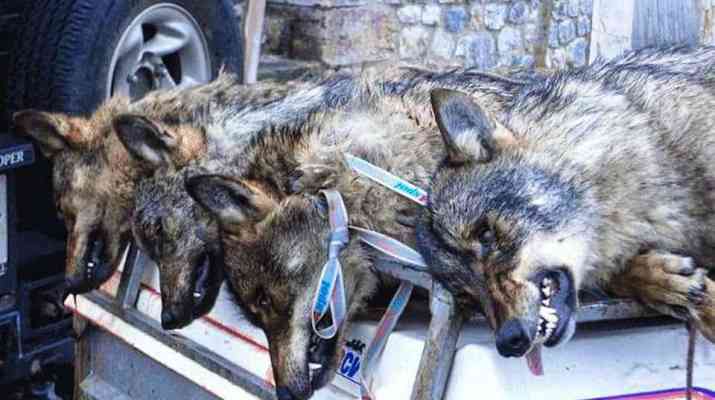
The protected status of the wolf is determined by the EU. Yet, EU countries determined what this status practically implies by including the species in different Annexes of the Flora and Fauna Habitats Directive. Therefore, countries like France and Slovakia, as well as regions of Spain can still legally cull wolves to a certain level. Yet, even Spain stopped the wolf culling activities last season. In the meantime, illegal killing of wolves continues to happen in many other countries. Here are a few highlights that need international attention.
Norway
The Norwegian regional Large Carnivores Committee recently made the decision to kill three wolf packs in the so-called wolf zones this winter. The wolf-zones are actually areas where wolves should be able to live, instead of being shot. This means that Norwegian hunters will try to kill another 17 wolves.
Many Norwegian organisations have appealed to the Ministry of Environment to call stop the killing. The Ministry will decide on the situation in November.
The decision follows many killings and demonstrations against it in Norway and across the world. Last year, Norway planned to kill half of its entire wolf population even. The Scandinavian wolf population is severely suffering from these impacts. There is less genetic exchange between populations, due to the fact that many migrating wolves die along the way.
And the so-called genetic inbreeding is used as an argument to reduce the wolf population size again. Yet, scientific evidence shows that the Scandinavian wolf population can recover, if people let it. On the 26th of October, people will go to the streets to demonstrate against this decision as well.
But the story of Danish wolves does not stop there. According to reporting, at least 7 wolves have gone ‘missing’ in Denmark since 2012. What is left is an estimated number of 4 adults and 6 cubs.
If the Danish authorities treat such felonies of killing strictly protected animals so mildly, it is only a matter of time before the re-extinction of wolves in Denmark.
Belgium
The latest news is from Belgium, which welcomed the wolf back after more than 100 years of absence. The she-wolf named Naya found a male partner August in the Belgian forests. Earlier this year, camera traps photographed her as she showed signs of being pregnant. However, since 4.5 months there has been no sign of her or the pups. August still roams the woods, but the official news came out this weeks that hunters most likely have killed Naya.
Although clear evidence is still lacking, experts state it is very unlikely that the wolf died of other causes. The official research still has to provide proof of what happened to the Belgian wolf, however.
Human-wolf coexistence
Killing wolves is not the solution for the problems that hunters and farmers are facing. Effective livestock protection measures are more effectively contributing to human-wolf coexistence than killing wolves. Practical examples from many different countries and regions prove that it can work. It is up to the people to decide whether they accept that the wolf returned.
My comment:First of all, we have to make one thing clear: the goal of the hunt is the executions!
After the reintroduction of the wolves in Germany it is forbidden (officially) to shoot a wolf.
The wolf enjoys a high protection status as a endangered species in Germany and at the same time is still protected by European and international law.
This is on paper.
But hunters have always hated wolves.
The murders against wolves have accumulated in recent years in Germany but they were never enlightened.
So how can a hunter eliminate a wolf without being punished?
He sends his hunting dogs, the hunter’s best manipulated!
It is about a miserable minority of 0.45% of the german population practicing undisturbed every day terror against defenseless animals in the forest.
The peasants claiming that their animals are being ripped off by wolves. They can build fences. For this they get the EU subsidies.
Also, if one or two animals are ripped off by the wolf they will get compensation.
The farmers do not mention that in Germany every year one million sheep are brutally slaughtered and often without anesthesia! that’s what they call business, fun food for a society that does not need it.
Hunters claim that they regulate nature.
They do not regulate anything, they massacre on murder lust.
Hunters are habitual offenders who deliberately kill defenseless animals.
this is one of the most dangerous animals on our planet. Year after year, it is responsible for multiple suffering and millions of deaths. Left beside it hangs a murdered wolf.
As a Brit, I have had some great times in New Mexico in the past – wonderful people, beautiful towns, and a rather hot series of Balloon festivals !
Thanks to Mayor Webber for his outstanding initiative for animals and for the environment. Regards Mark (WAV).
Exciting news for Santa Fe, New Mexico residents and the vegan community as the city’s mayor Alan Webber recently named November Vegan Awareness Month. Mayor Webber hopes this action will encourage residents to explore the many delicious vegan options available in their city and by doing so, make a positive impact on the environment, their health, and animal welfare.
The proclamation highlights the many benefits of a plant-based diet, including that every day it “saves 1,100 gallons of water, 45 pounds of grain, 30 square feet of forested lands, the equivalent of 20 pounds of CO2, and one animal’s life.”
Through this initiative, Webber says he hopes to continue Santa Fe’s legacy as “a leader in water conservation and earth-friendly practices, [. . .] support[ing] people who choose a vegan diet for whatever reason” and encouraging others to “learn about plant-based eating during November and beyond.”
The Mayo Clinic and the American Dietetic Association tout the multiple health perks of adopting a plant-based diet. The ADA states that plant-based diets “are healthful, nutritionally adequate, and may provide health benefits in the prevention and treatment of certain diseases” and are appropriate for any age. Consuming solely fruits, vegetables, whole grains, nuts, and legumes helps lower and manage blood pressure and cholesterol and makes developing chronic heart disease less likely. Additionally, research shows that this diet “reduces the risk of cardiovascular disease.”
In addition to the powerful impact a plant-based diet can have your health and the environment, eliminating animal products means no longer contributing to the rampant cruelty farm animals endure in the meat, egg dairy industries. Animals are frequently beaten, thrown, kicked, and discarded like trash. Male chicks in the egg industry are sometimes ground alive as they do not produce eggs and therefore are seen as unimportant. Pigs are confined to such small quarters that they are unable to move or stand. These are only a few examples of the awful conditions in which these animals must live.
We applaud Mayor Webber for this initiative and hope it will inspire more civic leaders to follow suit.
Great news out of Sacramento! On Saturday, October 12, Governor Newsom signed AB 44 (banning the sale and production of new fur products) and AB 1254 (bobcat trophy hunting) into law. This momentous legislation will spare countless wild animals from the cruel and unnecessary fur trade and bobcats from the horrors of trophy hunting.
Animals raised for the fur trade languish in tiny cages on factory farms and are cruelly killed by gassing or electrocution. Wildlife including foxes, coyotes, beaver, and otter are also trapped in their native habitat and their skins sold at auction. These two laws send a message to the fur industry that consumers no longer want animals skinned for fashion clothing and accessories.
The ban on bobcat hunting will spare countless bobcats and other nontarget species from being sport-hunted—following up on California’s precedent-setting ban on bobcat trapping in 2015. It will also help preserve the species, which faces a range of threats including human encroachment on their habitat and consequences from climate change.
Join us in thanking Governor Newsom and the bill sponsors—Asm. Laura Friedman (who introduced the fur ban bill) and Asm. Sydney Kamlager-Dove (who championed the bobcat bill)—for taking a stand against these inhumane practices. Please shoot them a quick email—contact information is at the links provided.
We are deeply grateful to all of you who supported these bills and spoke out for the voiceless animals.








 Serbian Animals Voice (SAV)