Posted on March 12, 2020 by Serbian Animals Voice (SAV)
No to aid for the cancellation of the bullfighting season!
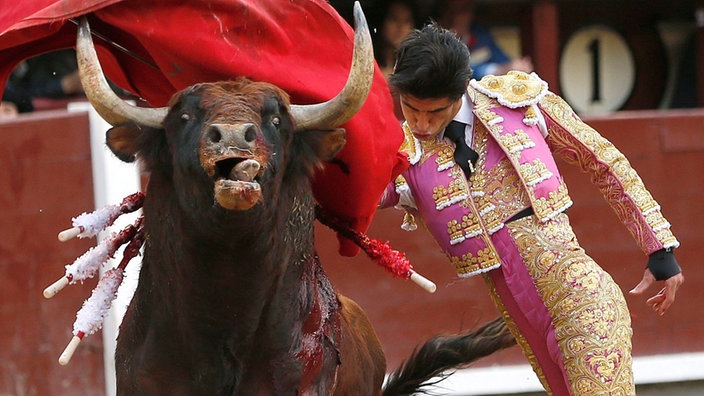
🐃All bullfights in March were canceled. Madrid, Valencia, Castellón, Murcia, Arnedo … 21 bullfights are already affected and 120 bulls saved because of it
Now the bullfighting sector is asking the government for support to save the season.
The Toro de Lidia Foundation and the Minister of Culture José Manuel Rodríguez Uribe requested an emergency meeting.
We will not let it happen!
The bullfighting sector, devastated: fairs suspended, thousands of tickets to return, San Isidro in the air … As has been done with sports events and schools, the bullring is being considered places of risk of contagion.
Thus, Madrid, Valencia, Castellón, Murcia and Arnedo have already canceled all the celebrations scheduled for March.
There are already 21 bullfights affected, and 120 bulls that, for the moment, are saved!But the bullfighting sector, which is beginning to recognize that the coronavirus is going to be a severe blow to bullfighting, especially for bullfighters, ranchers and bullfighting entrepreneurs, it has begun to react: the Toro de Lidia Foundation has already requested the Minister of Culture, José Manuel Rodríguez Uribe, an emergency meeting “to be able to study the possibility of starting contingency, recovery and support plans for the industry as soon as possible.” We will not allow it!
Now or never! Let’s use the opportunity to eradicate animal abuse once and for all. Join the petition to the Minister of Culture,José Manuel Rodríguez Uribe, so that he does not allocate a single euro from public coffers to financially help the bullfighting sector.
The European Central Bank recognizes that the economic crisis that is going to trigger the coronavirus may have the magnitude of thegreat financial crisis of 2008.
Public administrations across the country need to develop a package of measures so that companies do not suffer from liquidity problems due to the cessation of activities. Help for families has also been announced.
We need your help to demand that the government prioritize and not allocate funds to finance the bullfighting rescue. To do this, we ask that you dedicate less than two minutes of your time to perform the following action.
Send a letter to the Ministry of Culture and Sports – In this link is the petition-letter.
And I mean …those are the unexpected damages of the Omnipotent Corona Virus.
Nobody expected them, not even those who created it.
No bullfights, no environmentally harmful world trips, maybe no safaris, and soon there will be no more animal transports.
An animal friendly virus … this corona …
Everyone stays at home and waits for better times. The environment and animals benefit greatly from it.
WHO speaks of an extremely dangerous pandemic!!
Confirmed cases 80,754, including active infections 17,721, cured cases 59,897, deaths 3,136.
With 7, 75 billion human animals … 3000 deaths are the doom of the world.
Posted on March 11, 2020 by Serbian Animals Voice (SAV)
It’s Mark’s birthday today.
He kept it secret, only his animal comrades knew that
And today they gave him an extra portion of love and tenderness.
We wish him all the best! that he remains healthy and active and continues to be our campaigner for animal rights
Posted on March 11, 2020 by Serbian Animals Voice (SAV)
Shock for the animal torturers of Bad Iburg, Oldenburg-Germany!! Now 71 prosecutors are targeted by the prosecutor.
Image: SOKO Tierschutz
The horror of Bad Iburg, the slaughterhouse that had seriously ill and dying cows dragged to their deaths from all over Germany, will have serious consequences for dozens of animal transport drivers and numerous farmers. So far, authorities have focused only on butchers and veterinarians.
Now and after alleged animal welfare violations in this slaughterhouse, the public prosecutor’s office in Oldenburg has expanded its investigations to include animal owners and drivers.
The agency is now investigating 71 people, as spokesman for the Oldenburg prosecutor, Thorsten Stein, said on Tuesday.
Image: SOKO Tierschutz
There have been new allegations against 14 farmers, against 38 drivers and ten responsible transport companies. The reason for the expansion of the investigation is the evaluation of video recordings made by animal rights activists from the SOKO animal protection organizationin the slaughterhouse.
The accused animal owners are accused of not properly examining injured or sick animals by the veterinarian and having them transported to the slaughterhouse despite their condition.
The drivers are accused of knowing about the injuries or illnesses of the animalsand nevertheless having transported them. The police in the Osnabrück district are responsible for the questioning of the accused.
In addition to the new suspects, the public prosecutor’s office is investigating the two slaughterhouse operators, a veterinarian man and a veterinarian woman and five former employees of the company.
It is currently unclear when the investigation will be concluded.
In autumn 2018, activists from the “SOKO Welfare Organization”documented the conditions in the slaughterhouse with secret filming and informed the Ministry of Agriculture.
This filed a criminal complaint.
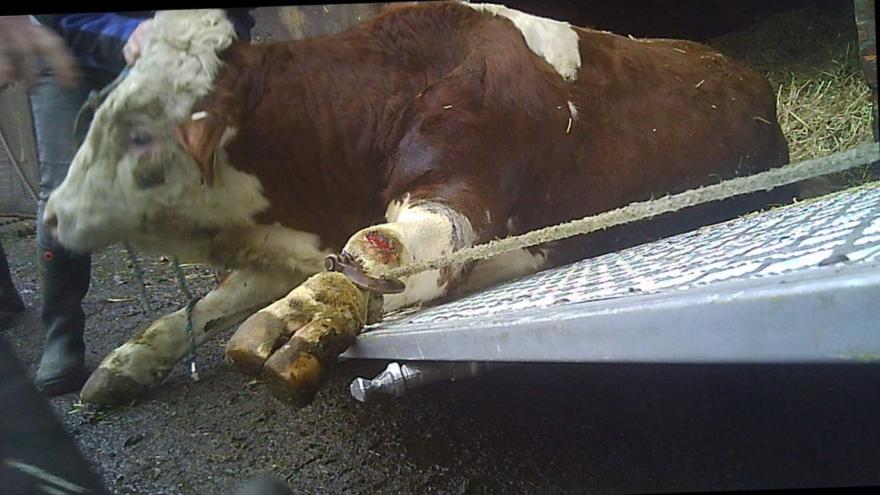
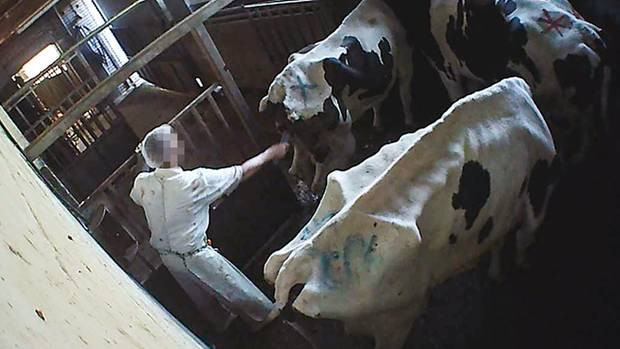
According to the animal rights activists, cattle were sometimes pulled from the transporter with a kind of winch, tortured with electric batons and beaten. The district of Osnabrück closed the slaughterhouse after the video recordings have been published.
Things are going in the right direction.
But SOKO animal protectionalways called for the dismantling of the entire network.
The animal rights activist Friedrich Mülln, chairman of the SOKO animal protection, shows with the pictures that the company has systematically slaughtered sick and seriously injured animals. –
Image: SOKO Tierschutz
Friedrich Mülln:If anyone asks me what was the cruellest thing I’ve ever seen, it wasn’t not China’s fur farms, it wasn’t Hungary’s live plucking or France’s foie gras factories, but an unassuming building in the small town of Bad Iburg in Lower Saxony.
Image: SOKO Tierschutz
The cows were mostly walking skeletons. The animals were so emaciated that you could really see every bone and vertebra. In about 200 cases, we documented that the general condition of the animals was so bad that they could not even walk.
The flap of an animal transporter opens and the entire floor is full of completely destroyed animals. These animals were then systematically, hundreds of times, with full consciousness dragged out of there with the cable winch or with electric shocks on their knees.
Bad Iburg was hell of the cattle. I want to see this case in court”!
And I mean…Before we Germans put a finger on the Chinese or others, we should check our own stables, most of which are apparently hell for the animals, although we supposedly have the best animal welfare laws in the world!
Posted on March 11, 2020 by Serbian Animals Voice (SAV)
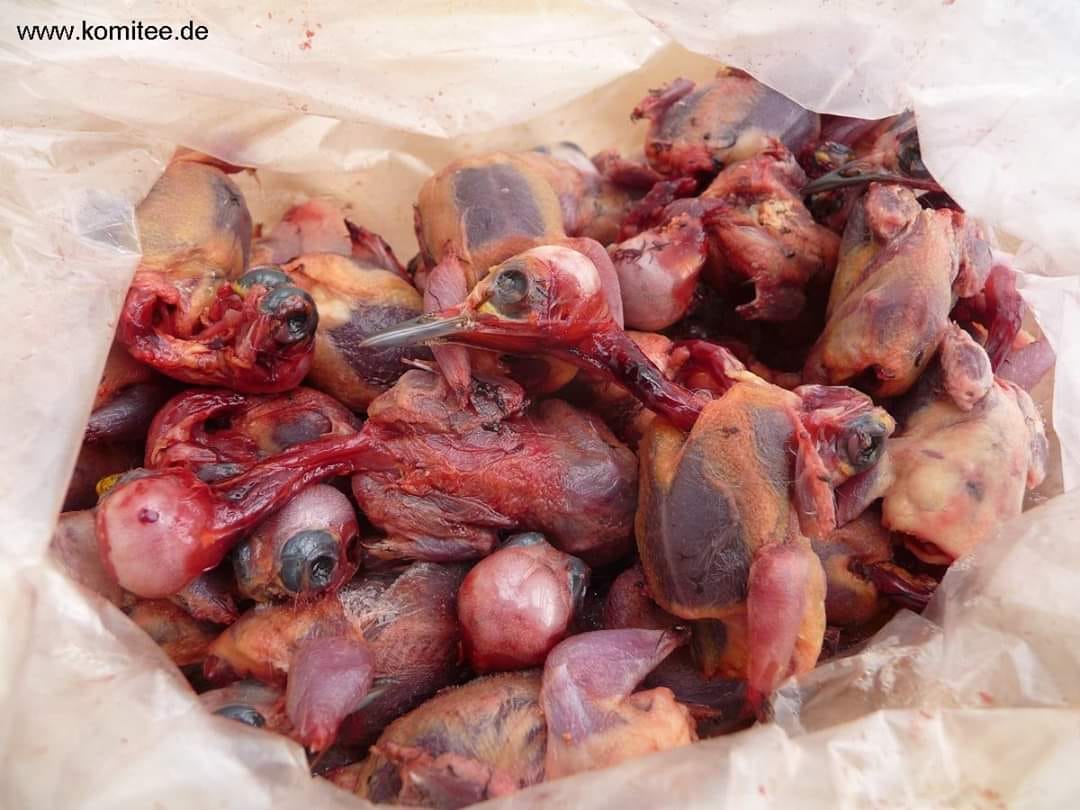
Our partner League pour la Protection des Oiseaux (LPO) has done a great blow against the illegal trade in songbirds for restaurants in France: A poacher has been shown to have had a total of 10,000 protected robins in the department of Les Landes in southwestern France over the past 9 years, robin, finch and titmouse caught, plucked it and sold it as kitchen-ready skewers (!!!)
The estimated profit is 50,000 euros. The traps he used for this are allowed for the “traditional” and non-commercial catch of skylarks, but are often used illegally, as the current case impressively shows.
Beginners of Ortol, against whom the “committee against bird murder” has been working in the same region for many years, also resort illegally to this type of trap. The poacher and three of his biggest customers – including apparently an internationally known rugby player – will have to go to court in Dax next September.
My comment: Rare and beautiful birds are illegally shot or caught by game killers for fun before they are plucked, skinned, and eaten – or simply thrown away.
Italy is one of the worst offenders on the great migration route between Africa and Eurasia. The worst is Egypt, where 5.7 million birds are illegally killed every year. It is followed by Syria and Lebanon with 3.9 million and 2.6 million birds killed, respectively.
A study by BirdLife Internationalincludes a breakdown of killings by country, here is the map:
In France, an estimated 149,000 to 895,000 birds are killed illegally each year.
In the name of tradition, birds are caught illegally in many regions and many non-target species are killed as by-catches. Trapping is the most common form of illegal killing of birds in France.
Of the 349 bird species studied in France, around 32% are killed to a significant extent illegally. Eurasian chaffinch, robins and Ortholan bunting are killed in large numbers .
The Ortolan bunting is considered an expensive “delicacy” and can bring in up to 150 euros – for French gourmets it was an entry-level ritual for centuries to eat this bird. Despite the illegality, the species is tolerated.
It is terrifying how few people notice that there are almost no birdsong in the forest. They don’t care.
What are we so busy with that we no longer notice the absence of the beautiful company of birds in the forest?
You can only hear roaring machines that smash, suck, blow, cut, destroy, saw, flatten …… how far we have gone from nature … and we find ourselves really great and powerful. ..
The number of birds is falling, the number of catchers is increasing.
We owe that to criminal politics and a Stone Age society that still does the murder for fun and has it on their menu!
Posted on March 10, 2020 by Serbian Animals Voice (SAV)
I chose loneliness to defend myself.
I protect myself from the humanity around me, from this loud and intrusive humanity.
I live surrounded by animals, trees, flowers.
I have horses, donkeys, mutton, goats, pigs, chickens, ducks, geese, pigeons. Then of course dogs and cats. I don’t even know how many there are …
(Brigitte Bardot)
Posted on March 10, 2020 by Serbian Animals Voice (SAV)
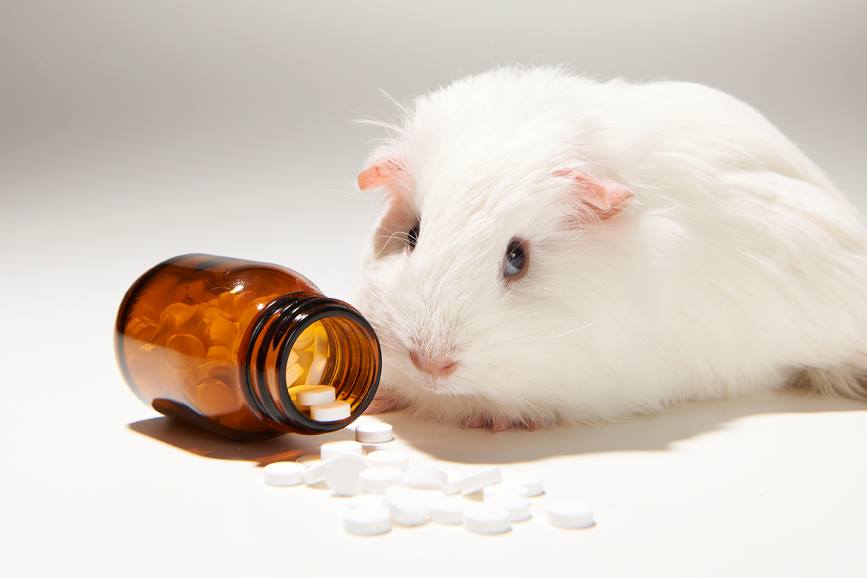
When you read that a lab animal with a human disease has been cured with a new drug candidate, do not get your hopes up. The stats for converting these successes into human patients are appalling. Results in animals are often the opposite of those seen in humans.
For example: corticosteroids were shown to treat head injuries in animals, but then increase deaths in new-born babies in trials.
This is a big deal. A staggering 95% of drugs tested in patients fail to reach the market, despite all the promising animal studies that precede their use in humans.
“There are lots of reasons why, but in essence we are not 70 kilogram rats and we are not inbred strains,” says Thomas Hartung, a toxicologist at Johns Hopkins University in the US.
Two industry studies showed that many key findings that triggered drug development could not be repeated.
Mice are the most popular lab animals, but their brains and biology are quite different from our own. Surprisingly, rats and mice predict each other for complex measures with only 60%. Different animals, different effects.
Newspapers headlines heralding cures for Alzheimer’s to autism, on the back of rodent studies, can be taken with a pinch of salt. Neurodegenerative disorders such as Alzheimer’s were one of the first areas to turn against the animal models, says Hartung.
“It was shown that the animal tests were misleading with respect to what is a cure and what is not,” he says.
After hundreds of human trials for promising treatments for Alzheimer’s, almost none helped patients.
This is a colossal waste of money. Industry has noticed.
“The pharma industry is now using about one-sixth the number of animals that they used in the past for drug studies,” says Hartung. “They go very late into these models.”
In a look at animal experiments, Hartung and colleagues found that pharma continues to reduce animal testing in Europe, despite rising R&D spend. From a stable 12 million used in Europe, the industry’s share dropped from 31% in 2005 to 23% in 2008, and then to 19% in 2011.
Disease researcher John Ioannidis at Stanford University in California has written that the safety and effectiveness of interventions in humans can only “be speculated from animal studies”.
Speaking at the EuroScience Open Forum (ESOF) in Toulouse, France, earlier this year, he said that “industry doesn’t want to waste money taking academic papers that promise that they have found a drug target and spend billions of dollars to develop it, and then come up with nothing”.
He pointed to just six of 53 landmark studies in cancer being repeatable and lamented that too many basic scientific discoveries are wrong.
One problem is that scientists often take a simple approach to mimicking a disease in mice, by just finding a gene that when knocked out stamps the mice with hallmarks of the human disease.
This is how the first Alzheimer’s disease mouse was created, but the animal did not reflect the true Alzheimer’s condition of most patients.
“Single gene mouse models are different from the illness that we experience in humans,” says neuroscientist Malcolm MacLeod at the University of Edinburgh, UK, who describes mouse models for stroke, high blood pressure, Parkinson’s and more as failing to reflect the complexity of the human disease.
“This has been a failed strategy,” he warns, in terms of finding therapies.
Hartung too has warned about the hype about these genetically modified animals.
Sometimes scientists discover therapies to cure mice, but not people. The record for inflammatory disease is especially striking.
More than 150 trials have tested agents to block inflammation in critically ill patients. The candidates worked in animals, but all failed in patients.
With this in mind, Ronald Davis, at Stanford Genome Technology Centre in California, decided to compare how all genes in mice and all genes in people react when they encounter trauma, burns or bacterial toxins. There was almost no connection whatsoever.
Mice genes did one thing; human genes did another.
The immune systems of mice and people are that different.
“Mice eat garbage,” says Davis. “Their habitat is extremely exposed to microorganisms that they eat.”
Our immune system is far more sensitive. For example, between five and 25 milligrams of endotoxin, per kilogram of body weight, will kill mice. Ten thousand times less can cause humans to go into life-threatening shock.
Davis initiated the statistical analysis after the journal Nature Medicine rejected a research paper with human results because it did not demonstrate the same effect in mice.
“It was almost as if the focus was in trying to treat mice, not humans,” he recalls. Mouse studies are valuable, but we always need to move to humans, he argues.
“We can cure cancer in mice pretty effectively, but the agents don’t work in humans in most cases,” says Davis. “These are complicated diseases and we live far longer than mice and evolutionarily we are far apart.”
He says many immunologists, who mostly use mice, criticised his findings, but industry shrugged its shoulders.
“The pharma industry said it was obvious,” he explains. “One person said we’ve known this for years, but they didn’t publish it.”
He recommends that science funders should give larger grants to those studying in humans – because it is more expensive. Another issue is that funders measure academic success by counting how many research papers a scientist publishes.
“The yardstick funders use is publications,” he says. “Whether you develop a route to curing a disease is irrelevant.”
He says more data is collected from people now, though, since it is possible to get more and more insight from a blood sample or even just a few human cells. This, at least, is promising.
Another issue is that inbred mice, often all the one age and sex, are usually used for tests.
“People are completely genetically diverse,” says Hartung. “We are different sizes, eat differently, have a disease history. This is not, and cannot, be reflected in animals.”
The animals, thus, only take us so far. Often a company will only realise a drug can cause side-effects in the liver, sometimes in one in 10,000 cases, after it goes into patients.
A final issue with animal studies is how many are carried out, often by trainee PhD scientists or lead researchers looking to publish interesting results. Sometimes outliers in results can be cherry-picked and written about.
“You then build a story of how you logically came to this result, but this is a fairy tale,” says Hartung.
He has argued that the quality of clinical trials in humans is monitored far better than in academia, so that statistics from industry are more reliable. But if the human trial is built on shaky animal experiments, then the trials will fail.
And there is a cost to failure.
“If all the money spent on biomedical research in the last 20 to 30 years had been spent instead on public health, stopping smoking and alcohol control, it would have had a greater impact on the incidence and severity of Alzheimer’s disease,” says MacLeod.
My comment: Penicillin saved human beings but caused serious damage to Guinea pig.
Arsenic is deadly to humans, not to sheep.
Asbestos causes cancer in humans, not in rats.
Cancer is a prime example of the chronic lack of success in animal experiments.
The history of cancer research is the story of how to cure cancer in mice.
We have been curing cancer in mice for decades, but it doesn’t work in humans.
On the contrary: many pharmaceutical products tested in animal experiments cause sharp damage.
Interferon, immunomodulators, chemotherapy are considered to be a miracle weapon against cancer – some have been shown to be worthless, others have side effects.
There is no real cure for cancer today, in the 21st century.
Despite hundreds of thousands of substances that have been tested on millions of “cancer mice”.
“Animal experiments are the greatest and most mean cultural disgrace of the present, they are morally and intellectually equal to the madness of the witch trials” (Manfred Kyber, writer)














 Serbian Animals Voice (SAV)