



An end to Japanese whaling?
Source: http://www.wildlifeextra.com/index.html
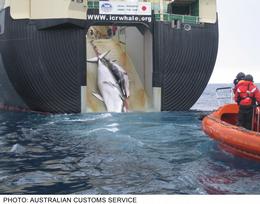
Photo: Australian Customs Service
Massive cuts to subsidy may force an end to Japanese whaling
November 12 2009. A major review of Japanese government spending could spell the end to whaling in the Southern Ocean Whale Sanctuary, according to Greenpeace, after the review committee proposed massive cuts in subsidies to a body which funds the so-called scientific research programme.
The Spending Review Committee recommended that the Overseas Fisheries Cooperation Fund (OFCF), which gives loans to the Institute for Cetacean Research (ICR) to run the discredited science programme, have all of its funding revoked, except monies needed for loans in 2010.
$US780 Million subsidy
The OFCF claims it needs 70.4 billion yen (around US$780 million) for various programmes almost certainly including whaling, in 2010. The Review Committee and Cabinet Office will have the final decision if the proposed operations for 2010 are actually “necessary” or should also be cut. If the loans for whaling are revoked it is unlikely the ICR can continue to operate. The news comes less than 24 hours before US President Barack Obama is due to arrive in Tokyo. Whaling was already on the agenda for discussions between the two heads of state.
“Prime Minister Hatoyama has a unique opportunity to signal he is serious about his election promises to clean up government spending by ending this controversial, corrupt and wasteful programme,” said Sara Holden of Greenpeace International Whales campaign. “We urge President Barack Obama to support Prime Minister Hatoyama and at the same time uphold his election promise and support Prime Minister Hatoyama in ending whaling in the Southern Ocean.”
Tokyo two
The committee recommendations also reinforce the assertions of the Greenpeace activists, Junichi Sato and Toru Suzuki, known as the Tokyo Two, who are currently awaiting trial for exposing the corruption of the whaling programme and the waste of taxpayers’ money.
Greenpeace launched a global protest against whaling more than 30 years ago which came to a successful conclusion in 1986 when an international moratorium on commercial whaling was declared. Since then a rearguard action has been underway to stop the Japanese government from abusing a loophole in the agreement that allowed for lethal ‘scientific’ whaling.
Greenpeace has mobilised millions of people worldwide in that time, sending ship expeditions to the Southern Ocean Whale Sanctuary, with activists placing themselves between the whale and the harpoons to stop the hunt. In recent years Greenpeace has been the only environmental organisation to prioritise its campaign inside in Japan in order to successfully turn government and public opinion.
Whale meat embezzlement
In April 2008 Greenpeace began an investigation into whistleblower allegations that organised whale meat embezzlement was being conducted by crew inside Japan’s so-called “scientific” whaling programme, which is funded by Japanese taxpayers.
The informer was previously involved in the whaling programme, and following his advice Junichi Sato and Toru Suzuki began an investigation, eventually discovering firm evidence that cardboard boxes containing whale meat were being secretly shipped to the homes of whaling fleet crew – and then sold for personal profit. Junichi delivered a box of this whale meat to the Tokyo Prosecutors’ Office in May 2008, and filed a report of embezzlement.
However, the embezzlement investigation was dropped on June 20 – the same day that both men were arrested and then held for 26 days before being charged with theft and trespass.
Filed under: CAMPAIGNS - Global Animal Welfare Issues, GENERAL NEWS - International / National / Regional |


 Serbian Animals Voice (SAV)
Leave a comment