

away with the pest!
Regards and good night, Venus
Filed under: GENERAL NEWS - International / National / Regional | Leave a comment »

Filed under: GENERAL NEWS - International / National / Regional | Leave a comment »


Filed under: GENERAL NEWS - International / National / Regional | Leave a comment »

We have some good news for hares!
With a six-week lockdown in force in Ireland, the Irish Coursing Club has been ordered to halt the hare-coursing season and release wild-caught hares back into the countryside
While it’s great news that no coursing meetings will take place while lockdown restrictions are in place, the Irish government must take action to protect hares exploited for coursing in the long run. If coursing is allowed to resume, many more terrified hares will be taken from their homes and forced to race for their lives.
Hares deserve to live in peace in the countryside – they’re not ours to abuse and kill in the name of entertainment. We’re demanding that Taoiseach Micheál Martin (the Irish prime minister) ban hare coursing altogether.
Every aspect of this ordeal is terrifying for the hares, who are gentle, solitary animals. They often die or are injured as a result of the netting process and during transport.
Those who survive are held in captivity and put through training sessions to get them used to the field where coursing meetings take place and to teach them to run up the centre of it. During training, they’re kept crammed together in an enclosure. This is completely unnatural and extremely stressful for them.
At course meetings, dogs are made to compete against each other in pursuit of each hare. The petrified hares run for their lives, desperate to evade the dogs. The dogs are muzzled, but this does little to reduce injuries and fatalities, as they can still forcibly strike the hares, pin them to the ground, and toss them in the air – breaking brittle bones, dislocating hips, fracturing spines, rupturing organs, and causing internal bleeding. Hares are extremely sensitive animals, and the fear and stress of the chase can also cause heart failure. If they can’t find the escape holes or routes at the end of the field, they may be chased for so long that they die from stress or exhaustion if they’re not caught and mauled to death first.
The dogs involved are also victims of the “sport”. Often subjected to intense training, they’re treated not as cherished members of the family but as money-making machines. They’re usually kept in concrete outdoor kennels, repeatedly used for breeding, and abandoned when they get injured or are deemed too slow for coursing and therefore are no longer profitable.
The government granted hare-coursing licences for the 2020/21 season despite the cruelty involved and the potential environmental impact. A private members’ bill, the Animal Health and Welfare (Ban on Hare Coursing) Bill, has been introduced by Paul Murphy TD and will be debated in the Irish Parliament in due course. This bill would make hare coursing a crime punishable by a €1,000 fine and up to six months in prison.
The situation is urgent – hare coursing must be stopped. Tell Taoiseach Micheál Martin (the Irish prime minister) to support this bill banning hare coursing altogether.
Demand that the Irish government end hare coursing by sending the taoiseach a message
Join the call for a ban today:
Filed under: GENERAL NEWS - International / National / Regional | Leave a comment »

WAV Comment – I stumbled across this today; it is from UK press back in April 2020, and is by Juliet – founder of Viva!
Regards Mark

If more of us were vegan, there would be less chance of a pandemic in the future
As our excessive demand for meat and animal products grows, we destroy ever more wildernesses for animal fodder and grazing, bringing wildlife into closer contact with people. And we put ourselves at greater risk
Thursday 30 April 2020 13:40
Animals transmit infections. Who knew? We did, a long time ago.
In the mid-19th century German pathologist Rudolf Virchow was the first to discover that infectious diseases can be transmitted between animals and humans – coining the term “zoonoses” in 1855.
A century later, in August 1958, the World Health Organisation Expert Committee on Zoonoses met at the Karolinska Institute in Stockholm. The outcome of the meeting was a stark warning: the prevention, control and eradication of these diseases were “responsibilities of considerable magnitude in every country”.
Fast forward to today and the world is in the grips of the worst global pandemic for generations. Covid-19 – like SARS, bird flu, swine flu and Ebola – originated in animals.
Three in four of the world’s new or emerging infectious diseases are zoonotic. These diseases are responsible for some 2.7 million deaths per year and are largely transmitted through the wildlife trade and factory farming. Despite knowing the dangers for over 150 years, we continue to put ourselves at risk of devastating outbreaks.
Cramming animals together in markets and subjecting them to intensive farming practices creates a breeding ground for disease. Today some two thirds of all farm animals are kept in factory farms where infections can spread with ease between animals, mutate and become infectious to humans.
As our excessive demand for meat and animal products grows, we destroy ever more wildernesses for animal fodder and grazing, bringing wildlife into closer contact with people. And we put ourselves at greater risk. This is no longer just a matter of animal welfare, it’s a global public health crisis too.
The coronavirus pandemic has inspired thousands to speak up against the unregulated movement of wild animals, ignited calls for stricter controls at airports and brought global attention to the barbaric cruelty of wet markets, all in a bid to prevent future outbreaks. But the most impactful solution is to stop the spread of these diseases at their source by putting an end to our consumption of meat and dairy.
Cramming animals together in markets and subjecting them to intensive farming practices creates a breeding ground for disease. Today some two thirds of all farm animals are kept in factory farms where infections can spread with ease between animals, mutate and become infectious to humans.
As our excessive demand for meat and animal products grows, we destroy ever more wildernesses for animal fodder and grazing, bringing wildlife into closer contact with people. And we put ourselves at greater risk. This is no longer just a matter of animal welfare, it’s a global public health crisis too.
The coronavirus pandemic has inspired thousands to speak up against the unregulated movement of wild animals, ignited calls for stricter controls at airports and brought global attention to the barbaric cruelty of wet markets, all in a bid to prevent future outbreaks. But the most impactful solution is to stop the spread of these diseases at their source by putting an end to our consumption of meat and dairy.
But the most important lesson doesn’t stem from this outbreak alone. It’s the culmination of our history, which has been blighted by preventable outbreaks of lethal diseases spread from animals to humans, and our collective decision not to act.
We’ve known the risks for almost two centuries. Too many lives have been lost. The solution is at our fingertips: it’s time to go vegan now.
Juliet Gellatley is director of Viva! a charity campaigning for a vegan world
Filed under: GENERAL NEWS - International / National / Regional | Leave a comment »
Filed under: GENERAL NEWS - International / National / Regional | Leave a comment »


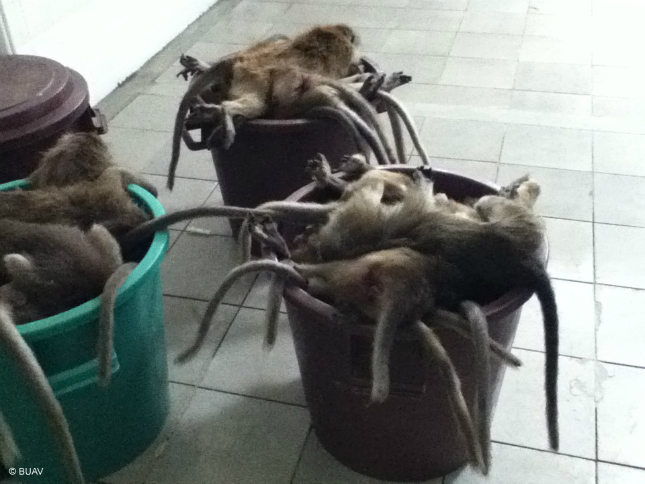
 Long-tailed macaques in a breeding station in Laos © Jo-Anne McArthur
Filed under: GENERAL NEWS - International / National / Regional | 1 Comment »
Old WAV posts:
Award-winning vegan filmmaker Shaun Monson’s new film, There Was A Killing, tells the story of Canadian animal rights activist Regan Russell, who was struck and killed by a pig transport truck while attending a Toronto Pig Save vigil in June. But the documentary is about more than just this tragedy; it’s about starting a conversation.
Russell, a decades-long fighter for animal rights, spent her last moments giving compassion to baby pigs on their way to slaughter. Footage from that day shows her—full head of white hair, black shirt, and blue jeans—carrying a spray bottle, which she used to give water to the pigs.
More than a month after Russell’s death, the police cited the truck driver with a non-criminal charge of Careless Driving Causing Death. The charge drew outrage among the animal rights community. “I just felt there was this cover-up. Or they were brushing it aside or dismissing it. And that began to nag at me,” Monson tells LIVEKINDLY about his initial desire to make the film.
After watching the cell phone footage, taken by activists attending the vigil, Monson says he was left feeling even more confused. “I’m thinking, how do we only have four minutes from this event? There was very little footage from the day,” he explains. “And it just felt like this haunting mystery. There’s something off. And I felt a little bit like a detective and I had to explore.”
Monson’s no stranger to making these kinds of documentaries. He wrote, produced, and directed 2005’s Earthlings and 2015’s Unity, among others. The former goes in-depth into the day-to-day practices of industrial factory farms around the world. The latter analyzes the destructive relationships humans have with each other, animals, and the planet.
But, according to Monson, making an impact-driven film that resonates with the audience isn’t easy. And a chance meeting with Academy Award-winning director James Cameron fueled Monson to tell harrowing stories like Russell’s in a way that makes people want to see them.
“I met him a couple of years ago here in L.A. at Crossroads—a vegan restaurant. I had on a t-shirt that said “Eat What Elephants Eat,” Monson explains. The shirt caught the attention of Cameron, who’s been plant-based for nearly a decade. “He says, ‘Hey, I like your shirt.’ And so we start talking,” Monson says.
He was blown away when Cameron told him he had seen Earthlings. Monson jokingly asked: “You saw it all the way through?” (The footage shown in the film of how factory farmed animals are treated is gruesome, to say the least.)
“He kind of puts his arm around me. And for a moment I thought: ‘Wow, I’m about to get the secrets of Hollywood filmmaking.’ He says: ‘Let me tell you something. Whenever I make a movie, I do two things. One: I make a movie that people want to see. Two: I put a message in it,” Monson recalls. “And then he pays me this really high praise. He says ‘The message in your film is probably one of the best messages I’ve ever seen.’ And then he leans in close and he goes: ‘But nobody wants to see it.’”
Monson continues: “And he’s right because it’s not like people are running out to get a bucket of popcorn to watch this kind of stuff. They just aren’t, you know?”
After spending more than 20 years making documentaries, Monson says he started to consider how to reach a larger audience. “I just had one of the biggest filmmakers in the world lean over and spend 20 minutes talking about how to reach more people.”
So, how do you make a film about a tough topic that people actually want to see? According to the filmmaker, you’ve got to make it in a way that will get viewers emotionally invested.
“A film is such a powerful medium. Why can’t a film change something?” Monson continues: “It’s a classic statement of a picture’s worth 1,000 words. If you look at what happened with George Floyd, unlike other unjust, corrupt deaths, they weren’t being documented. But when someone films for 8.5 minutes straight—just films the whole thing, it creates this visceral emotional reality. It’s almost like it’s not secondhand information.”
And There Was A Killing certainly provides a wealth of information: It interweaves video evidence along with eyewitness testimony. It provides interviews with attorneys Robert Monson, Lisa Bloom, and David Simon. And it features a former animal truck driver’s perspective on the day’s tragic events. For all intents and purposes, the film appears to accomplish its goal: It makes people think.
Monson hopes his new film will help bring Russell’s case to the court of public opinion. | Provided by Shaun Monson
Monson explains that he believes people are, overall, basically decent—even though there are exceptions to this rule. “They’re just not informed,” he says. “And so it’s almost like you have people that are asleep. And then you have people whose eyes are sort of fluttering open a little. And then you have people that are sort of sleepwalking. And then you have awake people. And the idea is for all of us to be awake—not to be sleepwalking, not to be eyes fluttering, and certainly not to be asleep.”
Through his films, Monson wants to awaken people to the impact they have on animals and the planet.
And Monson hopes There Was A Killing will help bring Russell’s case to the court of public opinion. He also wants the film to raise awareness for ag-gag laws—which seek to silence whistleblowers from exposing the horrors of the animal agriculture industry.
On the day of her death, Russell had been protesting Canadian ag-gag Bill 156—which the government enacted into law just one day before she was killed. Monson says he thinks her case will be a case of first impression—one that has never been decided by a governing jurisdiction.
“It’ll be the first time that law is now being put to trial to see if it’s eventually constitutional. And so attorneys later study case laws. That’s why in the States we have Roe v. Wade,” he explains. “Roe v. Wade is a case study. It isn’t a statute. It’s a case study. Both are very important. So that’s the power of a documentary is that it might challenge a law statute. And then a case can come out of that. And then a case law may change the law.”
Monson also hopes the film will inspire others to be more compassionate.
“And that’s my hope: That more people will maybe see these kinds of messages. And they can have a positive effect. Because I don’t know how to write books. I don’t start organizations. I don’t have a sanctuary. I don’t know what else I have to offer except films,” Monson continues. “Ultimately, all you can do is provide the information to people, hope that they watch it, hope that they actually press play and look at it. And then it’s really up to them.”
“I always say we’re like gardeners, and we’re just casting seeds,” Monson says. “And sometimes those seeds fall in rich soil. And sometimes it’s stony ground. But we keep casting seeds out just to have a positive effect in this world.”
There Was A Killing is now available to stream here. To learn more about Regan Russell visit www.JusticeForReganRussell.org.
Filed under: GENERAL NEWS - International / National / Regional | Leave a comment »

 Serbian Animals Voice (SAV)
 Serbian Animals Voice (SAV)