Posted on September 18, 2016 by Serbian Animals Voice (SAV)
The problem is the system.
In Germany, “Halal” banned since 1933rd
According to § 17 of the Animal Welfare ritual slaughter of animals is forbidden in Germany.
But the law says: “if special religious regulations prescribe shafts, then shafts may be made, because of tolerance and religious freedom”.
4,5 million Muslims and Jews living in Germany, may do so, because it is part of their religious rites.
Actually, in Germany kosher meat is imported frozen from France and Belgium. For these and other EU countries, in contrast to Germany, may be slaughtered without stunning. Lately, however, a number of Halal slaughterhouses are in operation in Germany: “Halal” slaughter of Iranian Amir Baharifar in Neuss (North Rhine-West Fallen),
or the slaughterhouse Bärlein-Denterlein in Bayer. This has Bavarian TV film twice the “halal” production!!!
The fact that Muslim slaughterhouses are worse than the Orthodox or Catholic slaughterhouses, does not change nothing to the brutal animal transport in Europe. And that is the key point.
Animals that are transported for slaughter do not suffer less than animals that are transported to the shafts. And when shafts prohibits the stunning of animals, that doesn’t mean that the anesthesia system of animals works well in German slaughterhouses.
Even a complete change of all farms to organic standard would still be bad enough for the animals. Animals are slaughtered, but nowhere respected. In other words: even if the Muslim slaughter system would mimic the European, would be purely cosmetic. The problem is the system. Illegal animal cruelty, illegal transport of animals of any kind in European livestock farms and slaughterhouses are ignored by governments or tolerated as legal states.
And they put millions of tax dollars in this sick system. These governments have a strong interest to keep the debate shafts / slaughter in the course of racism, so the main problem will disappear: the drama of the animals in European slaughterhouses.
That’s what should interest us, against it we have to fight.
Posted on September 17, 2016 by Serbian Animals Voice (SAV)
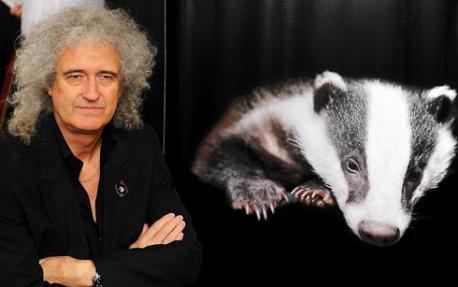
Dr. Brian May at Team Badger writes to the Prime Minister about the Conservative Party Badger Cull.
Above – Dr. Brian May (ex ‘Queen’ Guitarist).
A Letter to the Right Honourable Theresa May & Andrea Leadsom MP
The Rt. Hon Theresa May MP, Prime Minister, 10 Downing Street, London, SW1A 2AA
Cc: The Rt. Hon Andrea Leadsom MP, Secretary of State for Environment, Food and Rural Affairs, Defra, Nobel House, 17 Smith Square, London, SW1P 3JR
19th July 2016
Dear Prime Minister
May I firstly offer our congratulations to you on your appointment as Prime Minister; we wish you every success in this role.
I realise that you will have countless pressing issues in your first days as Prime Minister but, on behalf of the undersigned organisations which constitute ‘Team Badger’, I write to bring to your urgent attention the matter of the badger cull, and to respectfully urge you to instruct Natural England NOT to issue cull licences for 2016 and beyond.
On 12th July three of the country’s most highly qualified experts with experience of badgers and bovine tuberculosis wrote to you to explain their science-based position of opposition to the cull, on the grounds that it is both ineffective and inhumane. Team Badger organisations understand that bovine TB is a serious problem for farmers, requiring meaningful action from government. But the verdict from the overwhelming majority of experts is that this is a disease spread almost entirely through cattle to cattle transmission and, as such, it can only be solved through cattle-based measures such as increased disease testing and enhanced on-farm biosecurity. Using badgers as scapegoats for this disease is failing farmers, as well as badgers.
The badger cull continues to be an extremely unpopular and expensive policy which many millions of British people oppose. Over 70% of respondents to Natural England’s recently concluded consultation conveyed their concerns that a roll-out of the cull could be bad for business, due to people avoiding cull areas. A further 40% expressed fears that the cull could risk human health and safety in shared countryside spaces, and expansion of the cull would mean even greater pressures on police forces, drawing their attention away from crime prevention priorities. All this for a policy which is clearly seen to be failing in its objective.
We further observe that the UK’s commendable goal to be a world leading authority on animal welfare will continue to be seriously undermined if the government seeks to defend a wildlife cull with a methodology that animal welfare experts, including the British Veterinary Association and the Government’s own appointed IEP (Independent Expert Panel), have agreed cannot be carried out humanely and effectively, and has little or no potential for improvements.
Finally, of all your government departments, DEFRA faces perhaps the most acute resource challenges ahead on the Brexit path, making this a highly inopportune time to expand the extremely costly and divisive culling policy into, potentially, nine English counties. With this in mind, we ask that you and your newly appointed Secretary of State for Environment, Andrea Leadsom, take this moment as an opportunity to pause and review the evidence that unequivocally shows culling badgers to be a flawed policy.
Ending the cull will enable focus and funds to be redirected into effective and more humane solutions to bovine TB: the introduction of an effective cattle TB vaccine; increased frequency of testing in higher risk areas allowing better identification and management of the disease; and improved disease containment through risk-based cattle movement controls.
We urge you and your Ministers to examine the success of the Welsh government’s TB policy using such measures, where bovine TB is being driven down at a much faster and more efficient rate than in England, and without culling badgers.
I would very much appreciate the opportunity to speak to you face to face about these issues, if and when you have a moment in your schedule.
Yours sincerely, with respects
Dr Brian May
———————————————-
Find out everything that is happening to keep up the campaign for the UK badgers currently under government culling at the Team Badger web site:
Some of you oldies (like us !) may remember Brian when he was lead guitarist in the rock group ‘Queen’ – here he is in action at the Freddie Mercury tribute concert – Wembley, London. Guest guitarist – Slash from Guns and Roses:
Overnight, whistleblower vet Lynn Simpson became a pariah – and then she all but vanished
When vet Lynn Simpson documented the appalling conditions faced by Australian animals on live-export ships, she lost her job and her health. But has anything really changed?
She used her knife, killing quickly. Death came almost instantly with a blade when you knew what you were doing. Thank God, she was carrying a sharpener. Sharpen. Kill. Sharpen. Kill. They were in the Gulf of Aden, between Yemen and Somalia, and the heat was ferocious. The captain had started yelling about a crisis unfolding on deck five, which was when the nightmare started. She moved on to the next animal. The blade flashed – and then it happened. The blood spurting onto her wrist burnt her skin like boiling water. Shocked, Dr Lynn Simpson looked down at the sheep whose throat she had just cut, and then grabbed a nearby thermometer. Quickly making a hole with her knife between the dead creature’s ribs, she thrust the thermometer deep inside the cavity. The core temperature was 47ºC. A sheep’s normal body temperature is about 39ºC. This one had, quite literally, been cooking alive.
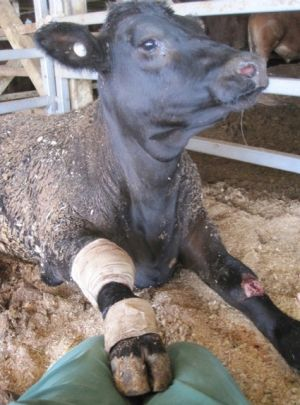
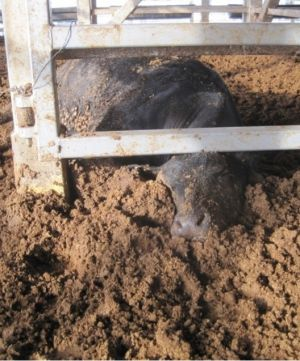
A young bull that became stuck in a railing and injured its legs while struggling to free itself in 2011. Photo: Courtesy of Lynn Simpson
Deck five on this particular ship was the top deck. Radiant heat through the roof, plus an accumulation of gases caused by a build-up of the animals’ faeces and urine on the decks below – conditions made worse by insufficient airflow – had turned the place into a hellhole. “After that, any animal that looked like it was about to collapse, I killed,” says Simpson, recalling the awful day in 2003. “I don’t know how many I killed. We chastise different countries for boiling animals to death, yet here were our sheep cooking from the inside out.”
Simpson, the woman once regarded as one of Australia’s most outstanding live-export vets, is driving me in her bright-red ute along an empty stretch of road heading north-west from Canberra. She has no love any more for the city where she was born. It was there, 3½ years ago, after she was asked to write a report for a special government steering committee, that a powerful industry turned on her. Overnight, Lynn Simpson became a pariah – and then she all but vanished.
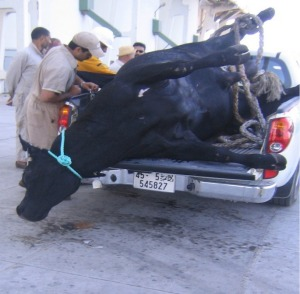
The remains of a bull which died after its head became stuck under a railing on a ship in Turkey in 2011. Photo: Courtesy of Lynn Simpson
I have flown to Canberra to meet her and now, as we head deeper into the landscape, I’m relieved she picked me up at the airport. Even with a GPS, I was bound to have got lost. Everyone does when they visit her, says the defiantly resilient 45-year-old, whose grey-green eyes and direct gaze project both warmth and wariness. She talks volubly as she drives, her long, light-brown hair partly shielding her face, her forthrightness and occasional expletive a hallmark of the days when she worked as a wharfie to put herself through vet school. “I speak fluent ‘wharf’, ” she tells me with a smile, “and Arabic.”
Later, as a public servant, she became known as someone who cared deeply about animals but who remained steadfastly unaligned with any animal-welfare group, including the RSPCA. “I’m pro-farming,” she tells me matter-of-factly. “I’ve worked in the agricultural sector, and I understand why farmers enjoy and cherish the lifestyle they have. I’ve never said I’m against the live export of animals. I’m against the way we do it.”
On June 22 this year, Simpson re-emerged from her self-imposed exile to appear on the ABC’s 7.30 program and tell the story of her extraordinary silencing by the federal government after she provided evidence of truths too unpalatable to be contemplated publicly.
As a live-export vet and veteran of some 57 voyages, she had spent the years between 2001 and 2012 documenting the conditions aboard vessels transporting Australian cattle from Perth to Libya, Turkey and the Middle East. That hellish day in the Gulf of Aden, when she’d been forced to personally end the suffering of countless sheep using a knife, had been just one of many.
After being unloaded into a truck in Libya, this bull escaped into the water, but died after being hit by a container ship. Photo: Courtesy of Lynn Simpson
When, on her return to Canberra, the Department of Agriculture (DA), the live-export industry regulator, offered her a role – on a six-month contract – within its Animal Welfare Branch in 2012, she took it. She was to serve as technical advisor while it carried out a review of the Australian Standards for Exporting Livestock (ASEL). The fallout from A Bloody Business, the ABC’s Four Corners report that had aired in May 2011 exposing the treatment meted out to Australian cattle in nightmarish Indonesian abattoirs, was still raging. When Simpson was asked to submit a report to the ASEL committee, she saw it as an opportunity to finally bring about some real, long-awaited change.
Now, in her new job, she gave PowerPoint presentations, with slides, to her co-workers, including the DA’s deputy secretary, Phillip Glyde. His horrified response suggested to her that her report to the ASEL committee, which she presented in November 2012, would be explosive. And it was – though not because of what she wrote, even though she didn’t hold back in describing hellish scenes of animals trying to rest in grossly overcrowded pens, their agony when they were stepped on by heavier animals and the scrotal hernias that invariably followed displacement of their intestines from this trampling. What truly stunned ASEL committee members was her no-holds-barred photos of cattle covered in their own excrement, unable to stand, suffocating or dying of heat exhaustion, drinking from faeces-filled water troughs and with sickening injuries caused by inadequate bedding.
One of those members was Dr Bidda Jones, RSPCA Australia’s chief scientist and joint author with Julian Davies of this year’s Backlash, a book about the reaction to the campaign to put an end to Australia’s live-export trade that followed the Four Corners exposé. “My response when I saw Lynn’s photographs was, ‘That’s what it’s like? Like, that’s really what it’s like?’ Just shocked,” Jones told 7.30. “This was the first time that an on-board vet had actually produced a report on conditions on board with photographs.”
Never intended for public consumption, on February 5, 2013, the report was mysteriously uploaded by someone inside the DA – it seems unlikely we’ll ever know by whom – to its website, along with the damning photographic evidence. Simpson doesn’t believe it was an administrative error. During our meeting, she speculates, for the first time, that her submission was deliberately leaked: “This was to shift the spotlight away from the problem of actually having to improve live-export standards. Suddenly, I had become the problem instead. I also suspect the submission was uploaded to muddy the waters so that the review process would be stalled. And, to date, it hasn’t moved on.”
Shipping is a super-secretive industry with brass plaques in places like Panama obfuscating transparency of ownership.
Grant Rowles of online shipping magazine Splash 24/7
In the days and weeks after the upload, Simpson found herself increasingly isolated at work. On June 13, 2013, she was sent home on “miscellaneous leave” after being told in a meeting that took place in Phillip Glyde’s office that she couldn’t stay in her job because, she says Glyde told her, the industry “has a witch hunt against you”. Mystifyingly, her report remained on the website for several more months.
When Simpson requested the reason for her removal be given in writing in early July, she received a letter from the first assistant secretary of the DA’s Animal Division, Karen Schneider, advising her that she couldn’t continue her work in the Animal Welfare Branch because “the industry with which we engage has expressed the view that they cannot work with you”. Significantly, Schneider added, “I would like to stress that I do not share the expressed views of industry… you have done [your job] competently, and, as deputy secretary Phillip Glyde and I have assured you … your technical expertise is valued by the department.”
“But I knew my career was over when my submission went public,” says Simpson. “The industry pressured the department to remove me. It’s known as ‘regulatory capture’, which is defined as corruption. I had fully intended to go back to sea once my contract with the department was up. But I knew that as far as the industry was concerned, I was finished.”
We’ve been driving for 40 minutes by now and I ask Simpson where we are. “Near Yass,” she replies. Eventually, we turn off the road onto a track and, within minutes, the little brick and weatherboard farmhouse that she rents on top of a hill comes into view. As we pull up outside, three dogs race rapturously to meet us. “Neil is a blue cardigan corgie, Smorgasbord is a kelpie cross koolie, and PooNeck is a koolie,” says Simpson. “I used to have three steers, too.”
Omar, Wallace and Razorback were three orphaned male bovines, just a few days old, when Simpson adopted them a few months after she lost her job. She has photographs of them – though not of the day, last spring, when she walked into their paddock carrying a large bale of hay and a bag of liquorice. When they had almost finished eating their treats, she got out a syringe and administered a powerful sedative. Within minutes, they were unconscious. Then Simpson shot each of them twice through the head. “I couldn’t afford to feed them any more and it would have cost about $300 to euthanise all three,” she tells me, referring to the barbiturate she’d have needed to buy.
Simpson, who hadn’t worked since her dismissal, was seriously broke. As her distress over losing her position increased, she was placed officially on sick leave. A battery of mandatory consultations with various mental-health specialists followed. Severely depressed, she slept for about 23 hours a day, began suffering from severe headaches and dizziness, and lost a large amount of weight, only to put on 20 kilograms later. Three psychologists and four psychiatrists concluded she was suffering from an adjustment disorder (also known as AD or situational depression) – that is, when a patient is unable to cope with, or adjust to, a major life event. “Yeah, I just couldn’t adjust to being screwed over by the government,” she says with a bitter laugh.
Simpson’s own doctor believes she has been suffering from post-traumatic syndrome disorder. Unfortunately, the antidepressants she was prescribed only left her feeling worse; she uses the word “suicidal” to describe her mental state during this time. Acknowledging the AD diagnosis, ComCare (the government compensation system) agreed in October 2013 to pay her 75 per cent of her former salary, a standard arrangement that will last until 2036, when Simpson will turn 65. She resigned officially from the DA only in May this year.
Money is still very tight. Simpson is now suing the Commonwealth for breach of contract and is also fighting a personal-injury claim. She won’t say how much she has paid in legal bills, but she currently has six lawyers working for her. She has partly funded the cost by selling a property she owned at Eden Creek, near Kyogle, on the NSW-Queensland border. The ongoing legal proceedings are cited as the reason why Karen Schneider, who still works in the DA, and Phillip Glyde, now CEO of the Murray Darling Water Authority in Canberra, are unable to speak to Good Weekend for this story.
The day we meet, Simpson is due to attend a directions hearing to set a date for mediation with the DA. In some ways, though, she’d rather go to court and see further airing of the national disgrace that Australia’s live-export industry has become. “My ultimate goal is some financial restitution because I’ll never get my career back again,” she adds. “But really, it’s about the animals. If I were to walk away from this case, I’d be walking away from a fantastic opportunity to fight for them.”
Inside the farmhouse, a huge painting of a dead bull lying in its own blood dominates a wall in the living room. The blood is seeping from a gaping cut in its throat. “It’s an image from one of the ships,” says Simpson, who is the artist. The painting is a work in progress for an exhibition being held later this year by Soldier On, the Canberra-based group that supports former service men and women who’ve been affected by their experiences of war. It made her a member when she became a volunteer worker in July 2015. She tells me that she still has to launch a flotilla of tiny ships on the sea of blood and then it will be finished.
The painting exudes a powerful melancholy. The fate of Australian livestock, whether on ships or in abattoirs, is now common knowledge and, increasingly, people are speaking out against both. Some DA employees were so affected by watching A Bloody Business they needed counselling. Simpson says the program left her aghast, too. It seems incredible, in her job, that she hadn’t heard stories about the appalling treatment of animals in overseas abattoirs, I point out. She never did, she replies. “I worked extremely hard on those ships and, after watching A Bloody Business, I wish I hadn’t. I wish now I’d shot more,” she adds grimly.
When I suggest that her painting of the bull shows that her years on live-export ships have perhaps affected her more than she admits, Simpson disagrees. “I still eat meat,” she points out with her trademark forthrightness, “though not slow-cooked lamb – ever.”
Simpson’s living room is bathed in sunlight on this freezing-cold day. Through the windows, there’s a spectacular view of the surrounding hills. If Simpson weren’t the story, her house would be. It’s filled with objects from her live-trade travels: a bullock cart from Rajasthan forms the base of her dining-room table; ancient slave shackles from Libya hang beneath a huge wooden horse’s head that Simpson carved herself. A second, huge painting of Nelson Mandela turns out to be her handiwork as well.
Simpson, who lives alone, talks briefly of a man she loved, an Israeli cattle importer called Roni, whom she met in the port city of Eilat in 2005. “Up the ramp walked this gorgeous guy,” she recalls. The two hit it off immediately and were soon in a serious relationship, and Simpson visited Israel often.
But only six months after they met, fighting broke out with Hezbollah in Lebanon on the same day in July 2006 that Simpson, who’d been staying with Roni in Haifa in Israel’s north, was due to fly back to Australia from Jordan. Roni dropped her off at the border crossing but, by the time she reached the airport, she saw on the TV monitors that Haifa was being bombed. She rang Roni, but only got a recorded message. The same message was still playing months later. Simpson never heard from Roni again and still has no idea whether he’s dead or alive.
Simpson had no family to turn to for comfort. The vet has a mother and brother, but doesn’t know where either of them lives. She and her mother are incompatible, is all she’ll say on the subject. She was six when she decided to become a vet, after a relative told her a vet was an animal doctor. “I got very excited that such a thing existed,” she says. She has never wanted children.
Making light of her background is her way, perhaps, of masking a great sadness. When Simpson was 12, her father, David, was diagnosed with stomach cancer. He died when she was 15. Six months earlier, one of her brothers, who was with the Australian Federal Police, had been killed in a motorbike accident on his way home. Her parents, along with her two much older brothers, had immigrated from Glasgow. David Simpson transferred to Australia with NASA in 1969 and worked as a technician at the Orroral Valley Tracking Station, south of the capital. He and his wife, Lorna, spent their free time in clubs, playing the pokies. The Canberra-born Simpson, who was left alone a lot of the time, doesn’t know whether her parents were serious gamblers, “but growing up alone, and being emotionally self-sufficient, probably made me more prone to being able to cope well at sea,” she says.
Mandy Peters, one of her closest friends, believes Simpson probably learnt something of family life after the two got to know each other in Perth in 1996. Simpson, who’d moved there after winning a place at Murdoch University’s School of Veterinary and Life Sciences, rented a granny flat from Peters and her husband. She, the couple and their three children were soon close. Simpson embarked on her first live-export voyages from Perth, and Peters remembers her friend always pushing her hair up into a cap and putting on a wedding ring before boarding the all-male ships.
The wedding ring wasn’t much protection. Twice, on two separate voyages, a crew member tried to rape Simpson. On both occasions she fought off her assailant. Her late brother, Jim, she explains, taught her self-defence – and no, she says in her breezy manner, it didn’t put her off working at sea.
Simpson was 26 by the time she began studying vet science at Murdoch University. At school, she’d always been one of the brightest kids until the deaths of her brother and father in 1985 and 1986. She started skipping classes and her grades slipped. She left school in Canberra with no plans and spent three years kicking around in the Northern Territory before picking up her books again. Eventually, she would complete a master’s degree in veterinary epidemiology, often studying late into the night on board the ships.
Working as a casual wharfie on the Fremantle docks in the late 1990s as one of only four women employed by Western Stevedores gave Simpson plenty of contacts in the live-export trade. She remembers being horrified when she saw dead and injured animals being dragged off trucks after the road-transport leg of their journey. When she was offered her first voyage to Jeddah on the Red Sea coast of Saudi Arabia in November 2001, just one month after graduating, she took it. She did three voyages back to back before starting work in a veterinary practice in Canberra in 2002 – but was bored within weeks. The pull of the sea and the accompanying sense of adventure, as well as the sheer scale of what her job involved, were irresistible. “I soon realised I’d rather spend my days helping large numbers of animals in life and death situations than investing eight to 12 hours a day doing surgery on the leg of one spoilt dog,” she says.
She talks nostalgically of her former life and about one old, rusty ship – with its crew of Palestinians and Pakistanis from the country’s troubled Swat Valley – that became a second home to her. “I spent five years of my life on and off that ship,” she says. “It was like living in our own tiny village. I had a pot plant in my cabin, which the stewards looked after when I wasn’t there.”
Simpson adds that she sometimes imagines living in an apartment overlooking a city port so she can watch the coming and going of the ships. “I pine for the ships, though not the cruelty,” she goes on. “I miss the meaningfulness of my work and the camaraderie. We had to have each other’s backs. It’s probably the closest you get to being in a military platoon. You’re in extreme environments where death is everywhere around you.”
Simpson could write a book, and intends to, though it will be a harrowing read. She’ll describe sheep so stressed they can’t eat – so they die. She’ll describe the phone call she once received from a rattled vet on a badly designed ship without proper ventilation, who told her the cattle in his care were literally disintegrating. (“To clean up, they were trudging through what he described as a soup of melting cattle,” she tells me.) There’s also the time she used the blunt end of a fire-axe to knock 22 cattle unconscious on a ship in Russia, before cutting their throats, after the Russians had confiscated her gun. She empathises with the Vietnamese abattoir workers vilified recently after they were filmed killing Australian cattle with sledgehammers. “They’ve got poor equipment, poor training and don’t know any better,” she says.
Bidda Jones, who got to know Simpson when she was appointed technical adviser to the ASEL committee, believes she’s more vulnerable than her outer resilience suggests. “I like Lynn’s ‘I don’t give a fuck’ attitude,” she says, but on the night 7.30 aired, Jones drove to Simpson’s house so the woman who’d become her friend wouldn’t have to watch the program alone. She has struggled, in recent years, to understand how Simpson could ever have gone to work for the live-export industry in the first place. “The [cattle] walk off that ship and face a truly awful slaughter. Didn’t that occur to her?” she says. “Lynn had pretty much shielded herself from that realisation. We eventually had that conversation where I understood [that] she felt by working on a live-export vessel, she could help more animals than in a small-animal practice. It took her some time to realise that it’s such a corrupt industry, and improvement so unlikely, that the best thing for it is to just stop.
“The draft version of ASEL that could have led to substantial improvements for exported animals is now just another file in the department’s vast electronic archives.”
Simpson agrees that she felt she could do more good by working inside the trade and with various industry groups consulting her at frequent intervals, she thought she was actually getting somewhere. But then she points out a 1985 Senate Select Committee report had already made clear everything the industry needed to fix, from better stocking densities to improved bedding for the animals. She has come to the conclusion that live export would prove to be commercially unviable were every recommendation acted upon. “But I strongly believe that if they’d acted on those recommendations, the live export trade would be proven to be non-commercially viable,” she says.
The Department of Agriculture doesn’t respond directly to any of my questions about why live-export animals continue to suffer, emailing instead a routine statement detailing how issues are identified and addressed and listing various improvements, such as a new heat-stress model that has been updated four times, significantly reducing mortalities. Bedding and space requirements have also been increased for “higher-risk consignments”, the statement reads.
After Simpson’s appearance on 7.30 in June, the chairman of the Australian Livestock Exporters Council (ALEC), Simon Crean, told the ABC that ALEC had not put any pressure on the DA to have Simpson dismissed. The possibility of a workshop run by the council, in which Simpson would participate, was mooted by him on the program, but Simpson says she hasn’t been approached by anyone.
“Dr Simpson was indeed held in high regard by many in the industry,” Crean confirms in an email, adding that ongoing changes “embraced by the industry” since 2013 meant a fresh perspective on “past attitudes towards people and organisations that challenged the status quo and, in Dr Simpson’s case, who sought, with the reflection of hindsight, to provide constructive advice to exporters on improvements”.
Lyn White, the high-profile Animals Australia campaign director, remains scathing about the industry. “The level of influence the exporters wield over the Department of Agriculture is obscene,” she says. “That they were able to successfully seek the removal of Dr Simpson from her position is nothing short of outrageous, especially when she was the only departmental employee with any shipboard experience.”
The live-export trade was worth $1.16 billion in 2014-15, according to figures supplied to Good Weekend by the Department of Agriculture. Simpson, who doesn’t name individual exporters, says she regards them as business opportunists pushing the limits of what the legislation allows. And the government just signs off on those limits. This is the real problem.
“Shipping, as a whole, is a super-secretive industry with lots of brass plaques in places like Panama obfuscating transparency of ownership,” comments Grant Rowles, the Melbourne-based co-founder of Asia Shipping Media, which publishes Splash 24/7, a widely read online shipping magazine. “Live export tends to be even more secretive due to the sensitive nature of the cargo and the questionable practices at sea – such as the washing of decks,” he adds.
Simpson, who has started writing for Splash 24/7, spelt out exactly what this means in a recent article. “Maritime pollution regulations are a bit ambiguous to read and sometimes we were not sure where we could discharge so much slurry of livestock shit and urine, so we would wash [the ships’ decks] at night to avoid detection by satellites as it left quite a distinct discolouration in our wake,” she wrote.
Posted on September 16, 2016 by Serbian Animals Voice (SAV)
SAV Comment
– The EU is supposedly comprised of millions of voting citizens each of whom have a voice in what goes on and how their Europe is run. The reality is that there are just a few ‘elites’ named Junker and Tusk – who, along with their un-elected Commissioners; have total control over what really happens – an action or no action. The people of Europe have no say in the end game. EU citizens have their MEP’s, but they are just a list of names of people who in reality; have no final say or decisions in how the EU moves. It is all really a major cover up by the EU elite to make the people of Europe think they have a say; when in reality they have no say about anything.
It would appear from the following that the EU leadership has some kind of secret strategy to make exit so hard for the UK to leave the EU that it will give up the negotiations and remain a member state.
In June this year the British people voted to get out of the EU; and the British people will make sure that is what happens. The Brits are used to trouble and campaigns with Europe; we fought a few battles there in the past. To Brits this is just another battle; and one which they are determined to get success with. Other democratic nations and peoples around Western Europe are also now thinking the ‘Brexit’ way. Elections in Germany and France next year will show in reality just how the people feel about their ‘democratic’ EU.
Currently this week, EU meetings are taking place with all member states except – yes you have guessed it – the UK; an uninvited but still existing and very much financially contributing member state. At the moment the UK is still a full member state of the EU until it submits a formal ‘Article 50’ to leave. But the Junkers and Tusks are making sure the UK is not now invited to any EU Party; as it is a bad boy and must be punished. Who knows what the ‘masters of the EU’ are planning as retribution to the British people for speaking (and voting) out against them.
The people of the UK want the British government to introduce Article 50 as soon as possible; the formal submission which must be enforced to get exit negotiations under way. The Brit voters have elected to democratically get out and away from the political elites of the EU named Junker and Tusk.
The Brits want to do it as soon as possible – so lets get on and get Article 50 under way Mrs. May (UK Prime Minister).
—————————————————————————————-
Senior figures in the EU believe that Britain will give up on Brexit if they make negotiations as tough as possible, The Telegraph understands.
One senior British official involved in the set-up for the coming negotiations said the EU elite “seem to think the game is to make us change our minds”.
Posted on September 15, 2016 by Serbian Animals Voice (SAV)
Video footage added 19/9/16. This is footage of the same trail / investigation:
————————————————–
Please note all of our international friends that the following information and report (from our friend Lesley at EoA in the Netherlands) has been sent to some Kent Members of Parliament, and also to Ministers at UK government Defra. We expect no action to be taken as always, but wish to show you the continuing support that the British Conservative government gives to convicted criminals under the guise of livestock hauliers such as the Dutchman J. Onderwater who makes up a large part of the following report.
There are government ministers in Defra, and we could name them now; who are conveniently turning a blind eye to all that is going on wrongly in the live animal export trade from the UK (Kent county) into Europe. Government ignorance in the abuses are reaching crisis level; and so it would appear that in the very near future, further action will be taken.
As you can see in the following link, Mark used to be the KAALE EU rep; and so Onderwater and his illegal activities are very well known to both him and the animal welfare movement of Kent, even if Kent politicians and Defra turn the other way and ignore all the evidence presented to them. No doubt, Defra will also ignore the report attached from Lesley – Defra have not acted in the past; did not act in the extreme heat of last week, and will no doubt not act in the future. That is a Conservative government for you.
Here is why Onderwater is a convicted criminal in the UK:
This was proven by KAALE in a UK court of law, when, working in conjunction with Kent Trading Standards (KTS); on 5th July 2010 at Folkestone Magistrates Court, Kent, Onderwater Agneaux BV (Onderwaters company) pleaded guilty to no less than six (6) offences under the Animal Health Act 1981 of causing the transport of sheep in contravention of the Welfare of Animals (Transport) (England) Order 2006 and EU.
It would appear from Lesley’s investigation and report of the (Ramsgate originating) trail in recent weeks, that a leopard never changes its spots. Many instances and examples of EU transport regulations being broken; and a UK government and EU (named Bernard Van Goethem) who continually and completely ignore everything that is sent to them regarding animals abuses.
Can we really expect Mr Van Goethem to act when we have all witnessed his utter lack of guts and actions regarding all the evidence presented to him over the last 6 years of EU animals destined for slaughter in Turkey.
Watch the following videos and decide if you consider there is enough evidence.
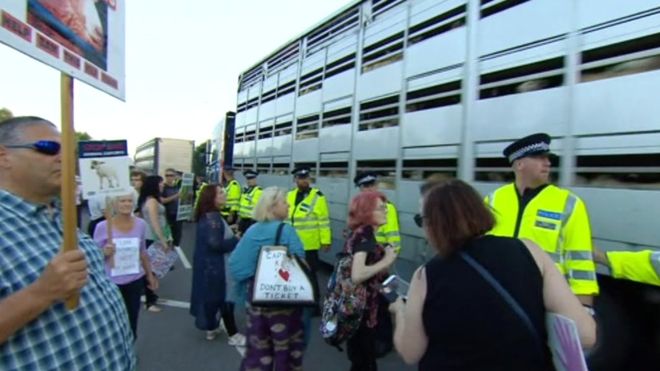
Just like UK Defra, the EU continues to turn a blind eye to everything that the animal welfare lobby present to them regarding live animal exports. Call it a Conservative UK government, or call it the EU animal transport team headed by ‘Vet’ (yes allegedly a vet) Mr Van Goethem; both are as useless as each other. Onderwater is the winner, protected in his every move by the police of Kent, whilst the Kent citizen and taxpayer cannot get a policeman to visit when their house when required, as 50 or 60 of them are on duty every night at Ramsgate docks protecting this convicted criminal and animal livestock haulier going about his lawful (?) business. Kent police should bow their heads in shame, as should the UK government and the self appointed elite who consider they are most important for animals; but who are utterly ineffective at the EU.
The animal welfare movement of Kent now have a right to gripe and to expose the useless UK government and the EU for what they really are. The video links above, existing EU regulations for animals in transport, and still we witness video evidence like this for animals destined for Turkey!! EU regulations which ban transporting livestock in extreme heat; utterly ignored by Defra and the UK government. So much for rules !
Here is the link from Lesley’s very recent (Ramsgate) report which involved trailing Onderwater and other Dutch transporters from the port of Ramsgate, here in Kent UK.
Dear EU ad MS officials, highway police, animal-transport organizations and fellow NGOs,
Please find attached a report about a sheep truck coming from the UK and heading via France, Belgium and the Netherlands to a Halal slaughterhouse in Germany, that we inspected in late August during a heat-wave.
We are not asking you to do anything, we have asked the English and Dutch authorities to look into this matter as you can see from the email below. This is just for your information and to keep you informed of our observations.
With best wishes, Lesley Moffat
Lesley says she does not expect anything to be done – her investigations into Turkey exports in the above videos prove that the EU are useless. UK animal welfare campaigners certainly do not expect the current government to act – they and the EU are two blind peas from the same pod.
Please watch the videos above and decide for yourselves who is right and who is wrong.
Whatever, regardless of the incompetents who are in government, the campaigning will continue and the gathering of utterly clear evidence will continue to be obtained and presented to non- efficient governments and EU officials such as Mr Van Goethem; who has failed to act on the recent Ramsgate report also.
Politicians; well they can turn a blind eye continually; but in the end they can and will be replaced.
That cannot be said for the compassion of the animal welfare campaigner.
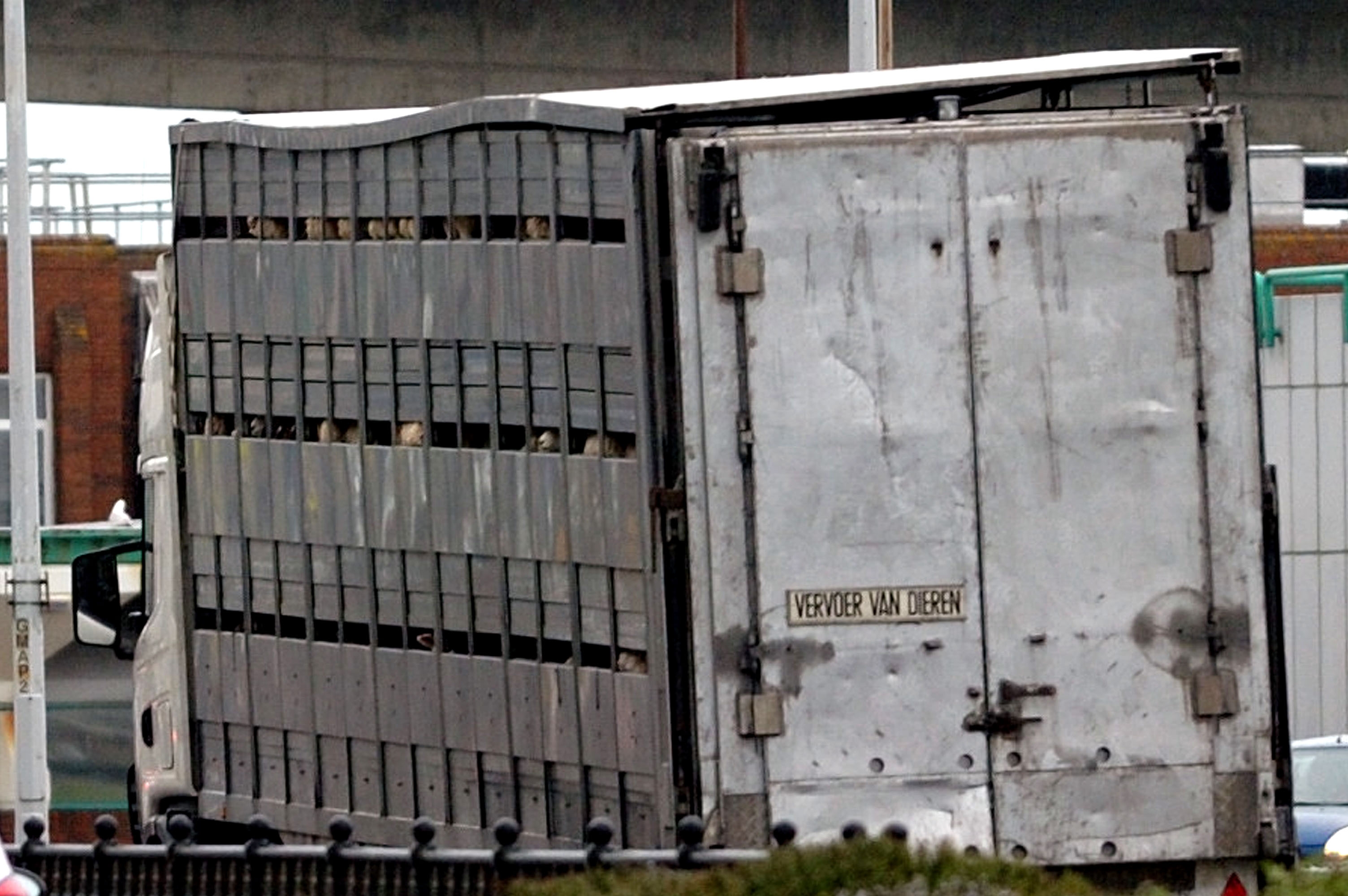
Above – an Onderwater transporter enters Dover harbour. Hardly the best, but Defra think all is good and ok. Who said about blind eyes ?











 Serbian Animals Voice (SAV)