Close to death, brain injured but so brave: Sona’s recovery
Laying on the road this poor little collapsed darling was fading away before our eyes. For several days she didn’t regain consciousness after suffering a head injury. We gave her IV fluids until she slowly began to eat on her own, but the reason we feel she stayed alive is because she was so motivated by love. Watch beautiful Sona who achieved the ability to eat again, walk again, run again (though wobbly), and in the process, bloomed with love.
This gorgeous boy’s ear was destroyed by maggots. Neighbors had tied him to make sure he didn’t wander away before we arrived, but when we met this sweetheart we realized he was so loving and friendly he would never have resisted being carried, if it meant he’d squeeze in some more snuggles. He needed extensive wound treatments, daily flushing and bandaging and a course of antibiotics, but he was cheerful from the first moment until his healing was complete after a month.
Please donate. When happy animals are very hurt helping feels so good
Sophia was badly burned but so brave
Sophia’s burn was almost a foot long. We don’t know what caused it but this beautiful girl was in excruciating pain. It took 2 months of daily wound dressings to heal and during that time, we fell in love with her. Her patience and understanding were inspirational; she was one of those special “people” who are so peaceful they can make wherever they are seem like home. Meet the gracious Sophia today.
Shylo’s skin was like cracked stone. Amazing recovery of a shy softie!
It’s almost impossible to spot her at first but you’ll soon see that this gravelly mound is a dog suffering in the desperate grip of mange. The mange parasites have caused a condition called crusting, and the pain and itching is part of the most extreme suffering imaginable. We named this shy, frightened girl Shylo, and when you see her transformation you seriously won’t recognize her as the same dog. But that’s what healing can look like: pure beauty.
Posted on July 27, 2019 by Serbian Animals Voice (SAV)
Animal tormentors would understand very well what animals suffer from their sadism if they experience the same thing. But also animal abusers have rights that protect and allow them to use violence and exploitation on other non-human animals.
Animals have no rights. Nowhere in the world.
They are valued as things, and what we define today as animal rights is nothing but a weak legal system that accepts animals not as persons but only as subordinate beings, and therefore this legal system recognizes to the animals only those rights which serve and favor humans!
For this reason alone, we are far from being a civilized and progressive society.
Posted on July 26, 2019 by Serbian Animals Voice (SAV)
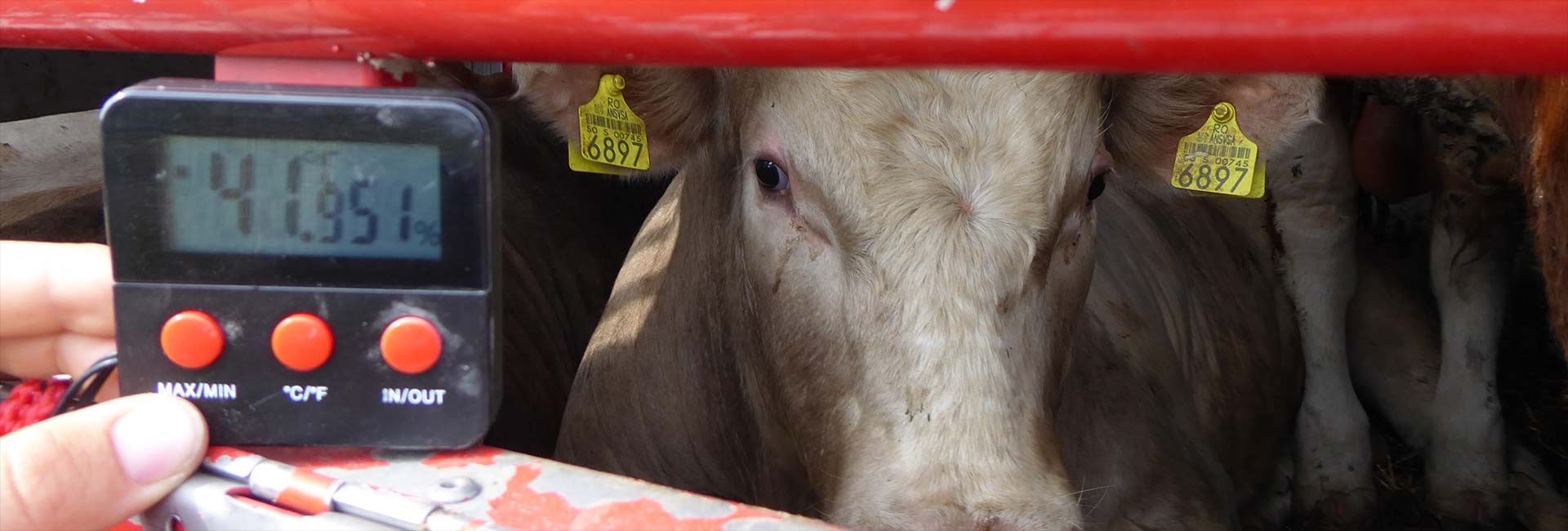
At the Agriculture Ministers meeting in Brussels on 14.05.2019, Lithuanian Health Commissioner Vytenis Andriukaitisreminded Member States’ agriculture ministers to respect EU animal transport standards.
This is especially true for the transport of animals at high temperatures.
The relevant EU regulation clearly states that the transport of animals at temperatures above 30 ° C should not be authorized.
Specifically, Andriukaitis also complained about a recent case in which he called on an EU minister of agriculture to prohibit such transport due to high temperatures. Although the Health Commissioner did not mention the name of the Member State, in all likelihood he was referring to Romania.
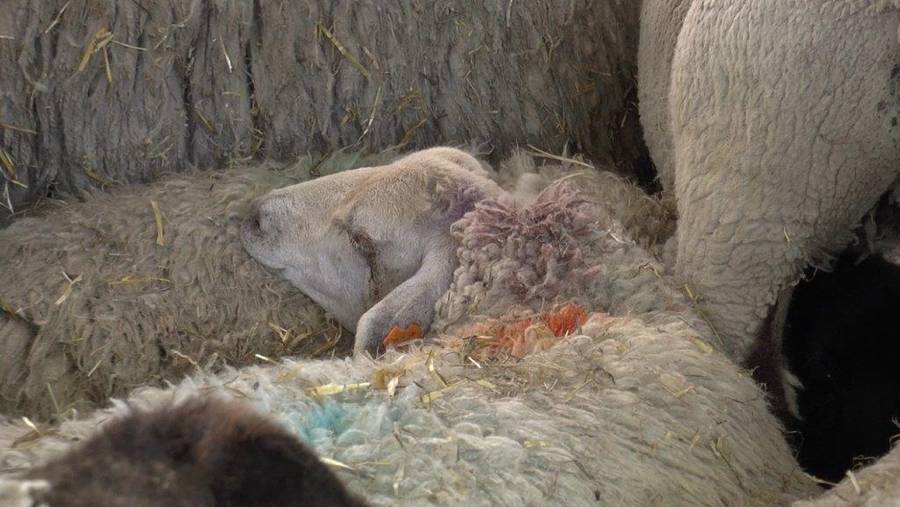
So Andriukaitis had urged the Romanian Minister Petre Daeato prohibit the transport of about 70,000 sheep in Arab states due to high temperatures.
A representative of the Romanian delegation representingAgriculture Minister Daeain Brussels defended his country’s actions in the case of Midia. In his opinion, there must be a tolerance margin of 5 ° C to the upper temperature limit of 30 ° C.
In addition, it should be remembered that the animals from the southern countries are better used to high temperatures than those from northern countries (!!!)
The Lithuanian, meanwhile, announced that, while there was still no ground for infringement proceedings againdt Romania (!!!) his services were keeping a close watch on the transactions in question.
Andriukaitis,who will no longer be a member of the upcoming Commissionfor reasons of age, also advocated an amendment to the EU Animal Transport Ordinance
And we think…The bad news is that Andriukaitis does not want to initiate infringement proceedings against Romania.
As always, the priority is loyalty among business partners.
The good news is that he, who has never done anything for the animals, or has shown never any responsibility for our health, bids farewell to his post.
We wish him a good rest, although we know best of all that he does not deserve the rest, because he never did anything.
He becomes in the story as the “Do Nothing Commissioner”, a failure one the worst kind!
It was the one who said that “5G and glyphosate – both are safe for health”.
And it was the one who advocates the renewed approval of the herbicide glyphosate for another 10 years in the EU.
Posted on July 26, 2019 by Serbian Animals Voice (SAV)
First report:
On the 24th of July 86,500 chickens died after fire in a stable in Lower Saxony, (Germany) – 2.8 million euros damage (!!!)
Police said the building was completely ablaze. The fire developed in the building, and although 150 firefighters were in charge, the animals could no longer be rescued.
“Even from a distance, a black cloud of smoke could be seen”, described the fire brigade master the first minutes after the alarm. On site, the firefighters then found “a stable in full blaze”.
The 86,500 chickens housed on five “floors” in the 100-meter-long building were beyond salvation.
The truth: In the present case, there is murder, because of clear over-number of inmates and not existing fire protection measures in the stable!
Second report:
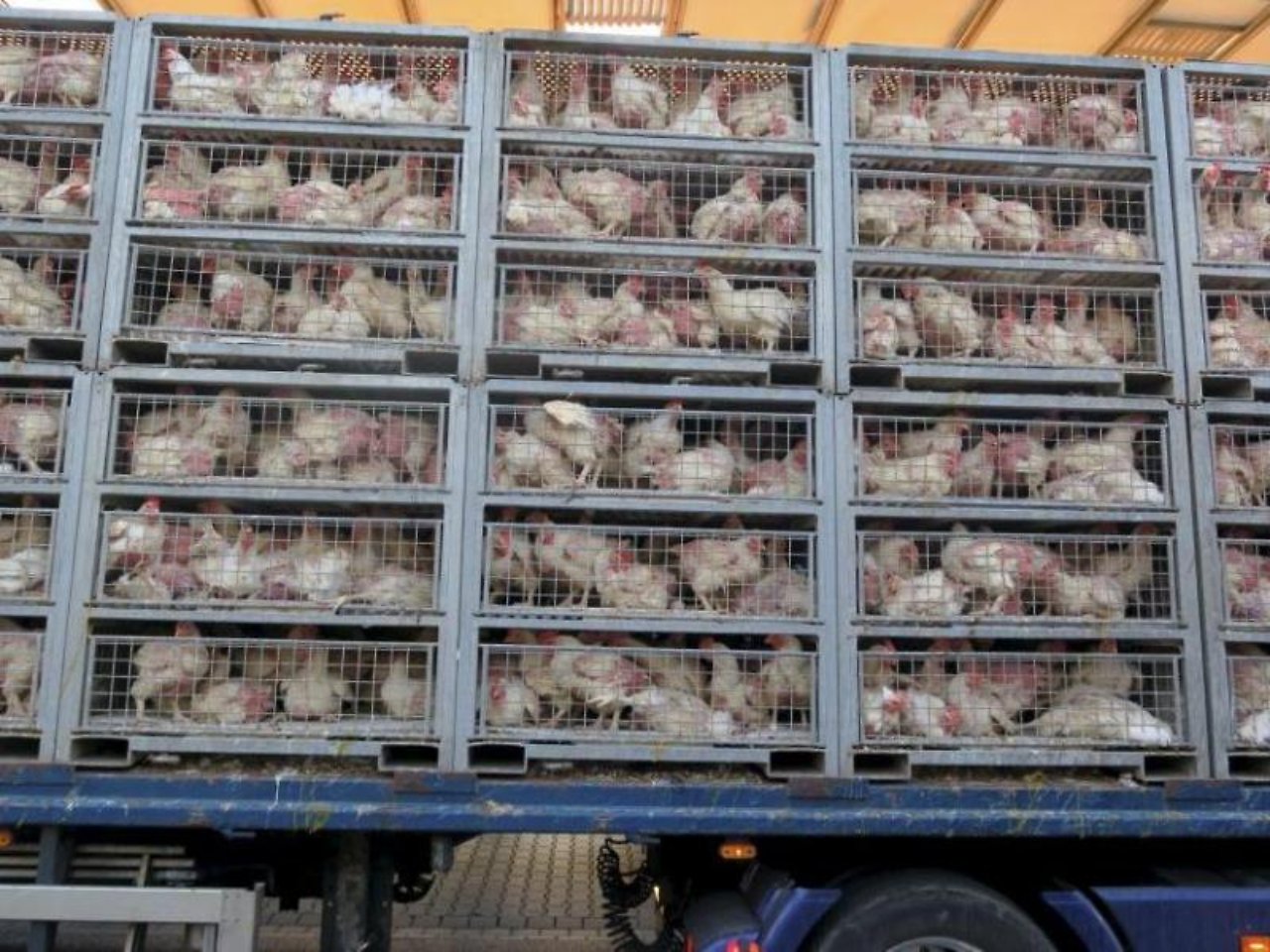
Hesse, Germany (dpa / lhe) – About 500 chickens died on the 25th of July during an animal transport. They were not supplied with water at 34 degrees, reported the police on Thursday in Giessen (Germany).
(Photo: Police Headquarters Central Hessen / dpa)
According to the officials, the livestock had neither a cooling system nor drinking water for the animals, which had already been travelingfrom France to a slaughterhouse in Poland for about 16 hours.
The drive there would have taken another twelve hours. The officials spoke of “incredible pictures”. In addition to around 500 dead chickens, numerous other animals would have been “in miserable condition” in the cages.
According to their assessment, not a single chicken would have survived until Poland.
Third report:
143 pigs transported on Tuesday, July 23 at 41 degrees without water
Photo: Police Dortmund, Germany
They were completely dehydrated, hyperventilated and could barely stand: On the highway the Dortmund police rescued with the fire brigade more than 100 pigs from the heat death.
At least three of the animals had already died when the police controlled the van.
In the transport officials measured 41 degrees despite ventilation– and the built in water tank was empty. No wonder that the pigs hyperventilate and could no longer stand on their feet. The driver (47) from the Netherlands had no animal welfare documents.
Conclusion: I see only one solution to this misery of the animal transport, created by the sub-system of the transport mafia.
That means: the 8-hour animal transport limit for EU countries.
Animal transports automatically become an unprofitable business for all!
For agricultural lobby, slaughterhouse operators and transporters.
New York City wants to ban foie gras, and duck farmers aren’t happy about it. A bill sponsored by Carlina Rivera, a city councilwoman who represents Manhattan neighborhoods, would prohibit the sale of the delicacy, and levy fines of up to $1,000 to businesses that violate the ban.
“What I am trying to do is put forward a bill that would end this practice and create a more humane New York City to live in,” said Rivera, during a City Council committee hearing in June, Crain’s New York reports. The animal welfare bill, which specifically targets “force-fed products,” is co-sponsored by the majority of the council.
Jeffrey Kittay
There are only three farms that raise foie gras in the United States, and two of them are in Ferndale, New York, a rural community in the Catskills, 90 miles outside of New York City
As you likely know, foie gras (fatty liver in French) is made by force-feeding grain to ducks and geese, several times a day, for up to three weeks. Their livers then expand up to ten times their normal size, with large deposits of fat—which is why it’s so rich.
Animal rights activists, as well as many armchair observers, say that’s inhumane, and that the process of force-feeding the ducks with a funnel-like device—called gavage—traumatizes the animals. The process also diseases their livers, and can cause health complications. All that, they say, for a luxury product, available to a select few. Less than 1 percent of New York City restaurants serve foie gras, Rivera told the New York Post.
The proposed ban in New York City would follow a similar statewide prohibition in California, and one that existed briefly in Chicago. A statewide ban in New York has been introduced several times in recent years in the state legislature, the Wall Street Journal reports, while Philadelphia has also considered it. England, Germany, Israel, and several other countries have banned foie gras production.
The bill’s opponents say claims that foie gras production is inhumane are dated and flawed. In an op-ed in Crain’s, Ariane Daguin, the co-founder of D’Artagnan, a gourmet foods distributor which does a brisk foie business, pointed out that a detailed scientific study concluded that the product is “non-pathological and non-harmful,” and stress indicators were “hardly affected” during force-feeding.
During a contentious City Council hearing in June, Andy Wertheim, the president of D’Artagnan, said his company and its 280 employees would “not be able to recover” from the ban. He said the company sells about $15 million worth of foie gras in New York City, The Wall Street Journal reported, making his company the state’s largest distributor of the product.
Jeffrey Kittay
A feeder, seated on stools inside the pens, holds and steadies a duck between his knees, as if giving medicine to a pet. Then, he guides a rubber tube down the throat, releasing the feed until a part of the esophagus, known as the crop, swells up.
There are only three farms that raise foie gras in the United States (most of our foie supply still comes from France and Canada). Two of these farms are in Ferndale, New York, a rural community in the Catskills, 90 miles outside of New York City. Between them, they employ 400 people.
Izzy Yanay, the vice president of Hudson Valley Foie Gras, urged city council members to visit his farm before passing legislation that would cause him to lose one-third of his annual sales—around $12 million, according to figures reported by Crain’s. Representatives from the local county legislature were there to bolster their opposition to the ban, the effects of which, they contend, would put several hundred local residents out of work.
So far, none of the NYC council members have taken up his offer, but that didn’t stop Yanay from opening up his 200-acre property, where he processes more than a half-million Moulard ducks every year, to interested media and Sullivan County legislators earlier this month.
During the tour, Marcus Henley, a farm manager, explained that about 10,000 day-old ducklings arrive weekly from Canada, and are raised indoors for 12 weeks. After that, ducks are sent to pens, where they’re force-fed a grain mix three times a day, during a 20-day feeding cycle.
Photo at top is from a French foie gras operation.
Gavage can be brief and jarring to the average human observer. Here’s how it works. A feeder, seated on a stool inside the pens, holds and steadies a duck between his knees, as if giving medicine to a pet. Then, he guides a rubber tube down the throat, releasing the feed until a part of the esophagus, known as the crop, swells up. During demonstrations on the tour, the process took about two seconds. Henley insisted that force-feeding a duck is different than feeding a human, because their esophagi are strong, and meant to temporarily hold large amounts of food. (The issue is certainly a source of robust debate.)
A spokesman for Rivera told Crain’s she has no plans to visit Hudson Valley Foie Gras because she has “concerns regarding the validity of the tours.” Though it’s not clear when the council will vote on her bill, when it does, it’s sure to pass, as it’s already endorsed by 28 of 51 members.




 (Photo: Police Headquarters Central Hessen / dpa)
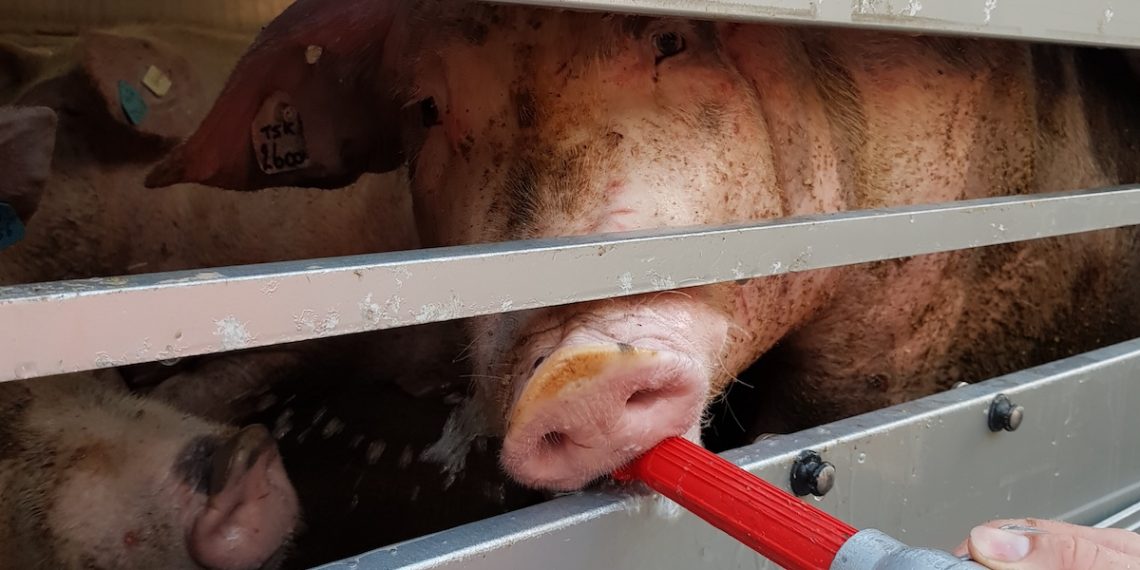 Photo: Police Dortmund, Germany


 Serbian Animals Voice (SAV)
 Serbian Animals Voice (SAV)